Bologna Travel Guide: What to See, Eat and Do
I’ll tell you the moment Bologna won me over. I was standing under a portico on via Pescherie Vecchie at about six in the evening, holding a warm focaccia stuffed with mortadella, watching a man behind a counter slice prosciutto so thin you could read a newspaper through it. Nobody was rushing. Nobody was photographing it for content. They were just eating, the way the city has eaten for centuries. That’s Bologna.
This Bologna travel guide is for the traveler who has done Rome and Florence and Venice, or is about to, and wants the city that locals quietly rank as Italy’s best for food and easiest to actually live in for a few days. Short version: Bologna is Italy’s food capital and one of its most walkable historic centers — porticoes overhead, Piazza Maggiore at its heart, the leaning Two Towers, a tangle of medieval food streets — and it’s the perfect base for the whole Emilia-Romagna food valley. You can see the highlights in a day. You’ll want two.
Bologna goes by three nicknames, and they tell you everything: la dotta (the learned, for the oldest university in the world), la rossa (the red, for those terracotta rooftops and brick towers), and la grassa (the fat, for the food). I’m going to cover all three, but let’s be honest about which one most people come for.
A quick note on numbers before we start. Prices, opening hours, and train times below are approximate and accurate as of 2026. Italian timetables and museum hours shift with the season, so treat everything here as planning estimates and confirm the day-of details. I’ll flag the things most likely to change.
Bologna at a glance: top sights and how long they take
Skim this first. It’s the fastest way to build a day that flows, since almost everything except San Luca sits within a 10-to-15-minute walk of Piazza Maggiore. Times below are how long I’d actually budget on the ground, not the bare minimum.
| Sight | Time needed | Cost (approx, 2026) | Worth it for |
|---|---|---|---|
| Piazza Maggiore + Fontana del Nettuno | 20–30 min | Free | The heart of the city, people-watching |
| Basilica di San Petronio | 30–45 min | Free entry; terrace + photo fees | Vast unfinished church, rooftop view |
| Le Due Torri (Asinelli climb) | 45–60 min | Around €5–7, timed ticket | The classic Bologna view, if open |
| Quadrilatero food market | 1–2 hr | Free to wander | The real reason to come; eat as you go |
| Archiginnasio + Anatomical Theatre | 45 min | Around €3 | Old-university awe, the wooden theatre |
| Basilica di Santo Stefano (Seven Churches) | 30–45 min | Free | Quiet, strange, beautiful complex |
| Pinacoteca Nazionale | 1–1.5 hr | Around €6–10 | Emilian and Bolognese painting |
| San Luca portico walk + sanctuary | Half day | Free (bus optional) | The longest portico in the world |
If you only have one day, do the top six and let San Luca go. If you have two, give the second morning to San Luca and the Pinacoteca, and the second evening to a long, unhurried dinner. More on pacing further down.
A one-day vs two-day plan
Here’s how I’d structure it, because the order matters more than the list.
One day: Start in Piazza Maggiore before the crowds, step inside San Petronio while it’s calm, then ride the elevator to its rooftop terrace for your first view over the rooftops. Walk five minutes to the Archiginnasio for the anatomical theatre. By late morning you’re hungry — good, because that’s the plan. Spend the heart of the day grazing the Quadrilatero: a plate of cured meats here, a cone of fresh tortellini there, a glass of Lambrusco standing up. Afternoon: the Two Towers (climb Asinelli if it’s open), then the calm of Santo Stefano. Aperitivo in a piazza. A proper sit-down dinner of tagliatelle al ragù. Done, and you’ve eaten like a local.
Two days: Run day one slower and don’t skip the long lunch. On day two, walk the San Luca portico up the hill in the morning — all 3.8 kilometers and 666 arches of it, covered the whole way — then come back down for the Pinacoteca and a wander through the university quarter. With a second day you also have the option to swap an afternoon for a food-valley day trip to Modena or Parma, which I’ll make the case for later.
The heart of it: Piazza Maggiore and Basilica di San Petronio
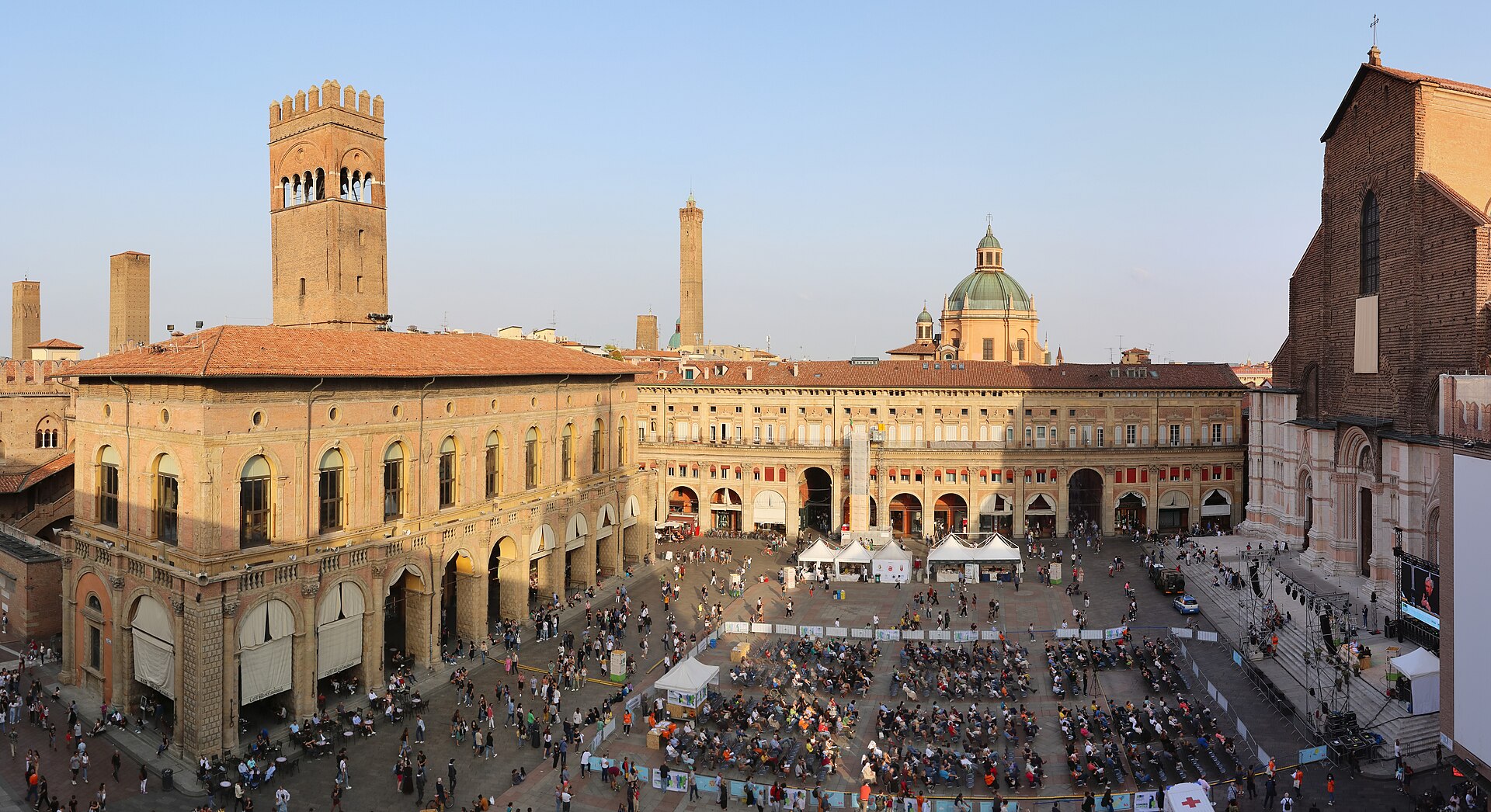
Piazza Maggiore is where Bologna gathers. The square dates to around 1200 and is one of the largest and oldest in Italy, framed by a run of serious palaces — Palazzo d’Accursio, Palazzo del Podestà, Palazzo dei Banchi, Palazzo Re Enzo. Grab a coffee or a spritz at one of the cafés along the edge and just watch for twenty minutes. Locals cross it constantly; street musicians set up; the light on the brick goes golden in the late afternoon. It costs nothing and it’s half the point of coming.
Tucked into the corner is Piazza del Nettuno and its showpiece, the Fontana del Nettuno — Neptune mid-stride with his trident, sculpted by the Flemish artist Giambologna in the 1560s. Look at the trident and you might get a flicker of recognition: Maserati, also a local company, is rumored to have taken its logo from it. The figures at the base are, let’s say, anatomically enthusiastic in a way that surprised more than one Renaissance cardinal.
Here’s a small secret worth knowing. Under the vault of Palazzo del Podestà, stand in one corner facing the column and have a friend stand diagonally opposite in the other corner. Speak quietly toward the wall and they’ll hear you clearly across the open space — a whispering gallery hiding in plain sight. It’s free, it’s fun, and most visitors walk straight past it.
Dominating the square is the Basilica di San Petronio, the sixth-largest church in Europe and one of the strangest stories in the city. Construction began in the late 14th century with the ambition of out-sizing St. Peter’s in Rome. Word reportedly reached the Pope, the funding mysteriously dried up, and the project stopped — which is why the façade is famously half-finished to this day, marble at the bottom, bare brick above. I find it more moving than a finished one. It looks honest.
Entry is free. Inside, the scale lands like a held breath: 22 chapels, priceless art, and a remarkable brass meridian line running about 67 meters across the floor, once used to track the solstices by a beam of sunlight through a hole in the roof. There’s a small fee to photograph the interior, and another to take the elevator up to the rooftop terrazza panoramica. Pay it. The terrace gives you the city skyline with the Two Towers right there — to my eye, the best view in Bologna that doesn’t require climbing 498 steps.
Le Due Torri: the leaning Two Towers
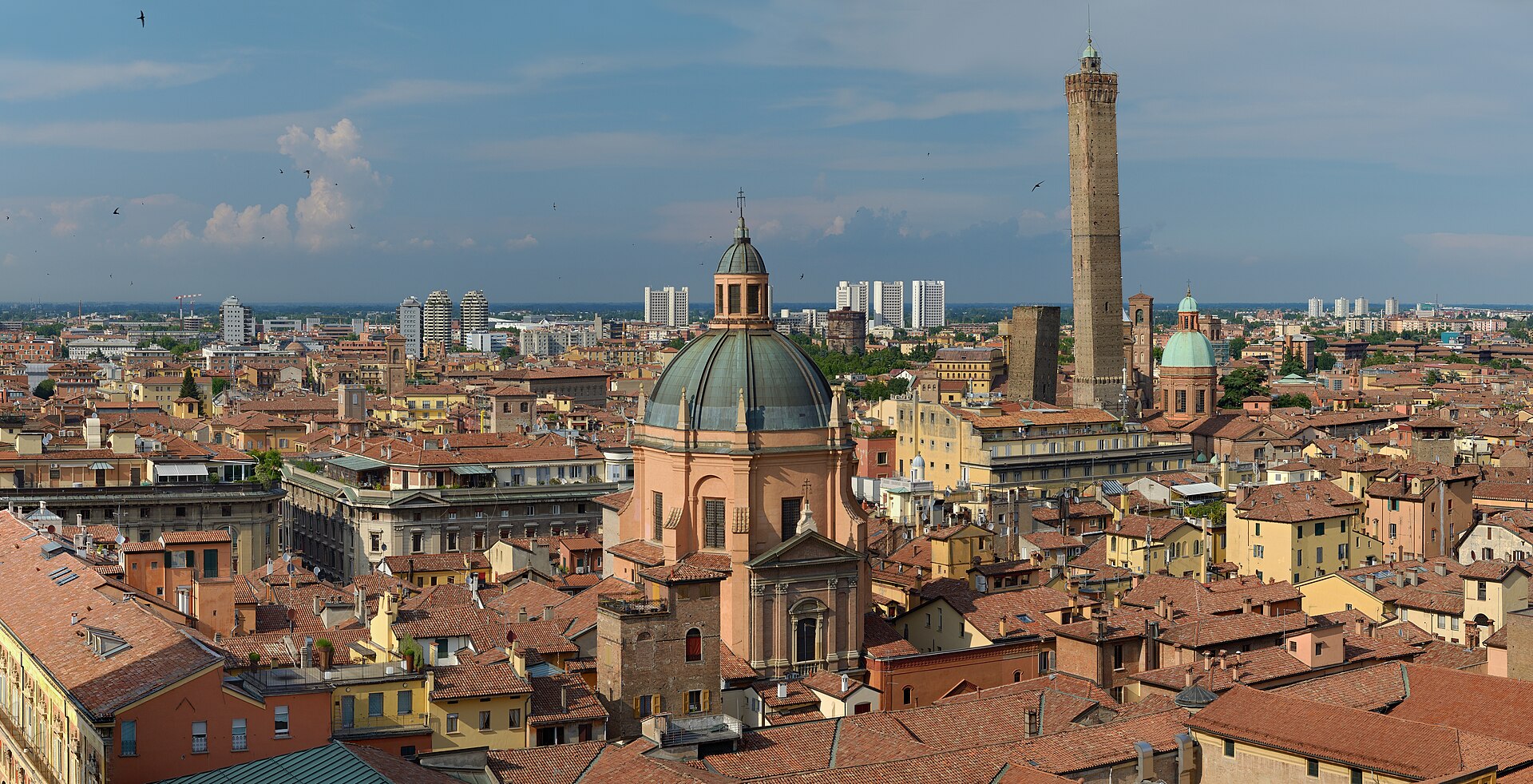
Bologna had close to a hundred medieval towers once, the social-media flexing of noble families who built upward to show off. Around twenty survive, and two of them — the Asinelli and Garisenda — lean together at the spot where the old Roman Via Emilia entered the city. They’re the symbol of Bologna, stamped on everything.
The taller one, Torre degli Asinelli, runs to roughly 97 meters, which makes it taller than the famous tower in Pisa and the tallest leaning medieval tower in the world. The legend is wonderful: a farmer found a chest of treasure, his son fell for a noblewoman whose father demanded the city’s tallest tower as the price of marriage, and the treasure built the tower. The shorter Garisenda leans more alarmingly and has long inspired nervous poetry — Dante name-checked it.
Now the honest, practical part. Climbing Asinelli — all 498 narrow wooden steps — has long been one of the great things to do in Bologna, and the view from the top is genuinely spectacular. But access has been on and off in recent years because of structural concerns about the leaning Garisenda next door, and the towers have been closed or restricted for stretches. As of 2026, check the current status with the Bologna Welcome tourist office in Piazza Maggiore before you build your day around it. When the climb is open, it’s a timed, limited-capacity ticket that sells out — book ahead. If it’s closed, the San Petronio terrace is your view, and it’s a fine consolation.
The UNESCO porticoes and the San Luca walk
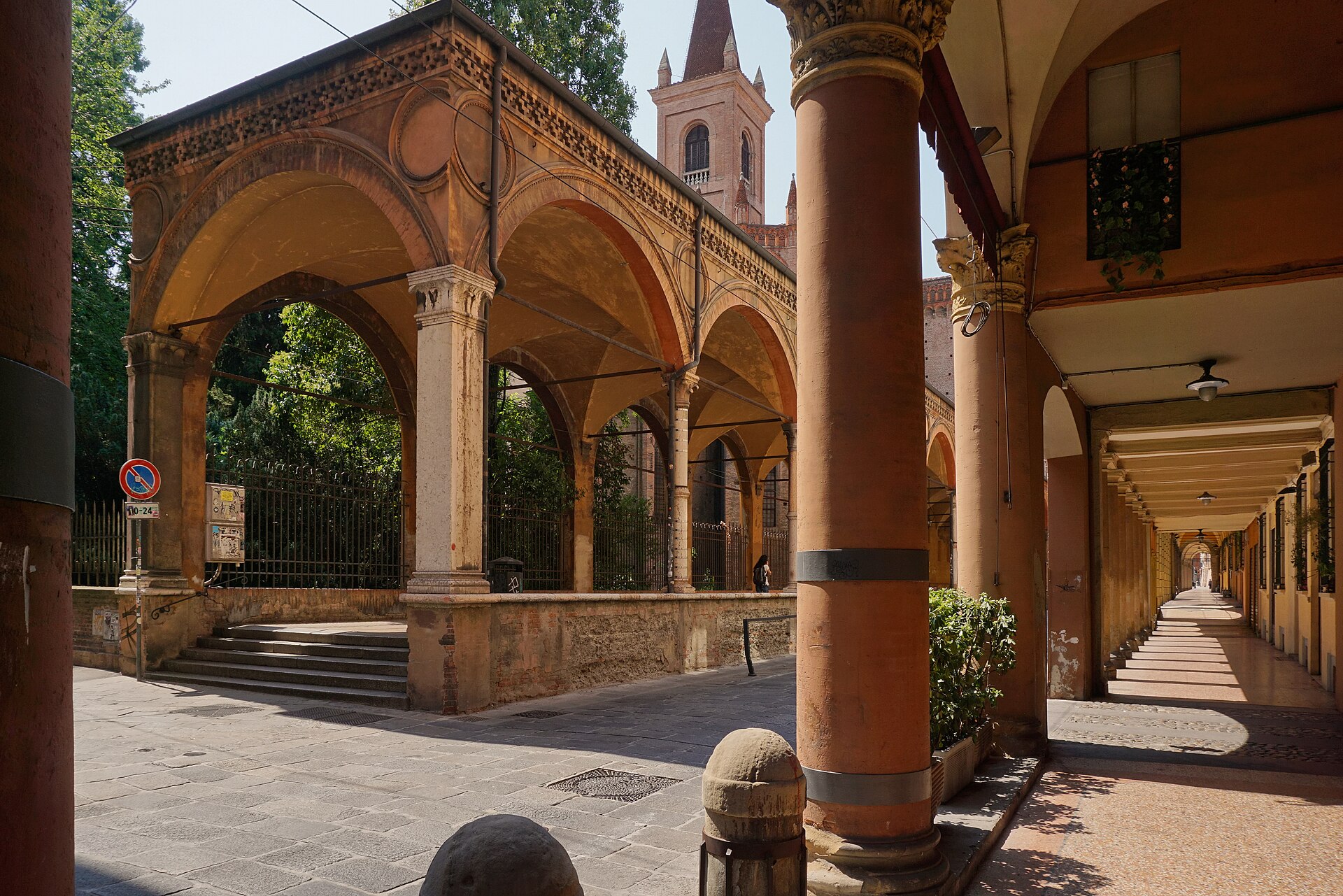
If the food is the soul of Bologna, the porticoes are its skeleton. The city has something like 62 kilometers of covered arcades, roughly 40 of them threading the historic center, and in 2021 they earned UNESCO World Heritage status. They started going up in the Middle Ages — partly to create more living space as the university swelled the population — and the practical genius of them is this: you can cross most of the old city in the rain, or the August sun, and never get wet or scorched. Once you’ve walked under them for a day, every other Italian city feels a little exposed.
Pause to actually look at them. The arcades around Piazza Cavour carry frescoes; the painted yellow columns around the quieter piazzas catch the light beautifully. Sit under one with a coffee for ten minutes and watch the columns recede into the distance. It’s the most Bolognese thing you can do for free.
The headline act is the Portico di San Luca, the longest portico in the world. It runs about 3.8 kilometers from the edge of the city up a hill to the Sanctuary of the Madonna di San Luca, sheltered by 666 arches the entire way — a covered pilgrimage route that locals have walked for centuries, rain or shine. The full walk from Piazza Maggiore takes a leisurely hour or so, with a real uphill push at the end; the covered stretch alone is roughly a 30-to-40-minute climb once you reach Porta Saragozza, where the arches begin in earnest. If your legs aren’t up for it, a bus runs to Porta Saragozza and there’s a little tourist train; you can also drive up. At the top, the sanctuary itself is free, and there’s a small paid “sky experience” climb into the cupola for a 180-degree sweep over the city and the green hills behind it. Go near sunset if you can. Locals bring a picnic and treat it as an evening ritual.
The Quadrilatero: where Bologna actually eats
This is the part I’d cross Italy for. The Quadrilatero is the dense knot of medieval streets just southeast of Piazza Maggiore, a market quarter since Roman times where the city’s old guilds were based. There’s no single entrance — put Mercato di Mezzo into your map and then get lost in the streets around it. The names tell you the trades: via Pescherie Vecchie (the old fishmongers), via Drapperie (the drapers), via Clavature, via Caprarie.
What’s there now is a slow-motion feast. Salumerie with mortadella the size of tree trunks and prosciutto hanging in rows. Fresh-pasta windows where you can watch the sfogline — traditionally women, rolling pasta by hand — fold tortellini one by one. Cheese counters, fruit stacked like art, fishmongers, flower stalls, and tiny bars where you stand at the counter with a glass of Lambrusco and a plate of cured meat. This is the move: don’t book a fancy lunch your first day. Graze. Get a mortadella panino from a counter, a cone of fried tortellini or a paper plate of cheese, a glass of wine, and eat standing up under the arcades like everyone around you.
A few specific things to look for, without sending you on a goose chase: Salumeria Simoni on via Pescherie Vecchie for a plate of salame rosa and mortadella eaten right there; Mercato di Mezzo itself, a covered market turned casual food hall if you want to sit; and for a calmer, more local market, walk ten minutes to Mercato delle Erbe on via Ugo Bassi, where part of the space is now stalls and counters where Bolognesi actually do their shopping and grab lunch. The Quadrilatero is photogenic and a little touristy now; Mercato delle Erbe is the everyday version.
The university quarter, the Archiginnasio, Santo Stefano and the Pinacoteca
Bologna calls itself la dotta for good reason: the University of Bologna, founded in 1088, is the oldest in the Western world, and the city has had students in its bones for nearly a thousand years. The eastern quarter around via Zamboni is the student district — cheap osterie, bookshops, graffiti, a young energy that keeps the city from ever feeling like a museum. It’s where you eat well for very little money.
The most beautiful piece of the old university is the Archiginnasio, a few steps from Piazza Maggiore, built in the 1560s to bring the law and arts faculties under one roof. Walk into the courtyard and look up: arches, a wall of painted coats of arms left by centuries of students, frescoed ceilings everywhere. Upstairs is the showstopper, the 17th-century Teatro Anatomico — a small wooden lecture theatre, all carved spruce, built around a central marble slab where public dissections were performed, watched over by two unnerving “skinned man” statues holding up the canopy. It was rebuilt after WWII bombing in 1944 and you’d never know. Entry is cheap, around €3, and it takes maybe 45 minutes. Don’t skip it.
A short walk away, Piazza Santo Stefano opens up like a stage set, and at the end of it sits the basilica known as the Sette Chiese — the Seven Churches. It isn’t one building but a layered complex of churches, courtyards, and a small museum, parts of it dating back over a thousand years, supposedly modeled on the holy sites of Jerusalem. It’s quiet, a little labyrinthine, free to enter, and one of the most atmospheric corners of the city. Wander it slowly, then take a coffee under the portico on the square afterward.
For art, the Pinacoteca Nazionale in the university quarter is the serious stop. It’s not a greatest-hits Florence-style blockbuster, and that’s the appeal — it’s deep in Bolognese and Emilian painting, with Carracci, Guido Reni, and a strong Renaissance-to-Baroque collection that you’ll often have nearly to yourself. Budget an hour or two, around €6 to €10, and go if you like art enough to want it without queues. If you don’t, no guilt in skipping it.
A couple of smaller things worth your time if you have it: the finestrella on via Piella, a little window that opens onto one of Bologna’s hidden medieval canals, colorful houses reflected in the water — a 30-second photo stop that surprises people who didn’t know the city had canals at all. And the Museo Civico Archeologico by Piazza Maggiore, one of Europe’s richer archaeology collections, strong on Etruscan and Egyptian material, if rainy weather sends you indoors.
A real Bologna food guide: what to eat, and what to never call it
Right. The reason most of you are here. Emilia-Romagna is arguably the most important food region in Italy — it gave the world Parmigiano-Reggiano, prosciutto di Parma, traditional balsamic vinegar, and the real ragù — and Bologna is its capital. Here’s what to eat, in roughly the order I’d eat it, with one firm rule up front.
Never order “spaghetti bolognese” here. It doesn’t exist in Bologna. It’s a foreign invention, and asking for it marks you instantly. The real dish is tagliatelle al ragù: wide, eggy, hand-cut ribbons of pasta in a slow-cooked meat sauce. The pasta width is literally regulated — the Bologna Chamber of Commerce specifies tagliatelle around 8mm wide — because the flat ribbon holds the sauce in a way thin round spaghetti never could. The ragù itself is a patient thing: a soffritto of carrot, celery and onion, ground beef (often with a little pork), a touch of tomato paste, and hours of simmering. No garlic, no oregano, no shortcuts. Order it once and you’ll understand why locals are touchy about the imitations.
Tortellini in brodo is the dish Bolognesi get sentimental about. Tiny rings of pasta — folded by hand, filled with pork loin, mortadella and Parmigiano — served floating in a clear, rich meat broth. Legend says the shape was modeled on the navel of Venus. It sounds humble and it’s anything but; the broth is the whole point, and a good one tastes like Sunday. Traditionally it’s a holiday and weekend dish, but you’ll find it most days. Have it in brodo, the proper way, at least once before you try the cream-sauce versions.
Mortadella is Bologna’s signature cured meat, and it’s the ancestor of the sad pink “bologna” of supermarket sandwiches — except real mortadella is a different species. It’s made from finely ground pork studded with cubes of fat (lardelli) and gentle spices, slow-cooked in big ovens for up to a day until it’s silky and fragrant. Eat it sliced paper-thin, or stuffed warm into focaccia as street food. It’s pork, perfected.
Then work down the list. Lasagne verdi here are made with spinach pasta and that same ragù, layered with béchamel — denser and greener than you’re used to. Cotoletta alla bolognese (also called petroniana) is a veal cutlet fried in butter, crowned with prosciutto and Parmigiano and a splash of broth to melt it all together — rich, unapologetic, the city on a plate. Tigelle (also called crescentine) are small round griddle breads you split and fill with cured meats, soft cheese, or a lardy herb spread called cunza; gnocco fritto is the puffed, fried cousin, and a plate of either with a board of salumi is the classic informal meal. For something green and festive, balanzoni are big spinach tortelloni filled with ricotta and mortadella.
To drink, the regional pour is Lambrusco — and forget whatever sweet fizzy stuff that name conjures abroad. Proper Lambrusco is dry, lightly sparkling, faintly bitter red wine, and it cuts through all that pork and butter exactly as intended. Order it cold by the glass with your cured meats and you’ll get it. The hills also produce a decent local Sangiovese and white Pignoletto if you want still wine.
Two more things that are technically from just down the road but are everywhere here, and worth understanding. Parmigiano-Reggiano is the real Parmesan, made only in this region; ask for it aged — 24 months is creamy and mellow, 30-plus months is sharper and crumbly with little crunchy crystals. And aceto balsamico tradizionale, the genuine traditional balsamic from Modena, is nothing like the watery stuff on supermarket shelves: it’s aged in wooden barrels for a minimum of 12 years, often 25, until it’s a dark, thick, sweet-tart syrup. You drizzle a few precious drops over Parmigiano, strawberries, or even gelato. If you only splurge on one edible souvenir, make it a small bottle of the real thing with the consortium seal. For the bigger regional picture, my Italy food and wine travel guide goes deeper on what makes this corner of the country special.
One last tip: leave room for dessert. Zuppa inglese is the Bolognese trifle — sponge soaked in bright-red Alchermes liqueur, layered with chocolate and vanilla custard — and torta di riso, a dense lemony rice cake, is the homey one locals actually grew up on. Neither is fancy. Both are wonderful.
Food day trips: Modena and Parma
Here’s where two days in Bologna quietly becomes the best food trip in Italy. Bologna sits in the middle of the Emilia-Romagna food valley, and the towns on either side are each famous for one world-class thing, all reachable in well under an hour by train. If you’ve got the time, give one afternoon to a day trip — this is genuinely some of the best eating on earth.
Modena, about 30 minutes west by train, is the home of traditional balsamic vinegar and the place to tour an acetaia — a vinegar attic where barrels of balsamic age for decades. It’s also Ferrari country (the Enzo Ferrari museum is here) and home to Massimo Bottura’s Osteria Francescana, one of the most celebrated restaurants in the world if you plan months ahead. Even without the three-star table, Modena is a handsome, walkable town with a UNESCO cathedral and a terrific central market.
Parma, around an hour west, is the source of two of Italy’s most famous exports: prosciutto di Parma and Parmigiano-Reggiano. Touring a Parmigiano dairy to watch wheels being made and aged, then a prosciuttificio where the hams hang curing, is one of the most memorable food experiences you can have in Italy — I’d put a well-run Parma food tour near the top of any trip to the region. Parma the town is elegant and underrated in its own right, worth a wander after you’ve eaten.
You can do either as a self-guided train day, or join an organized food tour that handles the factory visits and tastings for you — the producers aren’t always set up for walk-ins, so a tour is often the easier path. If food is the reason you came to Bologna, build in at least one of these. For more ways to structure a longer trip, see my Italy itineraries guide.
Getting there: Bologna is Italy’s rail crossroads
This is Bologna’s quiet superpower. It sits at the crossing point of Italy’s main high-speed lines, which makes it one of the easiest cities in the country to reach and the perfect hinge in a northern itinerary. Approximate high-speed (Frecciarossa or Italo) journey times to Bologna Centrale, as of 2026:
- Florence: around 35–40 minutes
- Milan: around 1 hour
- Venice: around 1 hour 30 minutes
- Rome: around 2 hours 10 minutes
That Milan number is the one I want to dwell on. Bologna is close enough that it works as a long day trip from Milan — about an hour each way on the fast train, leaving you a full day for the piazza, the Quadrilatero, and a proper lunch. It’s an ambitious day, but a very doable one, and if you’re using Milan as a base it’s one of the most rewarding escapes on the board. I cover the logistics of it in my guide to the best day trips out of Milan, and the wider region under the full Milan and Northern Italy guide. Honestly, though, an overnight is better — Bologna rewards an evening and a slow morning.
Book high-speed tickets in advance and the fares drop sharply; book last-minute and they climb. Always search for “Bologna Centrale” as your station. For the full how-to on Italian trains — classes, booking sites, validating tickets, high-speed versus regional — see my Italy transportation guide.
Flying in, Bologna Guglielmo Marconi Airport (BLQ) handles plenty of European routes, and the slick Marconi Express monorail connects the airport to Bologna Centrale in about 8 minutes — tap a card at the gate and you’re in town. From Centrale, the historic center is roughly a 20-minute walk down via dell’Indipendenza, or a short bus or taxi if you’ve got bags.
One firm warning if you’re driving: most of the historic center is a ZTL (limited-traffic zone) monitored by cameras, and rolling in without a permit earns an automatic fine in the mail weeks later. I’ve watched it happen to people. Leave the car in a garage at the edge of the center and walk — which you’ll be doing anyway, because Bologna is made for it.
Practical Bologna travel guide: where to base, when to go, how long to stay
Where to stay. Bologna is small and the center is dense, so almost anywhere within a 10-minute walk of Piazza Maggiore is a good call. The Centro Storico is the obvious, do-it-all choice — everything on foot, restaurants and bars at the door. For more atmosphere and quiet without giving up access, I’d point you toward the Santo Stefano area or the streets around the university quarter, which trade a little buzz for charm and lower prices, and put you closer to where locals actually eat. Avoid basing yourself right at the train station; it’s a touch grim at night and the walk in is short anyway. For a wider read on choosing a neighborhood and lodging style across the country, see my where to stay in Italy guide.
When to go. Spring (April to June) and early autumn (September to October) are the sweet spots — comfortable temperatures, the city alive but not overrun. Summer in Bologna gets genuinely hot and humid, and August empties out as locals leave and some restaurants shut, though the porticoes keep you shaded. Winter is cold, gray, and often foggy — but the food is at its most comforting, the tortellini-in-brodo weather is real, and the prices are lowest. There’s no bad time, only trade-offs; my best time to visit Italy guide breaks the seasons down in detail.
How long. One full day covers the headline sights and lets you eat properly. Two days is the sweet spot — it adds the San Luca walk, the Pinacoteca, a slower pace, and the option of a food-valley day trip. Three days only makes sense if you want to use Bologna as a base to fan out across Emilia-Romagna, which is a very good plan. For a first visit, plan two nights and don’t over-schedule them.
Bologna slots beautifully into a northern Italy run. It’s a natural stop between Florence and Venice, an easy add from Milan, and a soft landing after the intensity of Rome. If you’re stitching a trip together, my broader complete guide to visiting Italy and the Venice and Veneto travel guide help you see how the pieces connect, and a couple of my favorite nearby northern cities — Verona and Turin — make excellent companions.
Final thoughts
Bologna doesn’t try to dazzle you the way Venice or Rome do. It works on you slowly — a portico at a time, a plate at a time — until you realize you’ve found the Italy you actually want to live in for a few days. Come hungry, walk everywhere, order the tagliatelle, and give it at least two nights. Of all the cities I send people to in Italy, this is the one they come back surpris
Questions travellers ask
Is Bologna worth visiting?
Yes — emphatically, if you care about food and want a real, lived-in Italian city rather than a crowd-managed one. Bologna has the best eating in Italy, a gorgeous medieval center under UNESCO porticoes, the world’s oldest university, and far fewer tourists than Florence or Venice. One full day shows you the highlights; two lets you settle in. It’s one of my favorite cities in the country.
How many days do you need in Bologna?
One day covers the essentials: Piazza Maggiore, San Petronio, the Two Towers, the Quadrilatero, and a proper meal. Two days is the sweet spot — it adds the San Luca portico walk, the Pinacoteca, a slower pace, and the option of a food day trip to Modena or Parma. Three days suits travelers using Bologna as a base to explore the wider Emilia-Romagna region.
Can you do Bologna as a day trip from Milan?
Yes. High-speed trains link Milan and Bologna Centrale in about an hour each way as of 2026, so a day trip is very doable — enough time for the central sights, the Quadrilatero, and a long lunch. It’s an ambitious day rather than a relaxed one, so start early. That said, an overnight is better, because Bologna’s evenings and its slow mornings are part of the charm.
What food is Bologna famous for?
Bologna is Italy’s food capital. The signatures are tagliatelle al ragù (the real dish behind “spaghetti bolognese,” which doesn’t exist here), tortellini in brodo, mortadella, lasagne verdi, and tigelle. Nearby come Parmigiano-Reggiano, prosciutto di Parma, and traditional balsamic vinegar from Modena. The regional wine is dry, sparkling Lambrusco. Eat your way through the Quadrilatero market streets to taste most of it.
Is it spaghetti bolognese in Bologna?
No — and ordering it will mark you as a tourist. “Spaghetti bolognese” is a foreign invention that doesn’t appear on Bolognese menus. The authentic dish is tagliatelle al ragù: wide, hand-cut egg pasta with a slow-simmered meat sauce, the pasta ribbon specifically sized to hold the ragù. Round spaghetti can’t grip the sauce the same way, which is exactly why locals use tagliatelle instead.
Can you still climb the Two Towers in Bologna?
It depends on when you visit. The climb up Torre degli Asinelli (498 steps, a great view) has been closed or restricted in recent years due to structural concerns about the leaning Garisenda tower beside it. Check the current status with the Bologna Welcome office in Piazza Maggiore before counting on it, and book a timed ticket ahead if it’s open. The San Petronio rooftop terrace is an excellent backup view.
Is Bologna walkable and safe?
Very walkable and generally very safe. The historic center is compact — almost everything except San Luca is within a 15-minute stroll of Piazza Maggiore — and the porticoes mean you can walk in any weather. As in any Italian city, watch for pickpockets in crowded squares and on busy buses, and the area right around the train station can feel a little rough late at night. The center is fine to walk at any hour.
When is the best time to visit Bologna?
Spring (April–June) and early autumn (September–October) are ideal: pleasant weather and a lively but manageable city. Summer is hot and humid, and August quiets down as locals leave. Winter is cold and foggy but atmospheric, with the lowest prices and the most comforting food — it’s peak tortellini-in-brodo season. There’s no truly bad time; pick your trade-off between weather, crowds, and cost.