Practical Information, Safety & Etiquette
Italy Tourist Scams and How to Avoid Them
Let me say the reassuring part first, because the internet will try to scare you out of your trip: the vast majority of Italy tourist scams are non-violent, annoying, and completely avoidable once you know the playbook. Nobody is going to mug you on the Spanish Steps. What actually happens is more boring and more clever — a hand slips into a daypack on a packed bus, a “free” bracelet gets knotted onto your wrist, a taxi meter mysteriously stays off. The real risk is distraction-style pickpocketing in a handful of tourist chokepoints, and a short list of street tricks you can spot from across the piazza.
I’ve spent years wandering Italian cities with a notebook and a slightly-too-nice camera, and I’ve watched these scams play out dozens of times — usually on someone else, occasionally aimed at me. This guide is the tactical version: what each scam looks like, exactly where you’ll meet it, and how to shut it down without being rude or paranoid. For the broader “is the country dangerous” question, I send you to my honest take on whether Italy is safe, which is the calmer, big-picture companion to this page. This one stays in the weeds, city by city.
Who’s this for? First-time visitors to Rome, Venice, Florence, Naples and Milan. Solo travelers and families. Anyone who’s read three fear-mongering listicles and wants a grown-up briefing instead.
Italy tourist scams at a glance: the 60-second cheat sheet
Here’s the whole article compressed into one table. Skim it, screenshot it, move on with your day. Every amount below is approximate and current as of 2026 — fees and “fines” quoted by scammers are made up on the spot, so treat them as ballpark.
| Scam | Where you’ll meet it | How to avoid it |
|---|---|---|
| Distraction / bump pickpocketing | Crowded metros, buses (Rome 64/40), train stations, packed piazzas | Valuables zipped in a front-worn crossbody; nothing in back pockets; bag in front on transport |
| Phone-snatch | Anywhere you’re standing still staring at Google Maps near a curb | Step into a doorway to check your phone; keep a firm grip; consider a wrist tether |
| Friendship bracelet | Spanish Steps, Trevi, Florence Duomo, Ponte Vecchio | Don’t extend your wrist; hands in pockets; firm “no” and keep walking |
| Rose / sprig handed to you | St Mark’s Square, Rome historic centre, restaurant terraces | Don’t accept it “for free.” Don’t take it even for a second |
| Petition / clipboard team | Outside major monuments, near ticket lines | Don’t sign anything; treat the clipboard as bait and step back |
| Fake plain-clothes “police” | Tourist zones, near ATMs and stations | Real police don’t check your cash on the street. Ask to walk to the station |
| ATM skimming / “helpful” stranger | Standalone street ATMs, tourist-area machines | Use bank-lobby ATMs; cover the keypad; refuse all “help” |
| Taxi overcharge / unlicensed cab | Airports, Termini, ferry docks, Venice piers | Official ranks only; meter on or airport flat rate; ignore drivers who approach you |
| Tourist-menu / coperto surprise | Restaurants beside big sights with a host out front | Check prices and the coperto before sitting; walk a few streets away |
| Gladiator photo fee | Outside the Colosseum | Don’t pose unless you’re happy to pay; agree a price first or skip it |
| Gondola / photo “extras” | Venice canals, San Marco | Confirm the set rate up front; decline songs and add-ons |
| Spill-and-grab | Train stations, busy streets | If something lands on you, hold your bag tight and walk; clean up later |
| Counterfeit-goods fine | Beach and street blankets, Venice bridges | Don’t buy fakes — the buyer can be fined, not just the seller |
Now the detail. I’ll go scam by scam, then city by city, because where you are changes which tricks you’ll actually run into.
Pickpockets in Italy: the only threat worth real attention
If you remember one thing from this whole page, make it this section. Almost everything else is a nuisance. Pickpockets in Italy are the genuine, statistically-likely risk, and they are very, very good — this is an organized, practiced craft, not an opportunist grabbing your phone off a café table (though that happens too).
The core move is distraction. Someone creates a moment — a bump, a fake argument, a dropped object, a crowd surge at a metro door — and in those two seconds a second person lifts your wallet or unzips your bag. You feel nothing. Plenty of people don’t notice until they reach for their phone an hour later. Rome alone logged tens of thousands of reported pickpocketing incidents in a recent year, and reporting captures only a fraction of the real number.
The geography is predictable, which is the good news. Pickpockets fish where the tourists shoal:
- Public transport at rush hour — the single biggest hotspot. Crowded metro cars, the doorway scrum as people board and exit, and a few notorious bus lines (more on Rome’s 64 and 40 below).
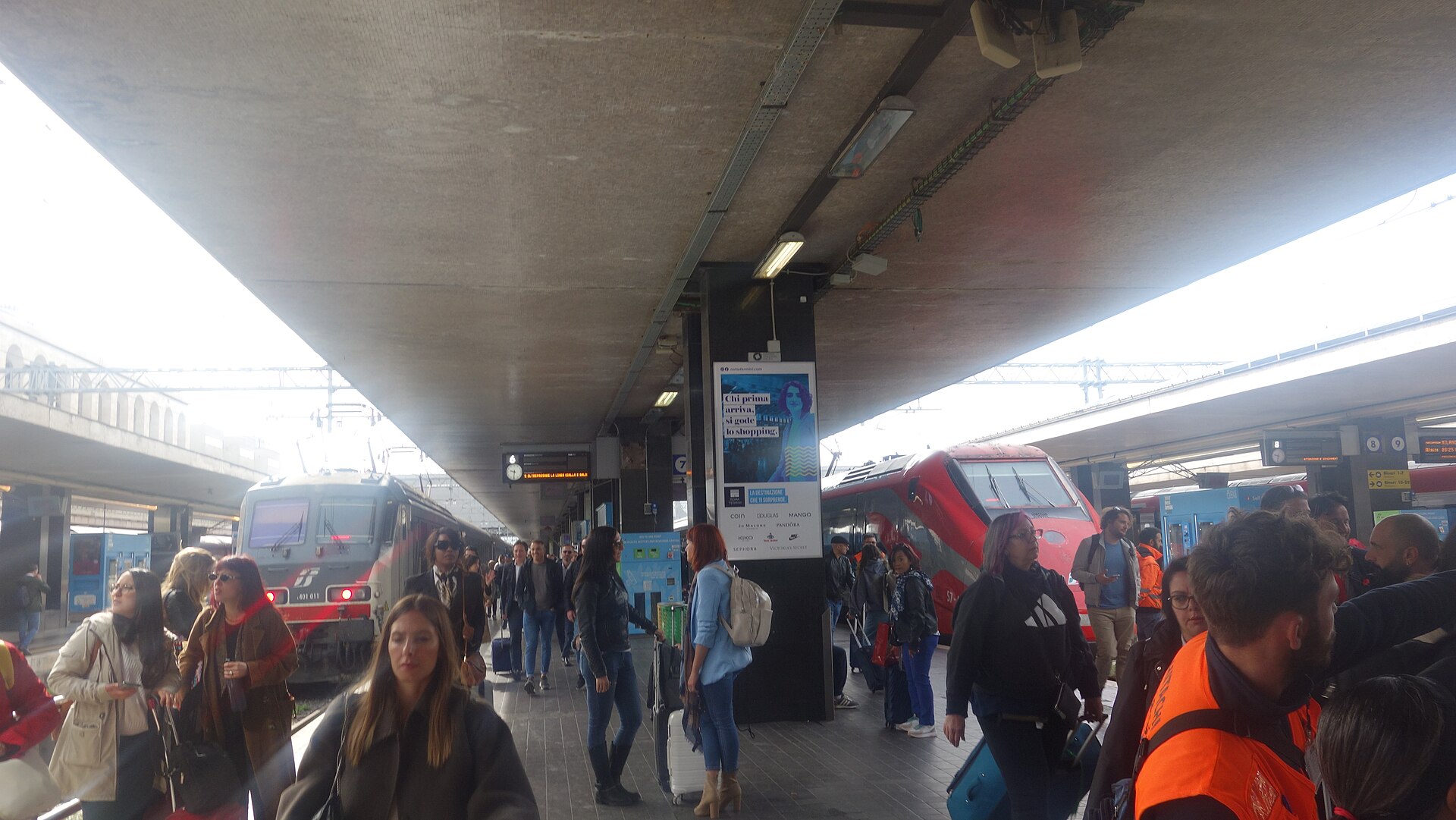
- Train stations — Roma Termini, Firenze Santa Maria Novella, Milano Centrale, Napoli Centrale. Arrival and departure chaos, luggage everywhere, jet-lagged people fumbling with tickets.
- Marquee monuments — the Trevi Fountain crush, the Colosseum entrance, St Mark’s Square, the Florence Duomo. Anywhere everyone’s looking up and holding a phone out.
- Churches and markets — yes, even inside churches. San Lorenzo market in Florence is a classic.
How to carry your stuff so this doesn’t happen to you
You don’t need a tactical money belt and a paranoid scowl. You need your valuables somewhere a stranger’s hand can’t reach without you noticing.
- Wear a crossbody bag on your front on transport and in crowds — strap across the chest, bag resting on your stomach, hand resting on it. This alone defeats most attempts.
- Nothing valuable in back pockets, ever. A back-pocket wallet is the easiest target in Italy. Front pockets only, and even then keep a hand there in a crush.
- Carry a “decoy” amount of cash for the day and leave cards and the bulk of your money in the hotel safe. Split it up — some in the bag, a backup card somewhere separate.
- Lock your daypack zippers. A small carabiner or a tiny padlock through the zipper pulls turns your bag into a slow, annoying target, and slow targets get skipped. I get into bag choice in my Italy packing list — an anti-theft daypack with lockable zips and slash-resistant straps is the single best gear upgrade for an Italian city trip.
- Mind the phone-snatch. A newer twist is grabbing the phone straight out of your hand while you stand at a crossing checking a map. Step into a doorway, get your bearings, then walk. A coiled tether on your wrist or belt loop makes the grab pointless.
None of this requires you to be tense. Set yourself up well in the morning and then forget about it.
The street-handout scams: bracelets, roses, and clipboards
These are the ones you’ll personally get approached by, probably within your first hour in any tourist centre. They run on social pressure, not stealth, so the counter is simple: refuse to engage, keep your hands to yourself, keep moving.
The friendship bracelet. A friendly man approaches, chats, compliments you, and before you’ve registered what’s happening he’s looping a braided string around your wrist or finger. Once it’s knotted on, he asks for money — and because you can’t easily get it off, you feel cornered. Sometimes the bracelet itself is the distraction while a partner works your bag. The defense is physical: don’t extend your hand or wrist to anyone, keep your hands in your pockets as you pass, and if someone reaches for you, pull back and say “no” clearly. You’re allowed to be blunt.
The rose or sprig. Someone presses a flower or a sprig of herbs into your hand “as a gift,” then demands payment, or hands it to your partner and turns to you for the money. Don’t accept it even for a second — once it’s in your hand the script flips. A flat “no, grazie” without slowing down ends it.
The petition / clipboard team. Usually a small group, often presenting as collecting signatures for a charity or a deaf-and-mute fund. One pushes the clipboard at you; while you look down to read it, another lifts your phone or unzips your bag, the clipboard conveniently blocking your view. Don’t sign, don’t look down, don’t let the clipboard get between you and your bag. Step back and walk.
The thread through all three: a stranger creating a reason for you to stop, look away, or stick out a hand. That pattern is the tell.
Fake police and the ATM trap
These two deserve their own section because they target your trust and your bank account directly.
Fake plain-clothes “police.” Two people in vaguely official clothing approach, sometimes flashing a badge, and say they’re tourist police running a check for “counterfeit currency” or “drug money.” They ask to inspect your wallet or cash — and palm bills or cards while they riffle through. Here’s the rule that protects you: real Italian police do not stop tourists on the street to inspect their cash. If you’re genuinely stopped, you can calmly ask to do any check at the nearest police station rather than on the pavement. A scammer will evaporate at that suggestion; a real officer won’t mind. Don’t hand your wallet to anyone.
ATM skimming and the “helpful” stranger. Two related problems. First, skimming devices fitted to machines that copy your card and PIN — these cluster on standalone street ATMs in tourist zones, and skimmers have gotten genuinely hard to spot. Use ATMs inside bank lobbies or attached to a bank branch where possible, give the card slot a wiggle before inserting, and always cover the keypad with your other hand when typing your PIN. Second, the helpful stranger: someone hovers near the machine, offers to “help” if you seem to be struggling, and either watches your PIN or pickpockets you mid-transaction. Sometimes they’ve stuck an “out of order” sign on a good machine to steer you to a rigged one. Refuse all help at an ATM, full stop. If you need help, go inside the bank.
Rome scams: where they happen and how to dodge them
Rome is the capital of Italy tourist scams by sheer volume, simply because it’s the most-visited city. The scams aren’t different in kind — they’re just denser. Here’s the Rome-specific map. For getting around the city without feeding the taxi sharks, pair this with my notes on transportation in Italy and the wider Rome travel guide.
Bus 64 and bus 40 (Termini to the Vatican). These two lines are legendary, and not in a good way. They run the exact route tourists want — Termini Station to St Peter’s — so they’re packed with distracted visitors and, accordingly, with pickpocket teams. If you take them, treat them as maximum-alert zones: bag in front, hands on it, valuables deep and zipped. Honestly, I often walk this route or take the metro to Ottaviano instead; the buses are a self-inflicted wound.
Roma Termini. Fine and busy by day, sketchier late at night. Keep luggage in contact with your body, ignore anyone offering to help with your bags or tickets, and head straight through rather than lingering.
Trevi Fountain, the Colosseum entrance, the Spanish Steps, the Pantheon. The four-star pickpocket buffet. Everyone here is shoulder to shoulder, phone out, looking up. This is where the bracelet and rose men work, and where bumps happen in the crush. Enjoy the sights — just keep a hand on your bag in the densest spots.
The gladiator photo fee. The costumed centurions outside the Colosseum are part of the scenery, but a photo with them comes with a “customary” charge of around five euros and up, and it can get pushy if you snapped a picture without agreeing first. Either negotiate a price before you pose, or just photograph them from a few metres away as part of the crowd.
Vatican / Colosseum ticket touts. People will swarm you near the lines offering “skip-the-line” tickets or guided tours, some with wild claims. They cost more than the official price and sometimes sell invalid passes. Buy entry online in advance from the official site, or book a legitimate guided tour ahead of time, and ignore the touts entirely.
Restaurant overcharging near the big sights. Cafés right beside St Peter’s or the Trevi have been caught inventing menu items and inflating bills. Walk a few streets back, check prices before sitting, and always take the receipt — by Italian law you must be given one. I keep the full table-manners briefing, including how the coperto really works, in my Italy etiquette guide, so I’ll keep it short here.
Venice scams: the lagoon’s particular tricks
Venice is one of the safest cities in Italy for violent crime — you can genuinely wander it alone late at night — and yet it has its own distinct catalogue of tourist tricks, most of them economic. Set it alongside my Venice and the Veneto travel guide for the fun stuff.
Fake water taxis. Real water taxis have set, agreed rates — roughly €80 to €110 for typical daytime routes, fixed with the city. Fake drivers won’t quote you a price, will usher you aboard, and then hit you with an invented fare that can climb to a few hundred euros, with pressure to pay. Only use official taxi piers and agree the rate before you step in. The public vaporetto water buses are cheaper, safe, and entirely sufficient for most visitors.
Gondola “extras.” The gondola ride itself has a set official rate — around €80 for roughly 25 to 30 minutes by day, more in the evening. The scam is the upsell: an offer to sing, or some vague “extra,” for more euros, sprung on you mid-ride. Confirm the standard rate and exactly what’s included before you board, and decline the add-ons.
Pickpockets in the crush. It’s rarer here than in Rome, but the over-crowded pinch points — the vaporetti, St Mark’s Square, and the Rialto Bridge — pack thousands of people into tiny spaces, which is exactly what a pickpocket wants. Same rules: bag in front, valuables secure.
The rose and the costume-photo grab. In St Mark’s Square especially, expect people forcing a rose into your hands, and people in cheap costumes inviting you to pose — who then demand up to €10 and may physically hold your phone hostage until you pay. Don’t pose, don’t take the rose.
Counterfeit goods on the bridges. The vendors with blankets of “designer” bags and sunglasses on the bridges are selling fakes, and in Italy the buyer can be fined heavily — reportedly up to several thousand euros. The souvenir isn’t worth it. (Cheap “Venetian” masks under about €20 are also almost always mass-produced imports, sometimes sold “for decorative use only” on a label that conveniently falls off.)
A non-scam hazard, because I like you: never step on the algae-covered green steps leading down to the canals to get a photo. They are spectacularly slippery, locals watch tourists slide straight into the water daily, and that water is not the kind you want to swim in.
Florence scams: the Duomo, the prints, and the mimes
Florence punches above its weight for documented scams relative to its size — the historic centre is compact and tourist-dense, which concentrates everything. My Florence and Tuscany travel guide covers the joyful side; here’s the watch-list.
Pickpocket hotspots. Piazza del Duomo, the Ponte Vecchio, Santa Maria Novella station, and the San Lorenzo market stalls. Same distraction-team playbook as everywhere else, just packed into a few hundred metres around the cathedral.
The friendship bracelet, Florence edition. Especially aggressive around the Duomo and Ponte Vecchio, where vendors will grab your wrist and start tying before you can refuse. Hands in pockets, don’t slow down, firm “no.”
The oil-print / canvas scam. Sellers lay large prints — often of Florence itself — flat on the ground around Piazza del Duomo and near the Uffizi, positioned so distracted tourists step on them. If you don’t, they may smudge or stain one themselves and then demand payment for the “damage,” with reported amounts ranging from around €25 to a few hundred euros, occasionally with intimidation. Give the ground-level art displays a wide berth and never engage if someone claims you damaged something.
The mimes. Pairs of figures dressed and painted in white drift between Piazza della Signoria and Piazza della Repubblica. One “performs” for or engages a family while the other works the bags. Treat a sudden street performance aimed right at you as the distraction it often is.
Naples and Milan: quick city notes
Naples has a tougher reputation than it deserves on the violence front, but petty theft and pickpocketing in crowded areas and around Napoli Centrale are real. Keep the standard discipline — bag in front, nothing flashy, hand on your phone — and you’ll be fine. Scooters can snatch bags from pedestrians on busier roads, so walk on the inside of the pavement, away from the traffic, with your bag on the building side. There’s much more in my Amalfi Coast, Naples and Campania guide.
Milan is polished and businesslike, with the trouble concentrated at Piazza del Duomo and Milano Centrale. The bracelet and rose men work the cathedral square hard. Milan also has its own version of a distraction trick around bars and restaurants — the “paper move,” where someone leaves a small object and a note begging on your café table, then on returning to collect it checks for cash and may lift your phone from under the note. Keep your phone in your pocket, not on the table, in tourist-area cafés. My complete guide to Milan and Northern Italy has the rest.
Taxis, restaurants, and the “ordinary rip-off” scams
A few that aren’t really crimes so much as opportunistic overcharging — worth a clear plan.
Taxis. The classic moves: a driver who approaches you inside the airport terminal (real taxis wait at the rank outside — never go with someone who solicits you indoors), a “broken” meter that’s just switched off, weekend “surcharges,” or wrong change. The fixes: use official taxi ranks only; from Rome’s airports take a Rome-registered taxi at the fixed city flat rate and confirm it before you set off; make sure the meter is running from the start; and get your luggage out of the boot before you hand over money. In Rome and Milan, the official taxi-hailing apps (the ones that dispatch licensed metered cabs) take the negotiation out of it entirely.
Tourist menus and the coperto. Restaurants beside major sights with a host out front waving laminated multi-language menus are the ones to skip — frozen food, inflated prices, occasional surprise charges. Check the menu prices and the coperto (the per-person cover charge, typically a small fixed amount) before you sit, and be aware a service charge may apply to larger groups. Walking even three or four streets away from a monument transforms both the price and the quality. The deeper etiquette — tipping, the coperto’s history, how to order like you’ve done it before — lives in my Italy etiquette guide.
The bar / club “friends.” Two friendly people strike up a conversation, suggest a drink at a place they happen to work with, and after a couple of rounds you’re handed a bill many times the normal price, with a bouncer making it awkward to refuse. It mostly targets solo travelers, often men, at night. If new “friends” steer you to a specific bar, pick your own place instead.
The gold-ring trick. Less common in Italy than in Paris, but you may see it: someone “finds” a gold ring on the ground near you, suggests it’s yours or offers to share the luck, then pressures you for a finder’s reward. It’s brass. Wave it off and keep walking.
What to do if you’re pickpocketed in Italy
Sometimes you do everything right and a true professional still gets you. It’s not your fault, and panicking helps no one. Here’s the order of operations.
- Block your cards immediately. Don’t wait until you’re back at the hotel. Open your banking app and freeze or cancel every affected card right there. Most apps can lock a card in seconds, which is faster than calling. This is the step that actually limits the damage.
- Call 112 if it just happened and you want police on scene, or to report the crime. 112 is the single European emergency number and works across Italy in multiple languages.
- File a denuncia (a formal police report). Go to the nearest Polizia di Stato (Questura or Commissariato) or a Carabinieri station and file a denuncia di furto — a theft report. List every stolen item with rough values, plus the time, place and how it happened. Ask for a stamped copy and keep several. You will need this denuncia for any travel-insurance claim and for replacing a passport, so it’s not optional bureaucracy — it’s the document that gets your money back later.
- For a stolen passport, contact your embassy or consulate (the major ones are in Rome, Milan and Florence) for an emergency travel document. Bring the denuncia.
- For a financial rip-off in progress — a restaurant refusing to show prices and demanding a wildly inflated sum — Italy’s financial police, the Guardia di Finanza, handle that; their number is 117. The threat of calling them often resolves things on its own.
Buy travel insurance before you go, and photograph your passport, cards and serial numbers (store them somewhere you can reach without your phone). Doing that the night before your flight turns a stolen-wallet disaster into a manageable afternoon.
Final thoughts
Here’s the honest summary after years of watching this stuff up close: Italy tourist scams are a logistics problem, not a danger. Carry your valuables in front and zipped, keep your hands to yourself when strangers get friendly, use official taxis and bank-lobby ATMs, and walk a few streets away from the big sights to eat. Do that and the scammers simply move on to an easier target — there’s always one nearby.
Don’t let any of this dilute the trip. You’re going to stand in front of the Pantheon at dusk and forget the modern world exists. The bracelet men and the broken meters are background noise. Stay aware in the chokepoints, relax everywhere else, and read my overview of safety in Italy if you want the calm, big-picture reassurance. For everything else about planning a smooth visit, start with my things worth knowing before you go and the main Italy travel guide — and figure out where to base yourself so the good neighborhoods, not the scam-dense fringes, are your home turf
Questions travellers ask
How common are scams in Italy, really?
Common enough to prepare for, rare enough not to dread. The genuinely likely problem is distraction pickpocketing in crowded transport and around top monuments in big cities. Violent crime against tourists is uncommon. Most visitors who follow basic precautions — bag in front, nothing in back pockets — go home with nothing worse than a story about declining a bracelet.
Which Italian city has the most pickpockets?
Rome leads on sheer reported volume because it draws the most visitors, with documented incidents in the tens of thousands a year. Florence punches above its size given how compact and tourist-dense its centre is, and Milan, Naples and Venice all report frequent thefts too. The pattern is consistent: crowds plus tourists plus public transport equals risk, in any of them.
Are taxis in Italy a scam?
Licensed, metered taxis are perfectly legitimate — the scams come from unlicensed cars and a few dishonest drivers. Use official ranks, never go with anyone who solicits you inside an airport, confirm the airport flat rate or that the meter is on before you move, and get your bags out before paying. In Rome and Milan the official taxi apps remove the haggling entirely.
Is it safe to use ATMs in Italy?
Generally yes, with care. Favor ATMs inside bank branches or lobbies over standalone street machines in heavy tourist areas, where skimmers are more common. Give the card slot a quick wiggle, always cover the keypad when entering your PIN, and refuse anyone who offers to “help” at the machine. If a machine looks tampered with or has a hand-made “out of order” sign steering you elsewhere, walk away.
How do I avoid pickpockets on Rome’s buses and metro?
Treat the 64 and 40 buses and the metro at rush hour as high-alert zones. Wear a crossbody bag across your front with a hand resting on it, put nothing valuable in back pockets, and stay aware of anyone pressing unusually close during the doorway crush. If you can walk the route or take a less-touristy line, sometimes that’s the easiest fix of all.
What should I do if a fake police officer asks to see my wallet?
Don’t hand it over. Real Italian police do not stop tourists on the street to inspect their cash for “counterfeit money.” Stay calm and offer to do any check at the nearest police station rather than on the pavement — a scammer will lose interest immediately, while a genuine officer won’t object. Keep your wallet in your hands or pocket throughout.
Can I get fined for buying a fake designer bag in Italy?
Yes. Italy fines the buyer of counterfeit goods, not only the seller, and the penalties can run into the thousands of euros. The cheap “designer” bags and sunglasses spread out on blankets by street vendors — common on Venice’s bridges and at beaches — aren’t worth the risk. Buy souvenirs from actual shops.
Do I need a money belt to travel in Italy?
You don’t strictly need one, though some travelers like an under-clothes pouch for passports and backup cards. For day-to-day, a front-worn anti-theft crossbody bag with lockable zippers does the job and is far easier to live with. Keep a small amount of cash accessible, leave the rest and your spare card in the hotel safe, and you’ve covered the realistic threat.