Italian Train & Transport Guide
Italy Train Strikes: What Tourists Need to Know

Somewhere between booking a Rome-to-Florence Frecciarossa and staring at a departure board full of cancellations, many travelers have the same quiet panic: is a sciopero going to wreck my trip?
The short answer is almost certainly no. Italy train strikes are announced days or weeks in advance, are legally required to leave certain trains running, and typically last 24 hours or less. Most travelers who get caught in one lose an hour of flexibility, not an entire day of plans. This guide explains exactly how the system works — the guaranteed service windows, which operators are and aren’t affected, where to check official alerts, and what your ticket is actually worth if your train gets cancelled.
This is for anyone who has seen the word “sciopero” in the news and wants a clear, honest picture before booking trains through Italy. For a broader overview of how Italian rail works, start with our guide to trains in Italy.
Italy Train Strikes at a Glance
| Strike type | Who’s typically affected | Guaranteed service windows | What to do |
|---|---|---|---|
| National FS Group / Trenitalia | Trenitalia Frecce, Intercity, regional trains, Trenord | 06:00–09:00 and 18:00–21:00 (Mon–Sat) | Check trenitalia.com for confirmed trains; rebook or claim refund |
| Italo (NTV) strike | Italo high-speed only | Italo publishes its own guaranteed trains list | Check italotreno.com; automatic refund if cancelled |
| Infrastructure / RFI | Both Trenitalia and Italo (share the same tracks) | Same protected windows apply | Both operators affected; check both sites |
| Local transport (buses, metro) | City ATM, ATAC, ANM — separate operators | Varies by city and region | Check local operator; often doesn’t affect intercity rail |
| General national strike | All rail plus buses, metro, sometimes aviation | Same rail windows protected by Law 146/1990 | Plan travel within guaranteed bands; allow extra buffer |
What Is a Sciopero and Why Does Italy Have So Many?
Sciopero is simply the Italian word for strike. Italy has a strong union culture and a legal framework that makes collective industrial action relatively straightforward to organise. The result is that transport strikes happen more frequently than in most northern European countries — typically several times a year for national rail, more if you count local and regional actions.
What makes the Italian system different from, say, a wildcat walkout in France or a surprise disruption in the UK, is that strikes are legally required to be announced in advance. The law sets minimum notice periods — typically at least 10 days for public transport services — and the announcement must be filed with the Commissione di Garanzia (the guarantee commission, known by its acronym CGSSE) before it becomes official.
That advance notice is the single most important thing to understand. You can check whether a strike is planned before you even leave home, adjust travel on specific days, and book guaranteed-window trains if you need to move on a strike date.
The strikes are also almost always time-limited. Most national rail strikes run for 24 hours. Many local strikes are eight hours or even four. A rolling indefinite action of the kind that occasionally paralysis rail in other countries is not really part of the Italian playbook. There is a day of disruption, and then it’s over.
How Italian Rail Law Protects Travellers: Fasce di Garanzia
The phrase you need to know is fasce di garanzia — literally “guarantee bands.” Under Law 146/1990, which governs the right to strike in essential public services, Italian rail operators are legally required to maintain a minimum level of service even when workers are on strike.
For national rail, those guaranteed bands are:
- Morning: 06:00 to 09:00 (Monday through Saturday)
- Evening: 18:00 to 21:00 (Monday through Saturday)
Within these windows, a published list of guaranteed trains must run. These are specific services — identified by train number — that have been agreed upon between Trenitalia and the trade unions as part of the essential services framework. Some long-distance Frecce services are also guaranteed on all days including Sundays and public holidays, even outside the standard commuter windows.
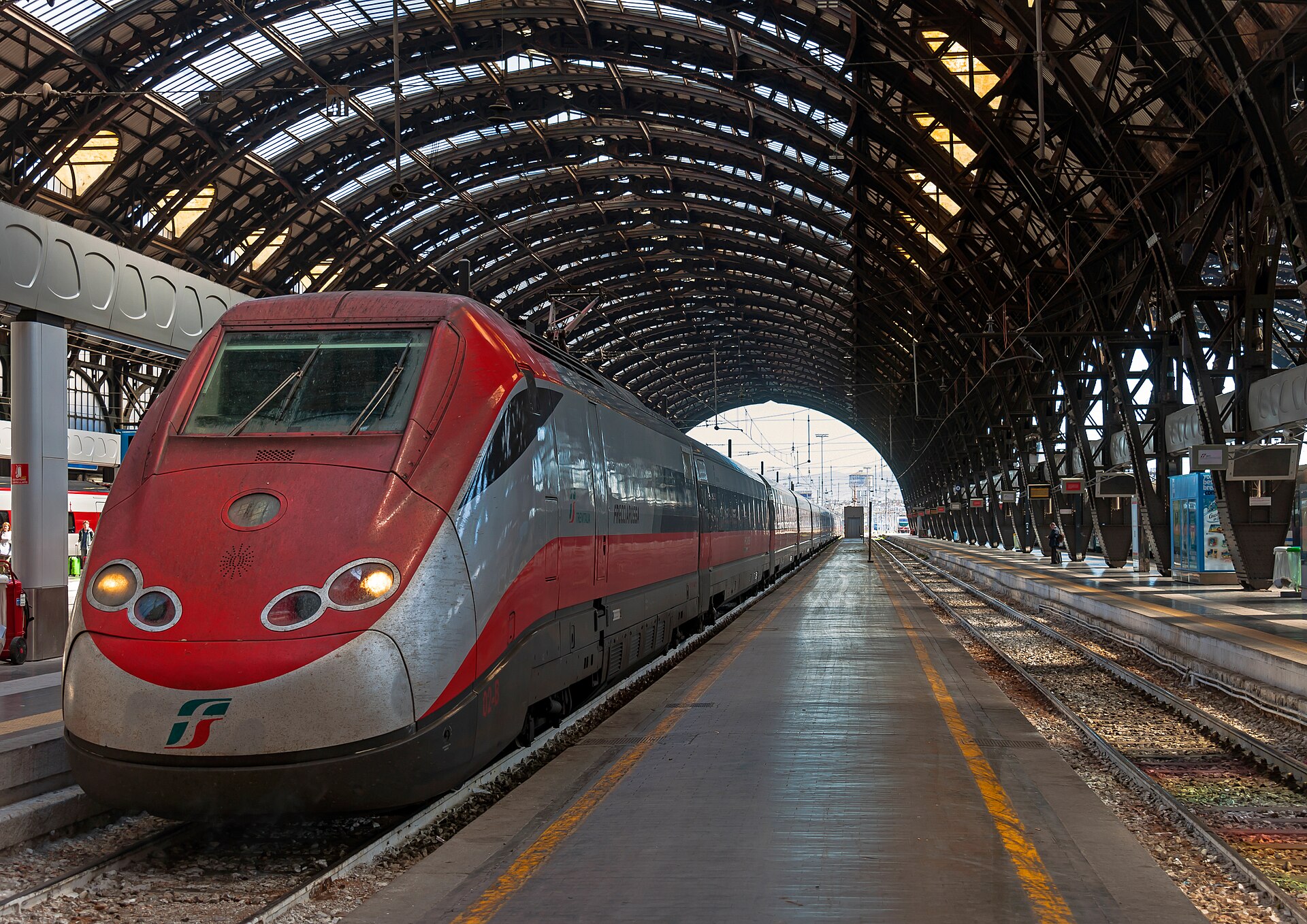
Outside those bands, in a major strike, expect cancellations. A strike that runs from 21:00 Friday to 21:00 Saturday creates a gap of nine hours — from midnight to 06:00 — with no rail service, another gap from 09:00 to 18:00, and then a brief guaranteed window before normal service resumes overnight. For most tourists travelling between major cities during daylight hours, the 09:00–18:00 gap is the one to plan around.
One rule worth noting: if your train has already departed when a strike begins, and it can reach its final destination within one hour of the strike’s start, it will normally complete the journey. If not, it may terminate at the next station. Trenitalia is supposed to assist with onward connections if this happens, though in practice this depends on what trains remain available.
Which Operators Are Affected — And Which Might Not Be
Not all Italian rail operators are the same entity, and a strike called against one does not automatically affect the others.
Trenitalia and the FS Group
Trenitalia is Italy’s state-owned rail operator, part of the Ferrovie dello Stato (FS) Italiane group. A strike called by FS Group workers can affect Trenitalia’s Frecce high-speed services, its Intercity trains, and regional trains across all regions. It can also pull in affiliated operators like Trenord (Lombardy) and Trenitalia Tper (Emilia-Romagna), which run regional services under FS Group agreements.
This is the largest category of Italian rail strikes. If you are travelling on a Frecciarossa, Frecciargento, Frecciabianca, or any regional train in Italy, check whether your travel dates overlap with any declared FS Group action.
Italo (NTV)
Italo, operated by Nuovo Trasporto Viaggiatori, is Italy’s private high-speed rail competitor to Trenitalia. It operates only on high-speed lines between major cities — Rome, Milan, Naples, Florence, Venice, Turin and a handful of others.
Because Italo has its own workforce and its own union agreements, a strike called against FS Group workers does not automatically affect Italo trains. In practice, many FS-only strikes leave Italo running its full timetable. This is one of the most practical and underreported facts about getting around Italy on strike days — if your route is covered by Italo, check its status independently. You may find a perfectly operational service waiting.
The exception is infrastructure strikes. Italo and Trenitalia share the same high-speed tracks, which are managed by RFI (Rete Ferroviaria Italiana), another FS Group company. If RFI infrastructure workers strike, both operators can be disrupted regardless of whether their own staff are walking out. Italo also publishes its own guaranteed trains list on its website when a strike affects it.
For a full comparison of how the two operators differ on routes, pricing, and experience, see our guide to Trenitalia vs Italo.
Regional and Local Operators
Many Italian regions have their own rail operators that are entirely separate from Trenitalia — Trenord in Lombardy, SAD in Alto Adige, Circumvesuviana in the Naples region. Local bus and metro operators in each city are also completely independent. A national rail strike may not affect your Naples–Pompeii Circumvesuviana connection at all. Read the specific strike notice carefully to understand which operators and which routes are named.
How to Check for Upcoming Italy Train Strikes
This is where most tourist guides fall short. Knowing that strikes exist is one thing. Knowing where to check whether one is actually happening on your travel dates is more useful.
The Official Sources
Commissione di Garanzia (CGSSE) — cgsse.it
This is Italy’s official guarantee commission for essential public services strikes. The site (in Italian) lists all announced actions, their status (active, modified, withdrawn), start and end times, and which sectors are affected. It is the most complete source but requires a little Italian or a translation tool. Look for entries marked “Settore Ferroviario” for rail.
MIT Strikes Portal — mit.gov.it
The Italian Ministry of Infrastructure and Transport (MIT) also publishes a public-facing strike calendar. It is updated with confirmed actions and is searchable by sector and date.
Trenitalia — trenitalia.com/en/information/in-case-of-strike.html
Trenitalia’s own English-language strike page explains the minimum services framework and links to the Italian-language page listing specific guaranteed trains for any active strike. The guaranteed trains list is published in Italian but is essentially a table of train numbers — you can cross-reference the number of your booked service.
Italo — italotreno.com/en
Italo publishes its own strike notices and guaranteed trains list on its website when relevant. Check the news and alerts section.
ViaggiaTreno — viaggiatreno.trenitalia.com
Trenitalia’s real-time train tracking tool. On a strike day, this shows the live status of each service — whether it is confirmed to run, delayed, or cancelled. Do not head to the station without checking this first.
Practical Monitoring
If you are travelling more than a week out, the CGSSE and MIT calendars are your first check. Within a few days of travel, switch to Trenitalia and Italo’s own alert pages, where confirmed guaranteed trains are published. The day before and day of, use ViaggiaTreno for live status.
Some English-language resources also track Italian strikes in a more tourist-friendly format — sites like summerinitaly.com maintain running lists of upcoming transport actions, and the Rick Steves travel forum often has real-time community reporting from travellers on the ground. These are useful supplements but verify against official sources for the final word.
For planning around disruptions more broadly, see our page on common Italy travel mistakes — strike-day timing is one of them.
Guaranteed Trains: What This Actually Means in Practice
Guaranteed trains are not a vague promise of “some trains will run.” They are specific services, identified by number, that operators are legally required to operate during the fasce di garanzia. On a major national strike day, Trenitalia publishes a list on its website of every guaranteed service — typically arranged by route and departure time.
For long-distance routes, this usually means a handful of Frecciarossa departures during each guaranteed window. A route like Rome–Milan that might normally see a high-speed train every 30 minutes could be down to one or two departures in the morning window and one or two in the evening window.
For regional trains, the guaranteed list is built around commuter demand — covering city-to-suburb connections that workers depend on. Tourist routes may be represented, but the list is thinner.
Two practical implications:
Guaranteed trains fill quickly. As soon as a strike is announced, travellers who need to move that day start booking guaranteed slots. If you have flexibility, book as early as possible once you know a strike coincides with your travel. Seats on guaranteed high-speed trains on a strike day can sell out.
“Guaranteed” does not mean “definitely running.” The legal requirement exists, but real-world disruptions — if a driver calls in sick, or infrastructure issues compound the walkout — can still affect even listed services. Check ViaggiaTreno on the day. A train appearing in the timetable is not the same as confirmation it will run.
Your Ticket Rights: Refunds and Rebooking
This is the part most tourists worry about and most guides get vague on. Italy has clear rules on what you are entitled to when a strike cancels your train.
Trenitalia
If your Trenitalia train is cancelled due to a strike, you are entitled to a full refund regardless of the fare type you purchased — including the cheapest non-refundable Super Economy tickets. The refund threshold is anything over €4.
The timing window for requesting a refund is:
– For Frecce and Intercity trains: from the moment the strike is announced until the scheduled departure time of your booked train
– For regional trains: from the announcement until midnight on the day before the strike
You can claim at any ticket office, through the Trenitalia app (Bookings → Cancel), or online through Manage My Trip. Refunds typically process within 30 days to the original payment method.
Alternatively, if your train is cancelled and another is available, Trenitalia staff should rebook you on the next service under similar conditions, subject to seat availability. You can also choose to wait and travel later in the guaranteed window.
Italo
Italo’s policy mirrors the same framework. If your Italo service is cancelled due to a strike, you get a full refund — automatically processed if you booked online or via the app, typically as a credit or voucher. If you bought at an Italo desk or machine, you need to claim in person or via their customer service. Italo also publishes its guaranteed trains list; if your specific train number is on that list, it is expected to run, and your ticket remains valid.
Third-Party Bookings (Rail Europe, ItaliaRail, Trainline)
If you booked through a third-party platform, your refund goes through them. The operators will still issue the refund, but it flows through the intermediary, which can slow the process. Some platforms take six months or more to pass refunds through. Contact the platform directly as soon as possible after the strike and keep all documentation.
How to Plan Around a Strike Without Rewriting Your Itinerary
A strike announcement two weeks before your trip is not a reason to panic. Here is a practical approach.
Step 1: Identify your critical travel days. Which train connections are non-negotiable — airport transfers, hotel check-ins with late penalties, onward connections to ferries? Flag those.
Step 2: Check the strike window against those days. Most strikes are 24 hours. If the strike runs midnight to midnight and your train is at 14:00, that’s a high-risk slot (outside guaranteed bands). If your train is at 07:30 or 19:00, you may be in a guaranteed window.
Step 3: If your train falls in a guaranteed window, book early. Pull up the guaranteed trains list once published and confirm your specific service is on it. If it is not, book one that is.
Step 4: Consider Italo as a fallback. If you are travelling between major cities and your route is served by both operators, check Italo independently. On FS-only strikes, Italo often runs a full timetable.
Step 5: Have a backup plan for the worst case. Long-distance buses — FlixBus, Itabus, Flixbus-Marino — run between major Italian cities and are not affected by rail strikes. Journey times are longer, but they’re a real option. For truly critical connections (catching a flight home, for example), price out a transfer service or rental car the night before.
Step 6: Don’t restructure your whole trip. Strike days are almost always a one-day event. Arriving a day early as a buffer is a reasonable precaution for a tight connection. Rethinking your entire route is usually overkill.
For more on structuring your rail journey through Italy, see our guide to suggested routes around Italy and the Italy trip planner.
Regional Trains: A Different Risk Profile
If you are travelling on regional trains — the slower, cheaper services that connect smaller towns and cities — the strike risk looks somewhat different. See our deeper guide to regional trains in Italy for full context.
Regional services are included in the guaranteed windows, but the number of guaranteed regional trains is typically much smaller than for long-distance services. A strike on a weekday in a rural region could leave you with very few options outside the 06:00–09:00 and 18:00–21:00 windows.
Practically speaking: if your itinerary is built around high-speed connections between major cities, a strike is a manageable inconvenience. If you are depending on regional trains for day trips to smaller towns, or using multiple regional connections on the same day, a strike day is worth avoiding entirely if possible. Rearranging your schedule by one day is easier than managing multiple cancelled connections in sequence.
For context on your specific itinerary, the guide to planning a trip to Italy and best time to visit Italy cover patterns of disruption by season as well.
The Mechanics: Strike Timing and “Tail” Disruption
One detail that catches travellers out: disruption does not always begin and end precisely with the official strike window. There is often a tail effect before and after.
Before a strike, some trains scheduled to depart in the evening ahead of a midnight start may already be running late as staff begin informal slowdowns or as scheduling adjustments cascade. After a strike ends, it takes time to get trains, drivers, and rolling stock back into position across the network. A strike that ends at 21:00 Saturday may mean limited service Saturday evening and some disruption Sunday morning as the network normalises.
If your travel falls in the 12–24 hours immediately following a major strike, build in extra time. Delays of an hour or more are common in the recovery period.
Final Thoughts
Italy train strikes are part of the texture of travel here, not a reason to rethink it. The Italian system is built with them in mind: announced in advance, limited in duration, legally required to keep certain trains running. Most tourists who travel Italy by rail for two weeks never encounter a serious disruption. Those who do and know the system — guaranteed bands, Italo as backup, refund rights — handle it in stride.
The key habits are simple: check the official calendars before you travel, book guaranteed-window trains early if a strike coincides with a critical connection, and keep your itinerary flexible enough that a single disrupted day doesn’t cascade into a bigger problem. Build your trip around the experiences, not the exact train time, and you’ll be fine.
For everything else about getting around Italy by rail, start with trains in Italy and dig into the Italy transport guide from there.
Questions travellers ask
Is it safe to book non-refundable train tickets in Italy given the strike risk?
Yes, with the caveat that you understand your rights. If a train is cancelled due to a strike, Trenitalia and Italo are legally required to issue a full refund regardless of whether your ticket was a non-refundable Super Economy fare. The strike exception overrides standard refund rules. Where this gets complicated is with third-party bookings, where the refund process can take much longer. Book directly with the operator where possible if you want faster refund processing.
Does Italo run during Trenitalia strikes?
Often yes, but not always. A strike called by FS Group workers — who work for Trenitalia and related companies — does not automatically affect Italo’s staff. Italo has separate union agreements. On many FS-only strike days, Italo runs a full or near-full timetable. The exception is when the strike involves RFI infrastructure workers, since Italo uses the same tracks. Always check Italo’s site independently, especially if your route is served by both operators.
How much advance notice do Italian rail strikes give?
Italian law requires a minimum of 10 days’ notice for transport strikes in the essential services category (which includes rail). In practice, many strikes are announced two to four weeks ahead, giving you time to check before you leave home. Spontaneous or wildcat strikes without notice are not supposed to happen under this framework — and when they do, operators typically contest them legally. You generally will not wake up to a strike you couldn’t have known about.
What happens if my train departs on time but then the strike starts mid-journey?
If your train has already left the station when a strike begins, it will normally continue to its final destination — provided it can get there within one hour of the strike’s start. If the journey would take longer than that to complete, the train may terminate at the next station along the route. Trenitalia is supposed to arrange alternative connections from that point, though your options depend on what guaranteed trains remain available. In practice, this mid-journey termination scenario is uncommon, but it is worth knowing if your train departs close to an announced strike start time.
Are airport trains affected by Italian rail strikes?
Yes. The Leonardo Express from Roma Termini to Fiumicino Airport (FCO) is a Trenitalia service and is subject to the same strike rules. During a major national strike, it may not run outside guaranteed windows. The Malpensa Express from Milan to Malpensa Airport (MXP) is operated by Trenord and follows the same framework. If you have a flight on a strike day, verify the specific airport train status and consider a taxi or transfer as backup — especially for early morning departures that may fall in the pre-guaranteed window gap.
Can I rebook my train for a different day instead of getting a refund?
Yes. If your train is cancelled due to a strike, you have the option to either claim a full refund or rebook on the next available service. Trenitalia staff at ticket offices can assist with rebooking under similar conditions (same class, same route, subject to seat availability). If you would rather travel a day later to avoid the disruption entirely, you can cancel and rebook a new ticket — though the new ticket is purchased at the current fare, which may be higher.
Do general strikes in Italy always affect trains?
Not always. Italy has “general strikes” called by various unions, and their scope varies significantly. Some are sector-specific (e.g., logistics or healthcare workers) that don’t touch rail at all. Even when transport is included, the same Law 146/1990 framework applies — guaranteed windows, published minimum services, advance notice. A declared “general strike” is not the same as a complete transport shutdown. Read the specific announcement to see which sectors and operators are named, and then check those operators’ sites for their individual responses.
Is there a season when Italy train strikes are more common?
Strikes tend to cluster in autumn and early spring, when union contract negotiations are typically underway, and occasionally in response to government transport policy decisions. Summer (July–August) and the Christmas–New Year period tend to be quieter for industrial action — the government has stronger legal grounds to defer or limit strikes during peak public interest periods. That said, there are no guaranteed strike-free months. Check the calendar regardless of when you travel.