Italian Train & Transport Guide
Regional Trains in Italy: Tickets, Validation and Fines

Regional Trains Italy: What You Need to Know
Regional trains in Italy are cheap, walk-up, and require no advance booking. You show up, buy a ticket, board — simple. There is, however, one rule that trips up more tourists than any other single thing in Italian travel: you must validate your paper ticket before you board. Skip that step and you risk a fine. This article is your complete guide to the Regionale network — what it is, where it goes, how to buy and validate your ticket (including what changes if you bought digitally), and exactly what happens if an inspector finds you unvalidated.
For a full overview of all Italian train categories — high-speed, Intercity, and regional — head to the guide to trains in Italy. This article lives in the detail on the Regionale tier specifically.
Regional vs High-Speed Trains at a Glance
| Feature | Regionale | High-Speed (Frecce / Italo) |
|---|---|---|
| Seat reservation required | No | Yes (included in ticket) |
| Pricing | Fixed fare by zone/distance | Dynamic — book early for best price |
| Validation required | Yes (paper ticket); automatic (digital) | No — ticket is tied to your seat |
| Typical speed | 80–130 km/h | 200–300 km/h |
| Ticket flexibility | Valid for 4 hours after validation | Specific train only |
| Where to book | Machine, app, counter, online | Same + third-party sites |
| Advance booking benefit | None — same price day-of | Significant savings |
The key difference in one sentence: a high-speed ticket is like an airline boarding pass — it names a specific train and seat, and no validation is needed because the ticket is already tied to you. A Regionale ticket is more like a bus token — valid for a window of time, good on any qualifying train, but meaningless until you stamp it.
What Is a Regionale Train?
Trenitalia, Italy’s state rail operator, runs several service levels. At the top are the Frecce (Frecciarossa, Frecciargento, Frecciabianca) — the famous red high-speed trains that link major cities in 90 minutes or less. Below those sit Intercity trains, which are faster than regional but slower than Frecce. Then there are Regionale trains, which subdivide into two categories you will see on departure boards and ticket machines:
- Regionale (R) — the standard local service, stopping at most stations along a line
- Regionale Veloce (RV) — “fast regional,” skipping smaller stops, running more like an express
Neither requires a reservation. Neither has dynamic pricing. You pay a fixed fare based on distance or zone, and the ticket is valid on any R or RV service in the same category for four hours after validation.
In Lombardy, the regional trains are operated not by Trenitalia but by Trenord — a joint venture between Trenitalia and the regional government. The ticket and validation logic is the same, but the operator, branding, and fine structure differ slightly (more on fines below). Other regions may have sub-contracted operators for specific lines, but Trenitalia regional trains are what most visitors encounter.
Where Regionale Trains Go (The Places the Frecce Skip)
The high-speed network is built around a backbone: Milan–Bologna–Florence–Rome–Naples, with spurs to Venice, Turin, and Salerno. It is fast and efficient. It is also not where most of Italy actually lives.
The Regionale network covers thousands of stations the Frecce will never see. If you want to visit any of these places, you will be taking a regional train for at least part of the journey:
Cinque Terre. The five villages — Monterosso, Vernazza, Corniglia, Manarola, Riomaggiore — sit on a coastal line between La Spezia and Genoa. Trenitalia runs a Cinque Terre Express specifically for this corridor, and it is pure Regionale. No high-speed train stops at any of these villages. You take a Frecce or Intercity to La Spezia, then switch to the local.
Assisi, Orvieto, Spello, Spoleto. None of these Umbrian gems sit on the high-speed line. Orvieto is on the Rome–Florence classic line, served by regional and Intercity trains — not Frecce. Assisi is near Assisi station (served from Perugia), accessible by regional connections.
The Tuscan countryside. Florence–Siena by train runs on a regional line through the hills. It is slower than the bus, but the views through Val d’Elsa are worth it. The guide to Florence and Tuscany covers day trips in more detail, but the train remains the most practical option for many villages in the region.
The Amalfi Coast hinterland, Puglia, Sicily, Calabria. Large parts of southern Italy are served almost exclusively by regional trains. The high-speed Frecce dip as far south as Salerno, but to explore Puglia or reach Palermo from Messina, regionals are your reality.
For anyone planning a route through smaller towns, the Italy itinerary by train resource will help you map connections between regional and intercity services.
Buying a Regionale Ticket
This is, mercifully, the easy part. Regional tickets are cheap, fixed-price, and available from multiple places.
At the Ticket Machine (Biglietteria Automatica)
Most Italian stations have self-service ticket machines — often yellow and grey Trenitalia machines, sometimes white Trenord machines in Lombardy. They take credit cards and often cash. Select your destination, choose “Regionale” or the service category shown, and purchase. The machine prints a paper ticket.
One detail: when you select your destination, the machine calculates the correct fare automatically. You do not select a specific train time for a Regionale ticket — just the destination. That flexibility is the whole point.
The Trenitalia App
The Trenitalia app (iOS and Android) lets you buy a Digital Regionale Ticket on your phone. This is increasingly the better option for tourists because — as we will discuss in a moment — digital tickets handle validation automatically. You can buy up to five minutes before departure.
Ticket Windows (Biglietterie)
At larger stations, staffed ticket windows sell Regionale tickets. Useful if you have a complicated journey to explain, need to pay cash, or the machines are out of order.
Third-Party Sites and Apps
Sites like Trainline and ItaliaRail sell Regionale tickets, though often with a booking fee added. If you are already buying your high-speed tickets through a third party, you may as well keep everything in one place — just understand that what arrives is still a Regionale ticket subject to the same rules.
What Regionale Tickets Cost
Prices are distance-based and fixed. A short hop — Florence to Pisa, for example — costs around €8–9. Florence to Siena runs about €10. Rome to Orvieto is around €6–9. Longer regional journeys can reach €15–20 for two or three hours of travel. Compare that with the hundreds of euros a last-minute Frecciarossa can cost, and you start to see why backpackers and slow travelers love the Regionale network.
The Validation Rule: This Is the Part That Really Matters
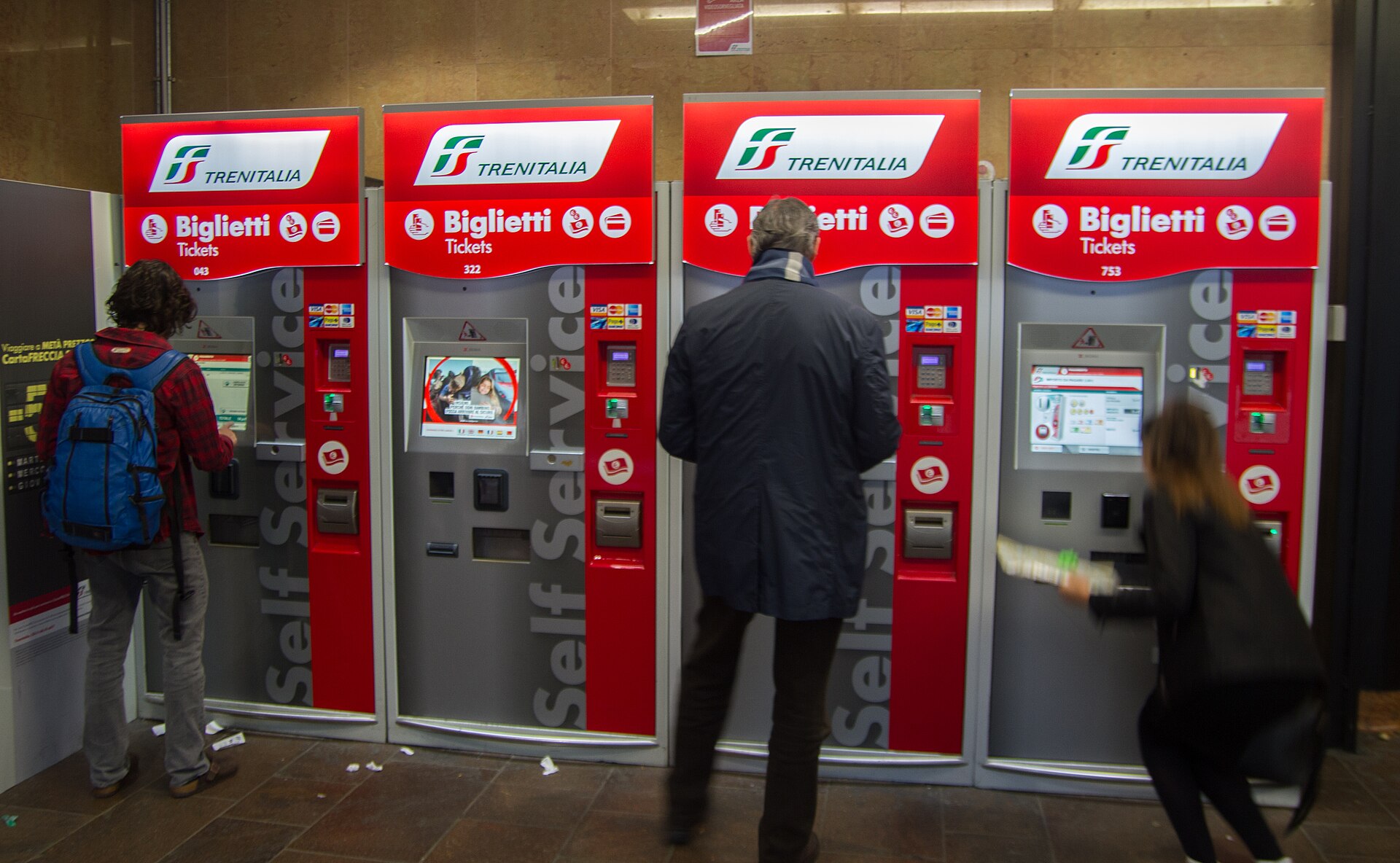
Let me be direct: failing to validate a paper Regionale ticket is the single most common and most expensive mistake tourists make in Italy when using trains. Inspectors are not lenient with the explanation “I didn’t know.” The rule has existed for decades. It is your responsibility.
Paper Tickets: The Green Machines
When you buy a paper Regionale ticket — whether at a machine, a window, or printed at home from a PDF — you must validate it before boarding. “Validation” means stamping it with the date and time. This starts the four-hour clock and makes the ticket legally active.
The machines are small, usually green or white, mounted on the walls in station concourses and on platforms near the boarding points. They look a bit like parking ticket dispensers. You insert your ticket into the slot (or slot it face-down — it varies by machine model), wait for a satisfying clunk and whirr, and pull it back out. The machine prints the date, time, and station onto the ticket.
If you cannot find a validation machine — they are sometimes out of order, occasionally missing from smaller unstaffed stations — find a train conductor or station staff member before you board and ask them to validate it manually. Tell them upfront that the machine is unavailable. This is a documented exception: staff can validate without a surcharge when machines are genuinely non-functional. The key word is “before boarding” (or immediately upon boarding with a clear explanation).
Some travelers ask: “Can I validate it once I’m on the train?” Technically no — validation should happen before you board. In practice, if you approach the conductor immediately as you step on and explain the situation genuinely and promptly, many conductors will validate without issuing a fine. But this is a courtesy, not a right. Do not plan around it.
Digital Tickets: The Automatic System
Here is the rule that confuses people, because it changed:
As of September 2024, Trenitalia’s Digital Regionale Ticket — the one you buy via the Trenitalia website or app — is automatically validated at the scheduled departure time of the train you selected when buying. You do not need to do anything. No machine. No check-in button. The ticket activates itself.
When an inspector boards, you show them the ticket on your phone. A dynamic green bar appears on the screen once the train has departed — this confirms validation. You may also be asked to show ID, because the digital Regionale ticket is personal and non-transferable.
Important nuance: this automatic validation applies to Trenitalia’s own Digital Regionale Ticket bought through Trenitalia’s site or app. If you bought a ticket through a third-party platform (Trainline, ItaliaRail, Rail Europe) and received a PDF, treat it as a paper ticket and validate it at the machine. Some third-party digital flows have their own check-in requirements — check your booking confirmation carefully.
How Long Is a Validated Ticket Valid?
For paper tickets, four hours from the moment of validation. If you validate at 9:15am, you can board any Regionale train heading to your destination up until 1:15pm. This flexibility is useful for busy travel days or uncertain connections.
For Digital Regionale Tickets, the ticket is valid until the scheduled arrival of the train at the destination — not a four-hour window, because the ticket is tied to a specific train.
Can You Validate the Same Ticket Twice?
No. Once stamped, a paper ticket cannot be re-validated. The four-hour window is your window. If your journey takes longer than four hours due to disruption, that is a different matter — you can ask staff for assistance.
Fines for Unvalidated Tickets: What Actually Happens
Let’s talk about inspectors and fines with the candor most travel sites avoid.
The Inspection
Regional trains are inspected — sometimes every journey, sometimes not. There is no pattern you can rely on. Inspectors (controllori) board at stations, walk the carriages, and ask every passenger for their ticket. They have handheld scanners for digital tickets and QR codes, and they read paper tickets visually.
If your paper ticket is unvalidated, you will be issued a fine on the spot. Being a tourist does not exempt you. Speaking no Italian does not exempt you. Inspectors typically have some English or can manage the transaction without it. The fine document is printed in Italian; you pay by card or cash.
Fine Amounts: The Honest Picture
Fine amounts for regional trains are not set by a single national tariff — they are determined by operator and regional law. This is why you see different numbers cited in different sources, and why I will be honest rather than invent a definitive figure.
For Trenord in Lombardy, the official penalty schedule is published on the Trenord website and is calculated as 100 times the minimum fare of a standard 2nd-class regional single ticket. As of 2026, that works out to roughly:
- If you pay within 5 days of the fine: around €35 plus procedure costs and the ticket price
- If you pay within 6–60 days: around €50 plus costs and ticket price
- After 60 days: the full 100x multiplier plus costs — potentially significantly more
For Trenitalia regional trains across the rest of Italy, traveler reports consistently cite on-the-spot fines in the €50–€100 range for an unvalidated ticket. Some inspectors issue a fixed penalty of around €50 payable immediately; others issue a notice with a higher base amount. Official Trenitalia conditions state that travelling without a valid (which includes validated) ticket means paying the full fare plus a penalty. Verify current exact amounts against Trenitalia’s Conditions of Transport if this matters to your planning, as tariffs can change.
The practical lesson: the fine will cost you at minimum several times what the ticket itself costs. A €5 regional ticket becomes a €50+ problem if unvalidated. Validation takes thirty seconds.
What Inspectors Actually Do with Tourists
Most inspectors on Italian regional trains are not looking for an argument. They are doing a job. If you have an honest mistake — you simply forgot to validate, you are genuinely confused — the interaction is usually professional and businesslike. They will issue the fine, you will pay or receive a notice, and that is the end of it.
Where things get complicated is if you try to argue, claim you “already validated” when you clearly did not, or if you cannot produce ID for a digital ticket. Produce your ticket, produce your ID if asked, listen to the inspector, and pay if you owe. That is the fastest path to a resolved situation and the rest of your journey intact.
Some tourists report that genuinely confused first-timers who produce an unvalidated ticket immediately and apologetically are sometimes warned rather than fined — particularly outside peak inspection periods. Do not count on this. It is a judgment call by the individual inspector, not a policy.
Reading Regional Train Schedules
The Trenitalia website and app let you search for regional train times just as you would for any other service. Enter your origin, destination, and date. Filter by “Regionale” or look for trains marked R or RV in the results.
A few things to know when reading a regional schedule:
No seat assignment. Regional trains have open seating. First come, first served. Peak-hour trains on popular routes (Florence–Pisa, Milan–Como, Rome–Naples on the classic line) can be crowded. Standing is common and legal.
Frequency varies wildly. On busy commuter routes between major cities, regionals run every 30 minutes or more often. On rural lines, there may be three or four trains per day. Check your return train before you set off — especially for smaller hill towns.
Platform announcements. At larger stations, departure boards show platforms (binario). At smaller stations, you may need to check a posted timetable on the wall or ask. The Trenitalia app shows live train tracking once you have your ticket.
Viaggiatreno. Trenitalia’s real-time train tracker at viaggiatreno.it lets you check the live position and delay of any train by number. Useful when you are already at the station and wondering whether the 14:23 is actually on time.
Practical Tips for Regional Train Travel
A few things that make the difference between a smooth regional train day and a frustrating one:
Validate early. Once you have your paper ticket, validate it immediately — even if you are early for your train. The four-hour window is generous. Validated tickets can then be pocketed; no more searching for machines on the platform while your train is already at the stop.
Buy digitally when you can. The automatic validation of the Trenitalia Digital Regionale Ticket removes the single biggest risk for tourists. The ticket is the same price as at the machine. The flexibility (change up to the departure time on the day) is arguably better.
Carry ID. Inspectors can ask for it on regional trains, especially for digital tickets, which are nominative. A passport or national ID card is standard.
Keep your ticket. Do not pocket the validated stub in a bin or your deepest bag pocket. Inspection can happen at any point in the journey, including near the end.
Multiple segments, multiple validations. If your journey requires changing trains — say, Bologna to La Spezia, then La Spezia to Monterosso — and each leg is a separate ticket, each ticket needs validating separately. Buy tickets for each leg individually at the machine or app.
Watch your time on connections. Regional trains are sometimes late. Italy’s network has its quirks — see the article on Italy train strikes for what can go wrong — and regional trains are more susceptible to delays than high-speed services. Build buffer time into connections, particularly to catch a Frecce from a regional station.
For broader budget thinking, the breakdown of what Italy costs guide covers how to factor train costs into your overall trip spend.
Final Thoughts
Regional trains in Italy are one of the genuine pleasures of slow travel here. They put small towns, coastal villages, and countryside on your itinerary without the planning overhead of a seat-reserved Frecce. The fares are modest, the views are often excellent, and the experience of sitting in an unreserved carriage with commuters and schoolchildren is decidedly more Italy than the high-speed bullet.
The one non-negotiable: sort out your validation. Stamp your paper ticket at the machine before you board. Buy digitally and let the app handle it automatically. Either way, your ticket needs to be in valid status when the inspector arrives — because they will arrive.
Get that right and the regional network opens up the Italy that most visitors only glimpse from a high-speed window. That is worth the extra thirty seconds at the platform machine.
For broader planning across your journey, the complete Italy travel guide and Italy itineraries pages are good places to start thinking about the bigger picture. And if you are sorting out getting around Italy more broadly, regional trains are just one piece of a network that r
Questions travellers ask
Do I need to validate a train ticket in Italy if I bought it online?
It depends on the ticket type. If you bought a Trenitalia Digital Regionale Ticket through the Trenitalia website or app, validation is automatic — you do nothing, and the green bar appears at departure. If you bought a PDF/print-at-home ticket through a third-party site, treat it as a paper ticket and stamp it at the yellow/green machine before boarding. High-speed (Frecce/Italo) tickets never need validation regardless of where you bought them.
What happens if I forget to validate my regional train ticket in Italy?
You risk a fine from the inspector. On the spot, you will typically be asked to pay the ticket price plus a penalty — reports and regional operator schedules suggest this lands in the €50–€100 range as of 2026, depending on operator and payment timing. Approaching the conductor proactively and immediately (before they reach you) when you realize the mistake can occasionally result in a warning, but this is at the inspector’s discretion.
Where are the validation machines at Italian train stations?
Look for small green or white machines mounted on walls in the station concourse, at the entrance to platforms, and on the platform itself near boarding points. At very small unstaffed stations, machines are sometimes on the platform only. If you cannot find any, tell train staff before boarding and ask them to validate manually — this is a recognized exception when machines are unavailable.
Can I buy a Regionale ticket on the day of travel?
Yes, and this is one of the great advantages of regional trains in Italy. You can walk up to the machine or counter, buy a ticket, validate it, and board — no advance planning required. The Digital Regionale Ticket on the Trenitalia app can be purchased up to five minutes before departure. There is no price difference for buying on the day versus in advance.
Are regional trains the same as the high-speed trains in Italy?
No. They are different services in the same network. High-speed Frecce and Italo trains connect major city pairs at 200–300 km/h with reserved seats and dynamic pricing. Regional trains (Regionale, Regionale Veloce) travel at 80–130 km/h, stop at more stations, require no reservation, and use fixed fares. For a full breakdown of all train types, see the trains in Italy guide.
Do I need to book a seat on a regional train in Italy?
No. Regional trains have open seating — you board and sit wherever you like. If a carriage is full, you can move to another or stand. There is no seat reservation option for Regionale services. This is a feature, not a flaw: it means you can change your plans on the fly without losing money on a fixed ticket.
Is it safe to use the Trenitalia app to buy regional train tickets?
Yes. The Trenitalia app is the official Trenitalia platform, accepts major credit and debit cards, and issues the Digital Regionale Ticket with automatic validation. It also lets you change your departure time on the day of travel up until the originally scheduled departure time, which gives you genuine flexibility if your plans shift. Download it before you leave home — app stores can be slow on Italian data.
How do Trenitalia regional trains compare to Italo?
Italo, Italy’s private rail operator, does not run regional trains. Italo operates only on the high-speed network. For a full comparison of the two main operators, the Trenitalia vs Italo guide covers fares, routes, and loyalty programs in detail. If you are planning a regional journey, Trenitalia is your operator.