Florence & Tuscany Travel Guide
Siena Travel Guide: What to See and How Long to Stay
The Honest Siena Travel Guide (Day Trip, Overnight, and What Nobody Warns You About)
Let me give you the short answer first. Siena is one of the finest medieval cities in Europe, full stop. You can do it as a day trip from Florence — most people do — and walk away satisfied. But if you stay even one night, you will understand why so many travelers leave wishing they had. This Siena travel guide covers every major sight, the transit truth (the bus is better than the train), the Palio and what it actually means to locals, and the food worth tracking down.
It is best suited for anyone making a Florence and Tuscany trip who needs to plan Siena properly, whether you have five hours or five days.
What to See in Siena: Quick-Reference Table
| Sight | Why Go | Time Needed |
|---|---|---|
| Piazza del Campo | Best medieval square in Italy; grab a coffee and stay | 30–60 min |
| Siena Duomo (Cathedral) | World-class art, mosaic floor, striped marble interior | 1–1.5 hrs |
| Piccolomini Library (inside Duomo) | Brilliant Renaissance frescoes, usually half-empty | 20 min |
| The Crypt (below the Duomo) | Rediscovered 13th-c frescoes; staggering and rarely mentioned | 20–30 min |
| Gate of Heaven / Porta del Cielo roof tour | Walk the Duomo’s roof; panoramic view of city | 45 min (timed entry) |
| Museo dell’Opera (Duomo Museum) | Duccio’s Maestà + best rooftop view in Siena | 45–60 min |
| Torre del Mangia | 400-step climb; iconic tower views | 45 min |
| Santa Maria della Scala | Former hospital turned museum; frescoed Pellegrinaio | 1–1.5 hrs |
| Palazzo Pubblico & Civic Museum | Lorenzetti’s Allegory of Good and Bad Government | 45–60 min |
| Wandering the contrade | Flags, fountains, medieval alleys — free and priceless | As long as you like |
Piazza del Campo: The Square That Changes Everything
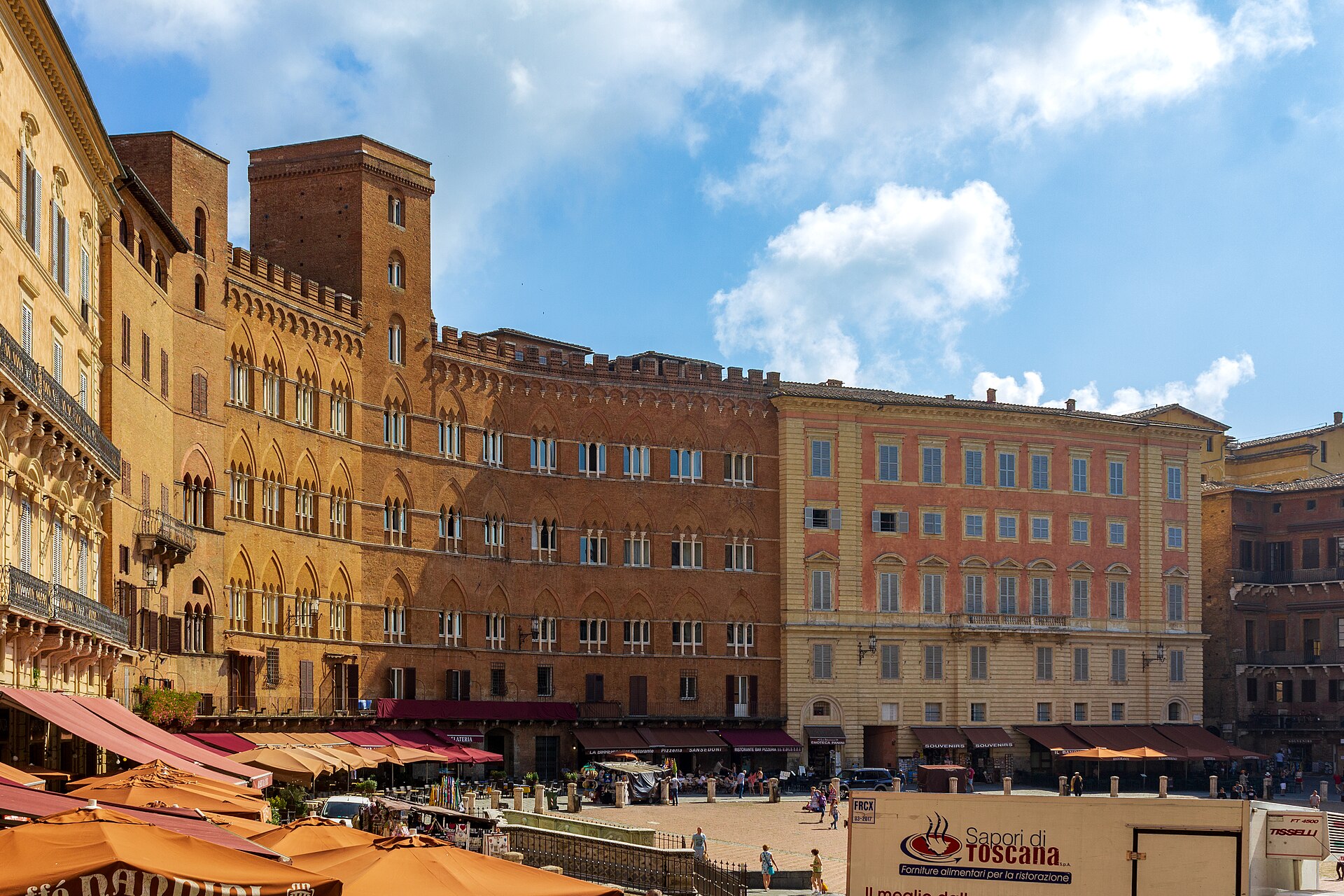
You have seen photographs of the Piazza del Campo, and they do not prepare you for the first time you walk into it from one of the narrow lanes that feed into it. There is no warning. You round a corner, and suddenly you are standing on one of the most beautiful public spaces in the world.
Il Campo — as locals call it — is a fan-shaped bowl of reddish brick, divided into nine segments by pale stone lines radiating from the Palazzo Pubblico toward the center. Those nine sections represent the Council of Nine who governed Siena in its medieval golden age. The piazza tilts gently downhill toward the palace, so that the whole crowd faces it like an audience. On ordinary days, people sit along the curved upper edge, lean against the warm bricks, eat sandwiches, read. In the early evening, the light turns amber and everything goes quiet in a way that Florence, frankly, rarely manages.
The Fonte Gaia sits at the upper arc of the square — a large marble fountain carved by Jacopo della Quercia in the early 15th century. What you see today is a 19th-century replica; the original panels (badly weathered) are upstairs in the Santa Maria della Scala museum. Worth knowing before you walk past it.
At the narrow end of the piazza rises the Palazzo Pubblico, Siena’s 13th-century town hall, still in use as the seat of local government. Attached to it, like a stone exclamation mark, is the Torre del Mangia.
Torre del Mangia: The Climb Is Worth It
The Torre del Mangia was completed in 1348 — the same year the Black Death arrived in Siena and killed roughly half the population, an event that froze the city’s ambitions and, arguably, preserved its medieval character for the next seven centuries. The tower stands around 88 meters tall. There are 400 steps and no elevator.
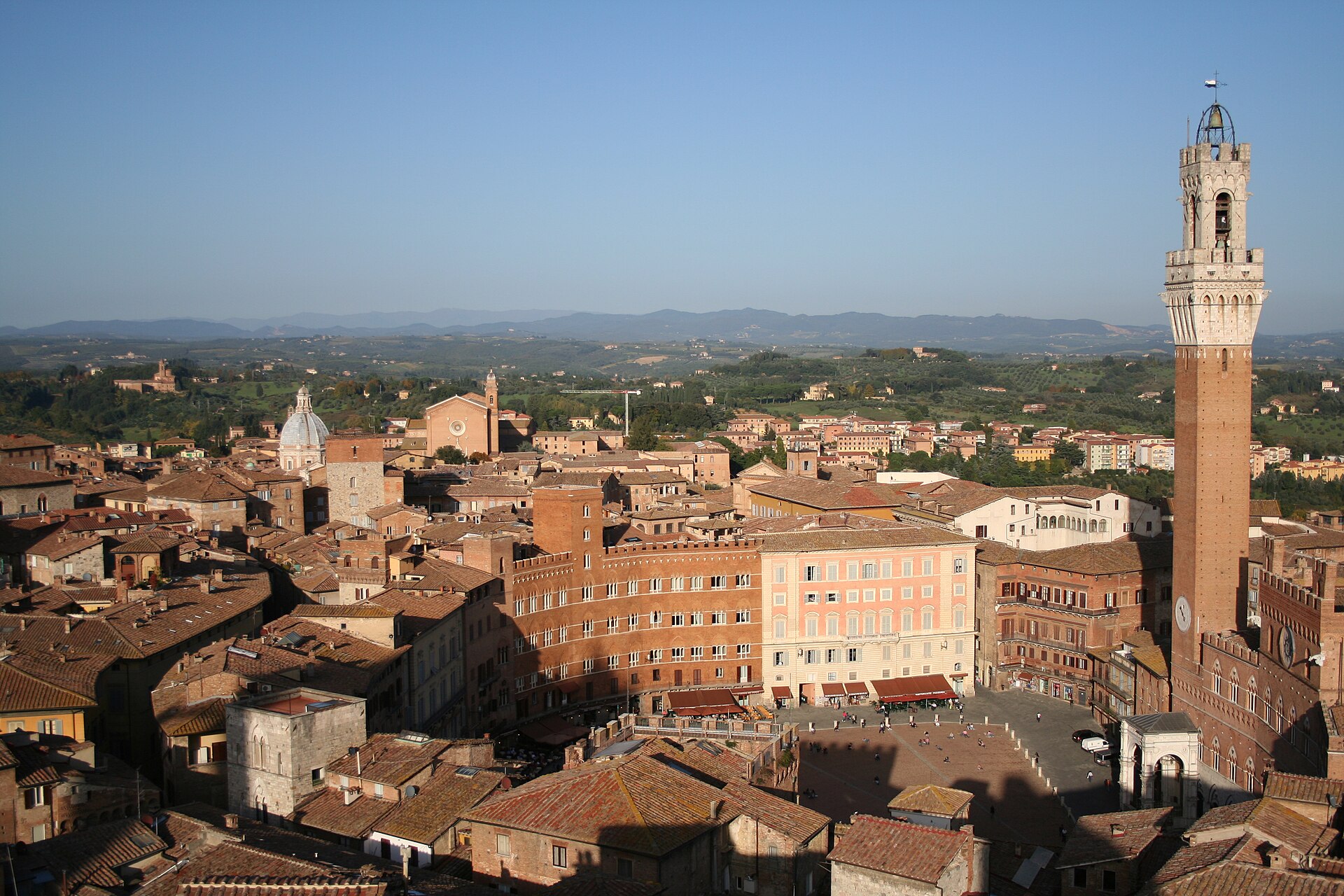
I will be honest with you: the view from the top is magnificent, and also partly redundant if you are already visiting the Museo dell’Opera, whose terrace offers an arguably better angle on the Campo and the Duomo simultaneously. But the Torre del Mangia has something else: the sensation of standing in a medieval city that looks almost exactly as it did in 1350. No skyscrapers break the horizon. No motorway. Just terracotta rooftops tumbling down three hills, and the Duomo dominating everything.
Tickets are around 10 euros as of 2026. The queue can be long in July and August; go early morning or in the evening if the tower has late hours during summer.
The Siena Duomo: Deeper Than You Think
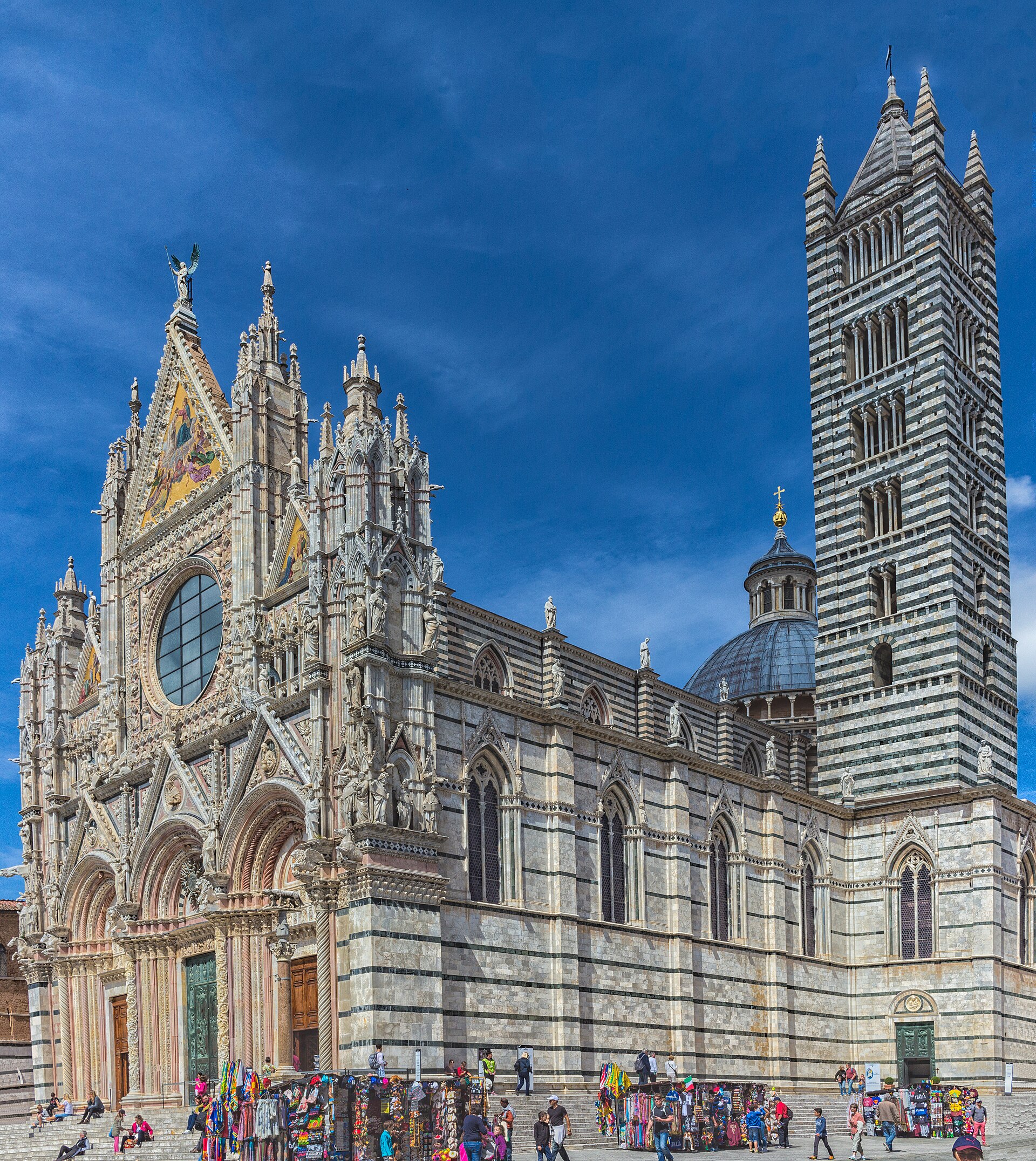
The Siena Duomo is the kind of building that makes you feel like someone raised the difficulty setting on Gothic architecture and then decided to also add a Romanesque bell tower, a Renaissance library, a 13th-century crypt, a rooftop walk, and one of the most extraordinary marble floors in the world. All in one building.
Most visitors spend 45 minutes inside and miss most of it. Here is what to actually see.
The Floor
The Duomo’s marble floor is covered by 56 panels of intricate inlaid and graffito decoration depicting biblical scenes, allegories, and Sienese heraldry. Most of the floor is protected under wooden boards for most of the year — typically uncovered in late summer. Even the sections that remain visible are remarkable. Do not walk through staring at the ceiling and miss it.
The Piccolomini Library
In the left transept, behind an ornate entrance arch, is a small room that stops first-time visitors cold. The Piccolomini Library was commissioned in 1492 by Cardinal Francesco Piccolomini (later Pope Pius III) to honor his uncle, Pope Pius II. Pinturicchio painted the entire room — walls and ceiling — with ten large narrative frescoes depicting scenes from Pius II’s life. The colors are still saturated and bright. In the center stands a marble group of the Three Graces, a Roman copy of a Hellenistic original.
It is easy to walk right past the entrance. Do not. This is one of the best small rooms in all of Italy.
The Crypt
Below the cathedral steps, on the exterior of the building, is an entrance to a space that was rediscovered only in 1999 during maintenance work. The Crypt — which is actually the earlier Duomo Vecchio, an unfinished predecessor of the current cathedral — contains a cycle of 13th-century frescoes in remarkable condition. Because they were buried and sealed for centuries, the colors survived. Most visitors walk past the entrance sign without realizing what it is. This is possibly the most underrated thirty minutes in Siena.
The Gate of Heaven (Porta del Cielo) Roof Tour
This is a timed-entry add-on that takes you up through the attic spaces and onto the exterior of the Duomo’s roof. You walk between the arches and buttresses, looking down at the Campo on one side and the unfinished nave extension (the Duomo Nuovo, abandoned after the plague of 1348) on the other. The view is extraordinary and the experience of standing on the cathedral’s spine, with marble pinnacles on either side, is genuinely unlike anything else in Tuscany. Book this in advance; it sells out.
All Duomo access (cathedral, Piccolomini Library, Baptistery, Crypt, and museum) is included in a combined OPA SI Pass ticket, available at the ticket office or online. The Gate of Heaven requires a separate time-slot booking on top of the pass.
Santa Maria della Scala: The Hospital That Became a Museum
Directly opposite the Duomo, where a former hospital stretching back to the 9th century once housed pilgrims, orphans, and the sick, you will find one of the most interesting and undervisited museum complexes in Tuscany.
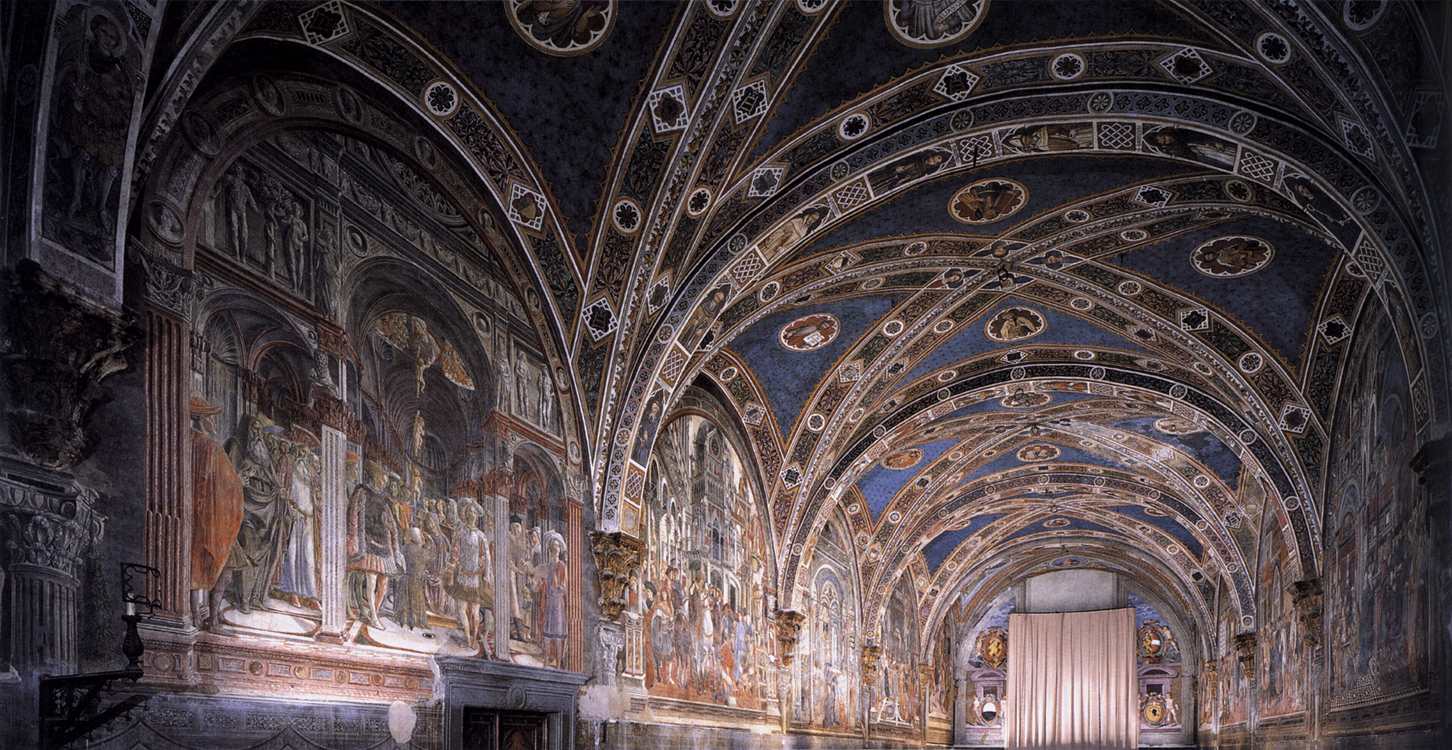
The Pellegrinaio is the heart of it: a long hall whose walls are covered floor-to-ceiling with a remarkable fresco cycle painted in the 15th century by Domenico di Bartolo and others. The frescoes show the actual daily life of the hospital — doctors treating patients, the feeding of orphans, the wet-nursing program for abandoned children — with a specificity and humanity unusual for the period. This was not a church glorifying saints. It was a civic institution documenting its own work, and it is extraordinary for it.
Elsewhere in the complex: the original panels from the Fonte Gaia, a vast underground warren of archaeological finds, and the oratory of Santa Caterina della Notte, where Catherine of Siena prayed through the night.
Tickets around 9 euros as of 2026. Allow at least 90 minutes.
The Palio and the Contrade: Why Siena Is Not Just a Pretty City
Most travel guides tell you the Palio is a horse race. That is like saying the Super Bowl is an afternoon of running. The Palio di Siena — held on July 2 (in honor of the Madonna of Provenzano) and August 16 (the day after the Assumption) — is the animating logic of the entire city. It is the reason Siena exists the way it does.
The race itself lasts about 90 seconds. Three laps of the Campo, bareback, on horses chosen by lot just days before. No rules except no grabbing the reins of another rider — which means almost everything else is permitted. Riders have been bribed, horses have been sedated, rivals have been thrown. Alliances shift year to year. A contrada that wins after a 30-year drought will weep openly in the streets.
The 17 Contrade
Siena is divided into 17 neighborhoods called contrade, each with its own symbol (Eagle, Wave, Tortoise, Giraffe, Caterpillar, Porcupine, Shell, and ten others), its own colors, its own church, its own museum, its own fountain, its own captain, and its own deeply personal enemies. Children are baptized twice — once in the church, and once in their contrada’s fountain. You are born into a contrada and you die in it. The rivalry between, say, the Goose and the Tower has been running for centuries and shows no signs of slowing.
Ten of the 17 contrade race each time; the seven that sat out the previous race get automatic entry, and three more are drawn by lot. The horse is assigned by lottery. Everything else — strategy, alliance, betrayal — is up to the fantino (jockey) and the captain’s negotiations.
As a visitor, you can wander the historic center at any time of year and read the city through its contrade flags. Colored banners fly from windows and iron rings mounted on walls. The symbols are everywhere. If you visit outside of Palio season, the contrade museums (small, free or nearly free, sometimes open by appointment) give context that the piazza alone cannot.
Should You Go for the Palio?
The honest answer is: only if you fully commit. The free standing area in the center of the Campo on race day is extremely crowded and extremely hot in July and August. You will be squeezed in from early afternoon for a race that begins in the evening, with no exits once capacity is reached. You cannot leave to use a toilet. You cannot sit down. If you want a seat in the bleachers or a balcony, you will pay significant money — anywhere from 300 to several thousand euros, depending on the position — and you should book months, not weeks, in advance.
What many travel writers do not tell you: the four to five days before the race are often more interesting for an outside observer. The trial heats (prove) happen morning and evening in the Campo. The streets fill with drums and pageantry. Each contrada holds a communal dinner the night before the race, hundreds of people eating together at long tables in the streets. If you are in Siena for any of that, you are seeing something rare.
For a broader look at Tuscany’s most dramatic landscapes and hill towns, the Chianti wine region and the Tuscany road trip route put Siena in its proper geographic context.
How Long to Stay in Siena: The Honest Call
Here is what I want to say clearly, because I think most Siena travel guides are too diplomatic about it.
A day trip is enough to see the main sights. You can do the Duomo (including the Piccolomini Library and the Crypt if you start early), the Campo, the Torre del Mangia or the Museo dell’Opera, and have a proper lunch. You will leave feeling you have seen Siena. And you will be right.
But staying overnight changes what Siena is. The day-trippers leave on the late-afternoon buses and the Campo empties. By 7pm, the piazza belongs to locals again. You can sit on the brick with a glass of wine from any bar along the edge and watch Siena do what Siena does in the evening — which is almost nothing, and is perfect. The narrow streets between the contrade glow with lanterns. You eat later than you would plan to and later than you intended, and it does not matter.
If your Italy itinerary includes Florence and you have a second or third night free, put it in Siena rather than spending another night in Florence. You already did Florence. Siena in the evening is the Tuscany you came for.
If you are basing in Siena for several days — and it is an excellent base for Florence day trips as well as explorations of the Val d’Orcia — plan at least two to three nights.
Suggested Siena Italy Itinerary: One Day
- Morning: Duomo complex — cathedral, Piccolomini Library, Crypt, and Museo dell’Opera terrace. Start at 9am to beat the queues.
- Midday: Walk down to the Campo. Lunch at a trattoria one street back from the piazza (the places on the square itself charge a Campo tax; perfectly fair, but know going in).
- Afternoon: Torre del Mangia or Santa Maria della Scala (choose one if time is tight; both if you have a full day).
- Late afternoon: Wander the contrade streets. Buy panforte from a proper pasticceria, not a tourist shop.
- Evening (overnight only): Dinner at one of the trattorias in the Onda or Chiocciola contrade, then back to the Campo after dark.
Getting to Siena: Why the Bus Wins
Let me be specific, because this is one of the most practically useful things in this Siena travel guide.
From Florence: Take the Bus
The Sena / Tiemme rapid bus (Rapida 131R) runs from Florence’s Autostazione bus station — immediately adjacent to the Santa Maria Novella train station — to Siena’s Piazza Gramsci in around 75 minutes, depending on traffic. It is cheaper than the train, runs frequently, and — this is the key point — drops you inside the city walls, a short walk from the Campo.
The train from Florence Santa Maria Novella to Siena Centrale takes longer (typically 1.5 hours but often more) and requires attention: Siena does not sit on a main rail line, so depending on your departure time, you may need to change at Empoli or Chiusi. The Siena train station sits at the bottom of the hill, outside the walls. You will need to take an escalator and then walk, or pick up a bus, to reach the historic center. In the heat of July, with luggage, this is less pleasant than it sounds.
The train is not a bad option — it is perfectly serviceable, and the scenery is lovely. But if you are comparing the two, the bus is faster door to door, cheaper, and sets you down in a better location. Buy tickets at the Autostazione ticket windows or on the Sena/Tiemme website in advance during peak season.
From Rome
Direct buses run from Rome’s Tiburtina station to Siena, operated by Flixbus and Marino, taking around 3 hours. Driving from Rome takes a similar time. By train, you need to change at Chiusi or Florence, making it an awkward multi-leg journey; the bus is generally easier.
Parking in Siena
If you are driving as part of a Tuscany road trip or Italy transportation circuit, Siena has car parks at the city gates — Il Campo parking, Santa Caterina, San Francesco. Cars cannot enter the historic center without a permit. The closest car parks to the center are at the Porta Tufi or Porta San Marco gates, from which it is a 10-15 minute walk to the Campo. There are also free parking areas further out with escalators and a moving walkway up to the walls.
What to Eat in Siena
Siena’s food scene does not get nearly enough coverage in generic guides. Here is what to actually order.
Pici
Pici is the pasta of Siena and the Sienese hills: thick, hand-rolled spaghetti, roughly textured so that sauce clings to it. It has none of the precision of factory pasta and all of the character. The classic preparations are pici all’aglione (a garlicky, lightly spiced tomato sauce made with the giant aglione garlic of the Val di Chiana) and pici cacio e pepe (cheese and pepper, the Roman dish here made local and heavier). Every trattoria in the historic center serves it; order it at whichever looks most local.
Panforte
Panforte is Siena’s great confection: a dense, dark, spiced cake of honey, almonds, hazelnuts, figs, candied orange, and spices — black pepper, cinnamon, cloves — pressed into a flat wheel and dusted with powdered sugar. It originated in medieval Siena as a long-keeping food for pilgrims, and it is still made by the same families using methods that have not changed much in centuries. The tourist shops sell it in bright packaging. Buy it instead from one of the pasticcerie in the contrade streets — Bini, or the shops near the Campo. It keeps for weeks and travels well. Ricciarelli are the companion biscuit: soft, chewy almond cookies that are the better choice if you find panforte too sweet.
Ribollita and Pappa al Pomodoro
Both are Tuscan bread-thickened soups that show up on Sienese menus in autumn and winter. Ribollita is built around cavolo nero (black kale), cannellini beans, and day-old bread. Pappa al pomodoro is tomatoes, olive oil, basil, and bread, cooked down to something between a soup and a porridge, which sounds unpromising and tastes extraordinary. Order both if you are there between October and March.
Wine
Siena sits between Chianti Classico to the north — the source of some of Italy’s best Sangiovese-based reds — and Brunello di Montalcino to the south, arguably Italy’s greatest red wine and certainly one of the world’s. Any decent enoteca in the historic center will have both by the glass. A bottle of young Brunello (the “Rosso di Montalcino,” its lighter sibling, is more affordable and less demanding) is worth ordering at dinner.
When to Go to Siena
April to June is the sweet spot: warm, not hot, the city relatively uncrowded, and the countryside at its most photogenic (green hills, wild poppies along the roadsides). September and October run a close second — harvest season, lower temperatures than August, and the golden light that photographers travel from around the world to capture.
July and August are the months of peak tourism and peak heat. If you are here for the Palio (July 2 or August 16), accept the crowds and plan accordingly. Otherwise, the shoulder seasons are simply more comfortable.
November through March is cold and quiet. Many smaller restaurants and shops close reduced hours, but the Duomo is never crowded and the city feels genuinely Sienese in a way that the summer version does not.
For more context on timing a broader Italy trip, see our best time to visit Italy guide, which covers the tradeoffs by region and season.
Siena in Context: The Wider Tuscany Picture
Siena is not a city that exists in isolation. It sits at the crossroads of several of Tuscany’s most compelling zones, all within easy day-trip distance.
The Chianti wine region lies immediately north, between Siena and Florence: rolling hills planted with Sangiovese vines, small fortified towns (Castellina, Radda, Gaiole), farmhouses that have been producing wine since the 13th century. You can drive it in an afternoon or devote two or three days to it, depending on how seriously you take the wine.
South of Siena, the Val d’Orcia stretches toward Montalcino and Montepulciano, with the volcanic spa town of Bagno Vignoni and the perfect hill town of Pienza somewhere in between. That is a separate trip, covered in our Tuscany road trip guide.
For planning the day trip from Florence, or building Siena into a longer Tuscany itinerary, see Florence day trips. And for the macro picture of planning your Italy trip, the Italy travel guide and first-time Italy itinerary cover the structural choices. Tuscany itself is one section of that Florence and Tuscany guide.
Final Thoughts
Siena is the city that Florence tells you it once was. It never quite grew out of its medieval skin — partly because of plague and political misfortune, partly because it seems content with what it is. The result is a place that rewards slowness: sitting in the Campo until the light changes, eating pici in a trattoria that has been there since before you were born, walking through streets where the flags still mean something to the people hanging them.
Come for a day if that is all you have. But if you have a free night, give it to Siena. You can find more of the logistical thinking for building this into a trip in our Italy travel guide, our Italy itineraries, and the first-time Italy itinerary.
Siena will look after the rest.
Questions travellers ask
Is Siena worth visiting for just one day?
Yes, genuinely. One full day gives you time for the Duomo complex (including the Piccolomini Library and Crypt), the Piazza del Campo, and either the Torre del Mangia or Santa Maria della Scala. You will not see everything, but you will see enough to understand why Siena has a different, calmer character than Florence, and why people keep coming back.
What is the best way to get from Florence to Siena?
Take the Rapida 131R bus from the Florence Autostazione (next to Santa Maria Novella station) to Siena’s Piazza Gramsci. Journey time is around 75 minutes, the bus is cheaper than the train, and it drops you inside the city walls — a far better arrival point than the train station, which sits at the bottom of the hill outside the walls.
Is Siena worth visiting without the Palio?
Absolutely. The Palio is a remarkable event, but Siena is a remarkable city every day of the year. The Duomo alone is worth the trip. The Campo on an ordinary afternoon is one of the great public spaces in Europe. The food, the contrade culture, the evening atmosphere — none of that requires a horse race.
How long do you need in Siena?
One full day covers the highlights. One night lets you experience Siena after the day-trippers leave, which is when the city is at its best. Two nights gives you enough time for the Duomo complex properly, Santa Maria della Scala, the Civic Museum, and the pleasure of wandering without an itinerary. Three or more nights only makes sense if you are using Siena as a base for the wider Val d’Orcia and Chianti region.
What is the Palio di Siena, and should I try to see it?
The Palio di Siena is a bareback horse race run three times around the Piazza del Campo on July 2 and August 16. It is the culmination of a fierce rivalry between Siena’s 17 contrade (neighborhoods) that runs year-round and has been running for centuries. To watch the actual race, you need either a seat in the bleachers (book months ahead; expect high prices) or a spot standing in the free center section of the Campo (crowded, hot, no exits for hours). The days before the race — the trial heats, the processions, the communal dinners in the streets — are often more accessible and just as compelling.
What should I eat in Siena?
Start with pici — the thick, hand-rolled pasta of the Sienese hills, ideally served all’aglione (garlicky tomato sauce) or cacio e pepe. Buy panforte (dense spiced almond and honey cake) from a proper pasticceria, not a tourist shop. Drink Chianti Classico or Rosso di Montalcino with dinner. In cooler months, order ribollita (bread and bean soup with cavolo nero) if it is on the menu.
Can I visit Siena with children?
Yes, and it works well. The city is pedestrianized in the historic center, so there are no cars to worry about. The Campo is a natural play space. The Duomo’s floor mosaics and the contrade’s colorful animal symbols (tortoise, giraffe, unicorn, caterpillar) tend to engage children who have no interest in another Renaissance Madonna. The Torre del Mangia climb, at 400 steps, is demanding for small children and not accessible; Santa Maria della Scala, with its underground archaeological rooms, tends to hold attention better.
What are the lesser-known parts of the Siena Duomo?
Three things most guides underplay: the 56-panel marble floor (largely covered most of the year, uncovered in late summer — worth checking the current schedule); the Crypt, a rediscovered 13th-century space beneath the cathedral steps with vivid medieval frescoes (entered from outside the cathedral, often skipped entirely); and the Porta del Cielo roof walk, a timed-entry experience that takes you across the cathedral’s roof between the marble pinnacles. All three require advance attention; the Gate of Heaven tour requires pre-booking.