Bari Travel Guide
Most people meet Bari by accident. They land at the airport for the trulli and the white towns, or they roll a suitcase off a ferry at six in the morning, and they treat the city as a turnstile. That is a mistake, and I made it the first time too.
This Bari travel guide is the version I wish someone had handed me: a candid, first-person look at Puglia’s capital as a place to actually stay, not just pass through. You get the old town, the relics of Saint Nicholas, the orecchiette women, the seafront, the port, and exactly how many days the city earns. Who it’s for: travellers who want a real southern Italian city, not a postcard.
Bari is loud, salty, and a little rough at the edges, and that is the point. It is a working port that happens to have one of the most atmospheric old towns in the south. If you give it a full day and a night, it rewards you. If you give it two, you start to love it.
Bari at a glance: how to use this Bari travel guide
Before the detail, here is the shape of a Bari trip. The city has two faces. Bari Vecchia (the old town) is the medieval peninsula of tangled lanes, churches, and pasta-making grandmothers. Bari Murattiana (the “new” Murat district, laid out in a tidy grid under Napoleon’s brother-in-law) is where the shopping street, the cafés, and the grand theatre live. You will spend most of your time crossing between the two, which takes about ten minutes on foot.
| Question | Short answer |
|---|---|
| How do I get in? | Air (Bari airport, train to centre in ~17–20 min), train (national lines to Bari Centrale), or ferry from Greece/Croatia/Albania/Montenegro |
| Where do I stay? | Murat district for comfort and walkability; Bari Vecchia for atmosphere |
| How many days? | One full day to see it; two nights to feel it; longer if you use it as a base |
| Old town safe? | Yes — the 1980s reputation is long gone; normal city sense applies |
| What do I eat? | Orecchiette, focaccia barese, panzerotti, sgagliozze, raw seafood |
| The one thing I must do? | Watch the orecchiette women on Strada Arco Basso, mid-morning |
| What’s it the gateway to? | Polignano, Matera, Alberobello, Monopoli, Lecce — and the whole region |
If you are building the wider trip around this city, I would pair this guide with the regional Puglia travel guide and a proper day-by-day Puglia plan so the nights and transfers line up. Bari is the front door; the rest of the house is enormous.
Is Bari worth visiting? My honest take
Yes, with a caveat. Bari is not a “pretty” town in the way Polignano or Lecce are pretty. It does not exist to be photographed. It is a real city of around 300,000 people, with traffic and graffiti and a fish market that smells like a fish market.
What it has instead is texture. The old town is genuinely lived-in: laundry strung between balconies, kids playing football against eight-hundred-year-old walls, and women rolling pasta on tables in the street as if no one is watching, because for centuries no one was. That authenticity is rarer than beauty, and it is the reason I keep coming back.
If your standard for a city is “every corner is Instagram-ready,” Bari may frustrate you. If your standard is “I want to feel like I stumbled into the actual south of Italy,” it delivers more than almost anywhere else on the Adriatic. For the wider question of where this region sits in a national trip, the complete guide to visiting Italy frames how the deep south compares to Rome, Florence, and the north.
Getting from Bari airport to the centre
Bari Karol Wojtyła Airport (named for Pope John Paul II) sits about 12 km northwest of the city and is the gateway for the whole region. It is small, modern, and easy. The good news for your wallet and your nerves: you almost never need a taxi.
The simplest route is the Ferrotramviaria train that runs directly from the airport station to Bari Centrale, the main station in the heart of the Murat district. As of 2026 the ride takes around 17–20 minutes and costs roughly €5 one way, according to the operator Ferrotramviaria; trains run through the day at intervals of around 20–30 minutes from early morning until late evening. Buy the ticket at the machine or on the operator’s site and validate it before boarding.
There is also a city bus (the Tempesta line) that connects the airport to the centre for a similar low fare, useful when the train timing is awkward. A taxi exists, of course, and runs a fixed-ish fare into town — fine if you have heavy bags or land late, overkill otherwise.
One small thing that trips people up: at Bari Centrale there are several small ticket offices clustered near Piazza Aldo Moro. One belongs to Ferrotramviaria (the airport line), one to Ferrovie Appulo Lucane, and the regional Ferrovie del Sud Est handles trains to towns like Alberobello. If you are sorting onward travel, the broader Italy transportation overview explains how these regional operators differ from the national Trenitalia network — it matters more in Puglia than almost anywhere.
Is Bari old town safe? Addressing the reputation
I want to be straight with you, because the internet is not. Bari — and Bari Vecchia in particular — had a rough reputation in the 1980s and early 1990s. Guidebooks of that era told you to keep your bag clamped under your arm and not to wander the old town after dark. Some of that caution calcified into legend, and you will still find people repeating it.
That Bari is gone. The old town has been cleaned up, repopulated, and woven into the city’s daily life. Today Bari Vecchia is a normal, safe Italian old quarter. The main squares — Piazza Mercantile, Piazza del Ferrarese — stay lively into the night, families with children fill the piazzas, and the restaurant streets hum well past dinner. I have walked it alone late in the evening and felt nothing but welcome.
The honest version of “safe” is this: apply the same sense you would in any city. Watch your pockets where it is crowded, do not leave anything visible in a parked car, and keep your phone in your hand rather than on a café table. There is nothing about Bari specifically that demands unusual fear. The reputation outlived the reality by a good thirty years. For more on this kind of everyday street sense across the country, the Italy travel tips page is the practical companion to this section.
Things to do in Bari: the old town first
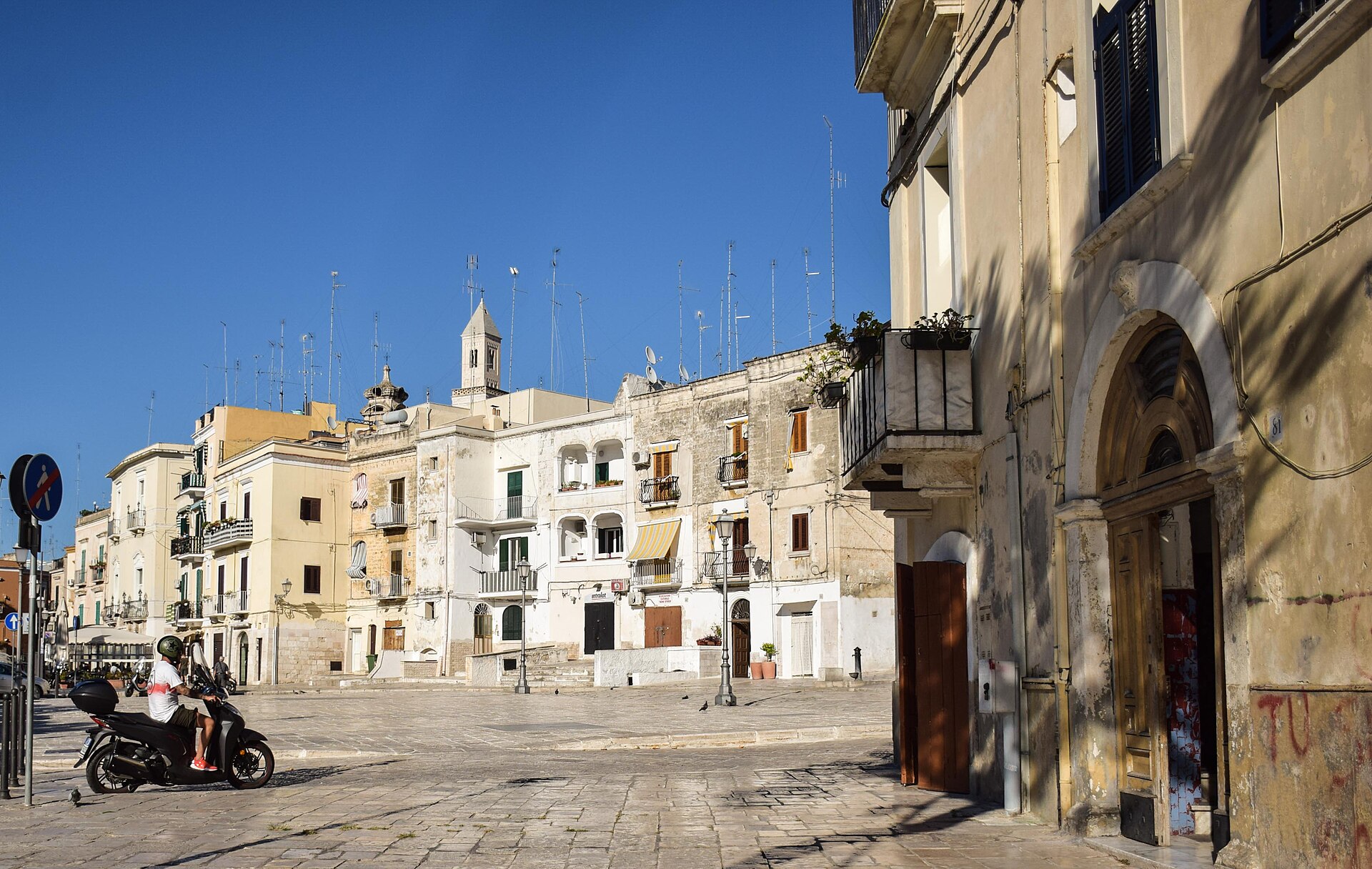
If you do one thing in this city, you wander Bari Vecchia with no plan. The old town is a peninsula jutting into the Adriatic, a knot of limestone lanes that the orderly new-town grid throws into sharp relief the moment you cross into it. Getting briefly lost is the entire activity. You will always pop back out at a familiar piazza or the sea.
Here is how I’d order the things to do in Bari that actually sit inside the old town, so you are not zig-zagging.
Strada Arco Basso: the orecchiette women, and how to behave
This is the one. Strada Arco Basso — known to everyone as the orecchiette street, or Strada delle Orecchiette — is a short lane in the heart of the old town where the women who live there set up tables outside their front doors and shape fresh orecchiette (“little ears”) by hand. They have done it for generations. One of them, Nunzia Caputo, has become quietly famous; you will see her stall and others nearby.
The pasta-making is liveliest in the morning, roughly 10am to noon, when the women are actively rolling and dragging the dough into shape rather than just selling trays of it. They work most days, including Sundays, when local families come to buy pasta for lunch.
Now, etiquette, because this matters and the guides rarely say it plainly. This is not a museum exhibit; it is people’s livelihood and front step. So: ask before you photograph faces, and accept a “no” gracefully. Do not film someone’s hands for ten minutes and then walk off without a word. If you want a photo, the warm move is to actually buy a bag of pasta — it is cheap, it travels (fresh orecchiette keep a few days refrigerated, or freeze them), and it turns a transaction into a small human exchange. Bring a little cash. A smile and a “buongiorno” go a very long way here.
Basilica di San Nicola and the Orthodox pilgrims
The spiritual anchor of the old town is the Basilica di San Nicola, an austere, fortress-like Romanesque church built from 1087 onward to house something extraordinary: the relics of Saint Nicholas of Myra — yes, the historical figure behind Father Christmas.
The story is wonderfully piratical. In 1087, Barese sailors essentially stole the saint’s bones from Myra (in present-day Turkey) and brought them home, and the city built this basilica around them. The relics rest in the crypt downstairs, and to this day they are said to exude a clear liquid called the Manna di San Nicola, collected once a year and sold in small vials in the adjoining shop (around €15 when I last looked).
Here is what makes San Nicola unlike any other church in Italy: Saint Nicholas is venerated by both Catholics and the Orthodox world, and Bari is one of the great Orthodox pilgrimage destinations in the West. The crypt has an Orthodox altar, and on any given day you may share it with pilgrims from Greece, Russia, Ukraine, Romania, and beyond, lighting candles and chanting. Standing in that low, candlelit crypt while two liturgical traditions overlap is one of the most quietly moving things you can do in Puglia. Entry to the basilica is free; the small Museo Nicolaiano next door, with its treasury and history, charges a modest fee (around €8, as of 2026).
San Sabino Cathedral and the layers beneath
A few minutes’ walk away stands the Cattedrale di San Sabino, Bari’s actual cathedral, often overshadowed by its flashier neighbour but worth your time. Built in Puglian Romanesque style, it has a serene white interior, a fine rose window, and a tall bell tower.
The real surprise is underground: an archaeological crypt where you can see layers of earlier churches and Roman-era mosaics stacked beneath the present floor, a literal cross-section of the city’s history. It is the kind of detail that page-one guides skip, and it takes twenty minutes.
Castello Svevo
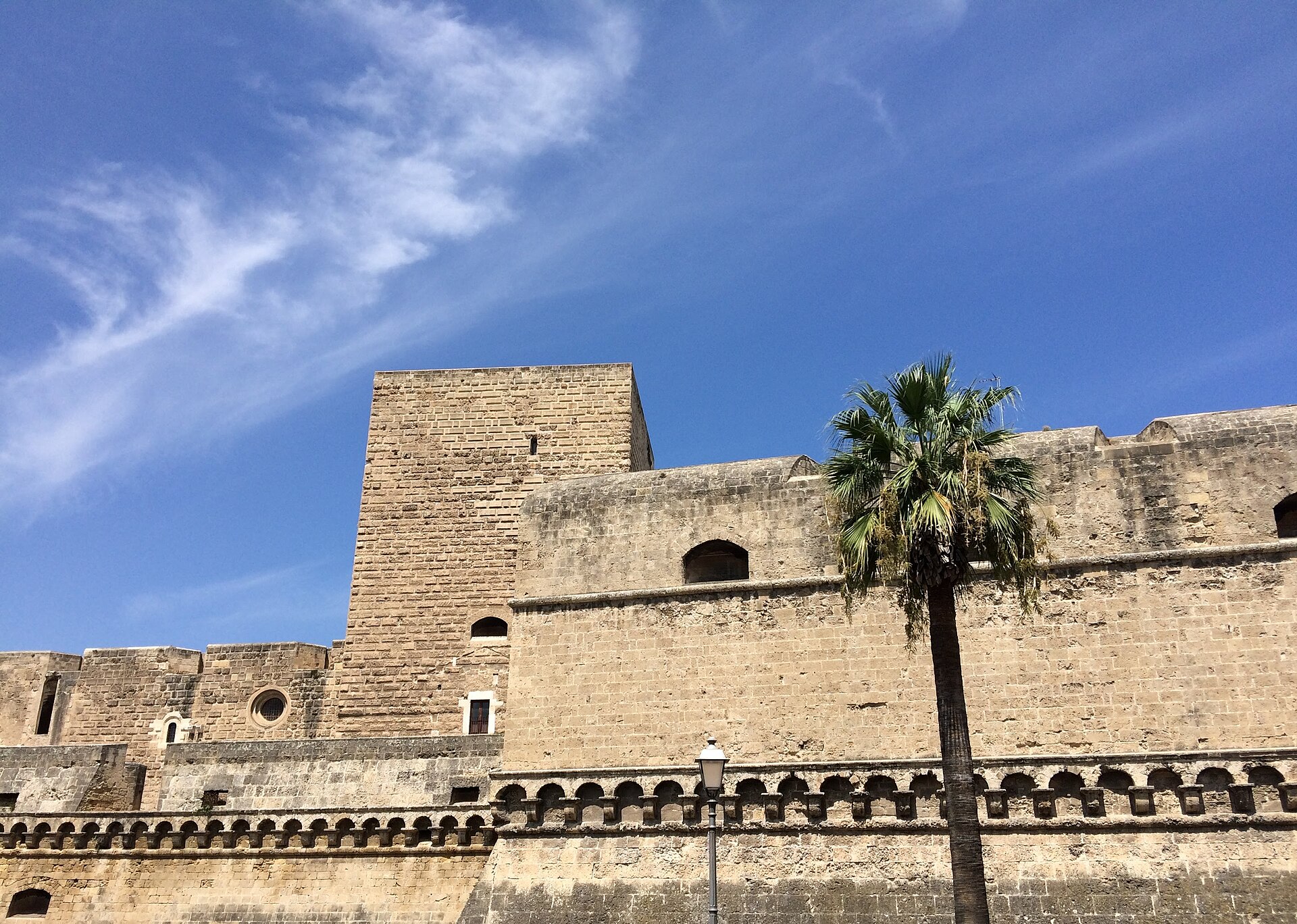
On the edge of the old town sits the Castello Svevo (Swabian Castle), a hulking Norman-Hohenstaufen fortress rebuilt by Emperor Frederick II in the 13th century. Over the centuries it has been a stronghold, a barracks, and a prison; today it hosts exhibitions and you can walk its walls and courtyards. Entry runs around €10 depending on what is showing. Even if you skip going in, the moat and the great square towers anchor the western end of any old-town walk.
The fish market, the port, and the lungomare
Walk to the tip of the old-town peninsula in the morning and you reach the working waterfront. Near Molo San Nicola and the old harbour (Porto Vecchio), Bari’s fishermen bring in the catch and sell it straight off the boats and stalls. This is where you will see locals eating raw sea urchins, mussels, and “allievi” (baby octopus) on the spot — a serious, briny tradition that is not for the squeamish but is utterly Bari.
In the late afternoon, do as the city does and walk the Lungomare Nazario Sauro, the grand seafront promenade that curves along the Adriatic south of the old town. It is one of the longest urban seafronts in Italy, lined with stately Fascist-era buildings, and at golden hour the whole city comes out to stroll, jog, and lean on the railings watching the water. It costs nothing and tells you more about Bari’s daily rhythm than any monument.
A practical note for old-town orientation: the seaward, left-hand side of the peninsula mainly overlooks the modern ferry port and is less scenic, while the lanes facing the old harbour and the promenade are where the magic is. Aim inland and toward the lungomare.
The new town: Via Sparano, Teatro Petruzzelli, and the café life
Cross back into the Murat district and Bari changes character entirely — wide grid streets, elegant facades, and the city’s shopping and café life.
The spine is Via Sparano da Bari, a pedestrianised boulevard of paving stones that runs from near Bari Centrale toward the old town, lined with Italian and international shops, boutiques, and pastry bars. It is where Bari does its passeggiata in the evening. Even if you are not shopping, it is the most pleasant walk between the station and the historic centre.
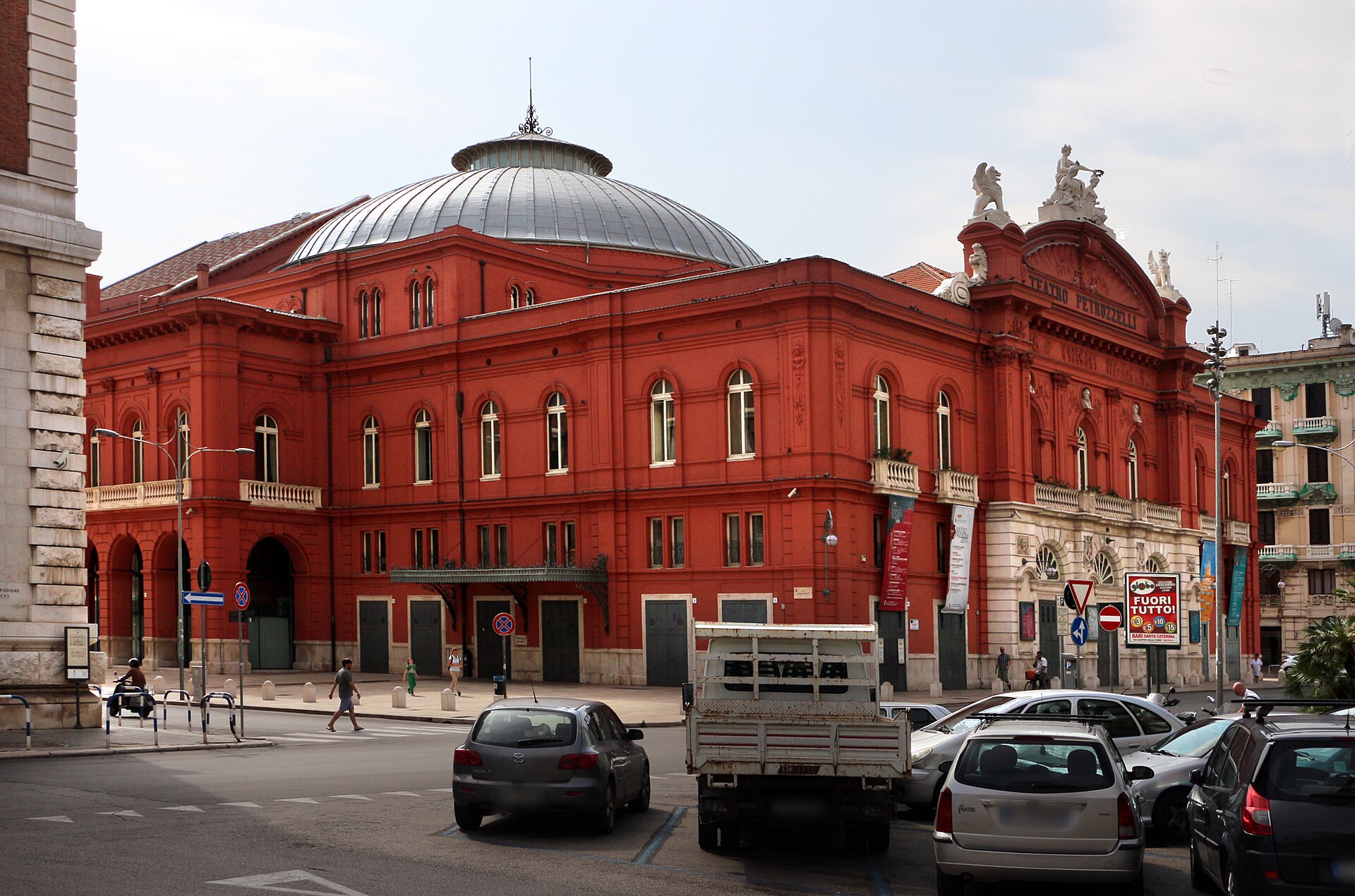
A block off it stands the Teatro Petruzzelli, Italy’s fourth-largest opera house and the pride of the city. It burned down in a notorious 1991 arson and was painstakingly rebuilt and reopened in 2009; today it stages opera, ballet, and concerts under a magnificent restored dome. If your dates line up with a performance, going is a treat; if not, the grand red-and-white exterior on Corso Cavour is worth a look. Nearby, the elegant Teatro Margherita — built out over the water on piles — now serves as a contemporary art space.
What to eat in Bari
Puglia is one of Italy’s great food regions, and Bari is its blunt, generous capital. Eat your way through this list and you will understand the place.
- Orecchiette alle cime di rapa — the signature dish, those little hand-rolled ears tossed with turnip tops, garlic, anchovy, and chilli. Order it once and you will order it again.
- Orecchiette al ragù / “the murderous pasta” — the old Barese Sunday plate. The local nickname for a fiery, slow-cooked horsemeat-and-tomato ragù earned its dramatic reputation from the long, spitting cook; these days it is rich rather than violent, and you will find tamer beef versions too.
- Focaccia barese — thick, oily, dimpled focaccia topped with cherry tomatoes and olives, baked in the same ovens as the bread. Eat it warm, standing up, from a forno. It is the city’s true street food.
- Panzerotti — fried (or baked) dough pockets, classically filled with tomato and mozzarella, hissing hot from the fryer.
- Sgagliozze — squares of deep-fried polenta, sold from old-town doorways as a snack. Cheap, golden, and addictive.
- Raw seafood — at the harbour and in fish restaurants: urchins, mussels, oysters, and tartare. For the adventurous, this is Bari at its most elemental.
Sit-down warning that is true across the country: most cafés and trattorie add a small coperto (cover charge, often around €1–2 per person) when you sit and order, separate from a tip. It is normal and not a scam. If you want the food culture in a national frame — what to drink with all this, where Puglia’s wines sit — the Italy food and wine guide goes deeper than I can here.
Bari as a base: the port and the day trips
Two things make Bari a brilliant base rather than just a stop.
First, the port. Bari is one of the Adriatic’s major ferry hubs, with overnight and daytime sailings to Greece (Igoumenitsa, Patras, and the island of Corfu), Albania (Durrës), Croatia (Dubrovnik and Split), and Montenegro (Bar). Crossing times range from around 8 hours to Durrës or Dubrovnik up to roughly 16 hours on the long Patras run, and ferries run year-round with more frequency in summer; check current schedules with the ferry operators, as timetables and fares shift seasonally (figures here as of 2026). The terminal is northwest of the old town; give yourself buffer time, because port check-in for vehicles and cabins closes well before departure. If a Greek-island add-on tempts you, it is genuinely doable from here.
Second, the rail connections. Bari Centrale puts a lot of Puglia within easy reach, which is why I treat the city as a launchpad. A quick rundown, with the deeper guides where they belong:
- Polignano a Mare — the cliff-and-cove town, about 25–35 minutes south by train. It deserves its own visit; see the dedicated Polignano a Mare guide rather than rushing it.
- Matera — the ancient cave city, reachable by the Ferrovie Appulo Lucane line in roughly 1.5 hours; the full Matera travel guide covers timing and the sassi properly.
- Alberobello — the trulli town, via the Ferrovie del Sud Est regional line.
- Lecce — baroque “Florence of the South,” about 1.5 hours by fast train; the Lecce travel guide makes the case for a night there too.
For the coastline specifically — and there is a lot of it within reach — the best beaches in Puglia roundup is the one to open, and for the full menu of regional excursions, our pick of the highlights in Puglia lays them all out. I would not try to do these as breathless half-day dashes from Bari; pick two or three and give them room.
How many days do you need in Bari?
Here is my honest scaling, the way I actually plan it by nights.
One full day is enough to see Bari: a morning in the old town for the orecchiette women, San Nicola, San Sabino, and the castle; lunch of focaccia and panzerotti; an afternoon along Via Sparano; and the lungomare at sunset. You will leave satisfied.
Two nights is where I land for most people, and what I’d recommend. It lets the city breathe — one day for the old town and food, a second to slow down, do the fish market at dawn, and not feel rushed. An evening at Teatro Petruzzelli, if the calendar cooperates, slots in beautifully.
Three or more nights makes sense only if you are using Bari as a base for day trips by train and ferry, which is a completely valid way to do Puglia. In that case the city becomes your comfortable, well-connected home with the suitcases parked, and you radiate out.
What I would not do is the classic mistake — landing, dumping bags, and giving the city ninety minutes before fleeing to a white town. Bari is better than its reputation as a transit point, and the only way to learn that is to sleep here at least once.
Where to stay in Bari
Two honest options, depending on what you want.
Stay in the Murat (new town) if you value comfort, easy luggage access, and walkability. It is steps from Bari Centrale and Via Sparano, the streets are flat and wide, and you can roll a suitcase without bouncing it down medieval steps. This is what I’d pick for a first visit or for using the city as a base — the practical choice.
Stay in Bari Vecchia (old town) if you want to wake up inside the atmosphere, hear the church bells, and step straight into the lanes. Rooms here have real character, though access can mean stairs and the morning soundscape is, let’s say, vivid. For weighing these against the rest of the region, the where to stay in Puglia guide is the regional companion, and the broader where to stay in Italy page frames how southern cities compare on price and style. Expect a small per-person city tax (around €2–2.50 per night) added to most stays.
When to come, and what it costs
The sweet spots are April to June and September to October: warm, walkable, and far calmer than the July–August peak, when the heat sits heavy and the coast fills up. Summer is when the ferries and beaches are busiest; winter is quiet, atmospheric, and cheap, though some seaside life shutters. For the national picture of shoulder seasons and festivals, see choosing the right season for Italy.
On money, Bari is one of the better-value cities in Italy. A plate of orecchiette, a stand-up focaccia, the cheap airport train, free entry to San Nicola, modest museum fees — it adds up gently. If you are budgeting the wider trip, the Italy travel budget guide shows just how far the south stretches your euro compared with Rome or Venice, and the Italy itineraries hub helps you slot Bari into a longer national route.
Final thoughts
Bari is the city most people underestimate and then, having actually stopped, defend loudly to anyone who will listen. It is not trying to charm you, which is exactly why it does. Sleep here at least one night. Buy the pasta from the woman who made it. Stand in the candlelit crypt of San Nicola while Orthodox pilgrims chant a few feet away, walk the lungomare at golden hour, and eat focaccia warm from the oven on a street corner. Then point yourself at the rest of Puglia — the Puglia itinerary is waiting — knowing you started in the south’s most honest city.
Questions travellers ask
Is Bari worth visiting?
Yes, if you want a real, lived-in southern Italian city rather than a manicured postcard. Bari trades prettiness for texture: an atmospheric old town, working fishermen, pasta-making grandmothers, and the relics of Saint Nicholas. Give it a full day and a night and it rewards you. Treat it only as an airport, and you will miss the point entirely.
How many days do you need in Bari?
One full day is enough to see the highlights — the old town, San Nicola, the castle, Via Sparano, and the seafront at sunset. Two nights is the sweet spot for most travellers, letting the city breathe. Stay three or more only if you are using Bari as a well-connected base for train and ferry day trips around Puglia.
Is Bari old town safe?
Yes. Bari Vecchia had a rough reputation in the 1980s and early 1990s, but that era is long over. Today the old town is a normal, safe Italian quarter, lively into the night with families and diners filling the piazzas. Apply ordinary city sense — mind your pockets in crowds, nothing visible in cars — and you will be fine.
What is Bari famous for?
Bari is famous as the capital of Puglia, for the Basilica di San Nicola holding the relics of Saint Nicholas (Father Christmas) and drawing Orthodox pilgrims, and for the orecchiette women who hand-roll pasta in the streets of the old town. It is also a major Adriatic ferry port and the regional gateway to Polignano, Matera, and the white towns.
How do I get from Bari airport to the city centre?
Take the Ferrotramviaria train, which runs directly from the airport to Bari Centrale in around 17–20 minutes for roughly €5 one way, as of 2026. Trains run through the day. A city bus offers a similar cheap option, and taxis run a fixed-ish fare into town if you land late or have heavy luggage.
What should I eat in Bari?
Start with orecchiette alle cime di rapa, the hand-rolled local pasta with turnip tops. Then focaccia barese (thick, tomato-topped, eaten warm), panzerotti (fried dough pockets), and sgagliozze (fried polenta squares) from old-town doorways. At the harbour, the brave eat raw sea urchins and mussels straight off the boats.
Can I take a ferry from Bari to Greece, Croatia, or Albania?
Yes. Bari is one of the Adriatic’s main ferry hubs, with year-round sailings to Greece (Igoumenitsa, Patras, Corfu), Albania (Durrës), Croatia (Dubrovnik, Split), and Montenegro (Bar). Crossings range from around 8 hours to roughly 16 on the longest routes. Always check current schedules and fares with the operators, as they shift seasonally, and arrive early for check-in.
Is one day enough for Bari, or should I day-trip from here?
One day covers the city itself comfortably. But Bari’s rail and ferry links make it an excellent base, so if you have the nights, stay put and day-trip out to Polignano a Mare, Matera, Alberobello, and Lecce by train. That beats moving hotels every night and lets you keep your suitcases parked in one well-connected place.