Polignano a Mare and Monopoli Guide
Two towns, eight kilometers apart, and most people only photograph one of them. That is the mistake I want to talk you out of.
Polignano a Mare is the cliff-top old town with the famous cove beach and the Instagram crowds; Monopoli, a few minutes down the coast, is a working fishing port with a quieter old town and better swimming. See them together. Polignano gives you the postcard, Monopoli gives you the evening. A day does both; two nights does them justice.
This guide is for anyone basing themselves on the Adriatic coast of Puglia, or running a day trip down from Bari, who wants the photo without spending the whole visit shuffling through a gift-shop alley. I have done this stretch on a tight day-trip clock and at a slow two-night pace, and I will tell you which one I’d choose.
Polignano vs Monopoli: which is which
Here is the short version before we get into the weeds. These are sibling towns, not rivals, but they feel genuinely different and you should set your expectations accordingly.
| Polignano a Mare | Monopoli | |
|---|---|---|
| Vibe | Cliff-edge old town, dramatic, very photogenic | Working port town, lived-in, relaxed |
| The famous thing | Lama Monachile cove beach below the cliffs | Old harbour full of blue fishing boats |
| Beaches | One iconic cove (tiny), sea caves by boat | A city beach plus real sand south at Capitolo |
| Crowds | Heavy, especially midday in summer | Noticeably calmer, busier on Sundays |
| Time needed | 2 to 4 hours to see the core | Half a day, or a few nights as a base |
| Eating | Touristy in the centre, a couple of standouts | Quietly excellent, better value |
| Best for | The view, the boat tour, a quick hit | Staying over, swimming, slowing down |
If you only have a window, Polignano wins on spectacle and Monopoli wins on everything you do once the camera is away. The good news is you do not have to choose. They are close enough that the whole question dissolves.
For where these two sit in the wider region, my Puglia travel guide lays out the geography, and the Puglia itinerary shows how the coast threads together with the trulli towns inland. If you want the full beach picture beyond these two, that lives in the best beaches in Puglia guide so I can keep the cataloguing here light.
Why Polignano a Mare is worth the hype (and where it isn’t)
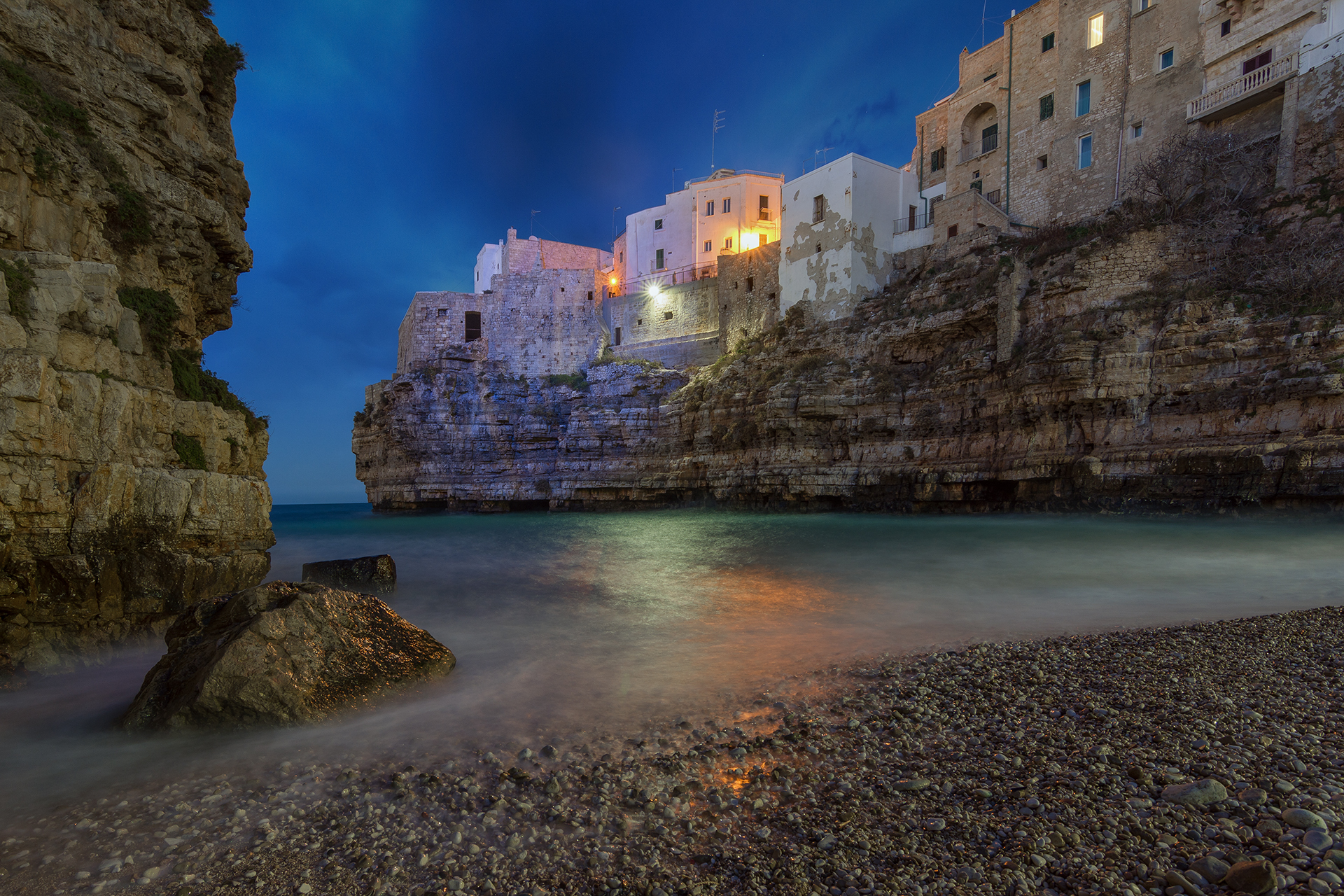
Let me be honest about what you are walking into. Polignano a Mare is built on a limestone shelf about 20 meters above the Adriatic, and the old town genuinely hangs off the cliff edge. The view down to the water is as good as the photos, sometimes better, because no photo captures how loud the sea is when it slaps into the rock below the terraces. That part earns every bit of its reputation.
What the photos hide is the volume of people. The centro storico is small, the alleys are narrow, and by late morning in summer they fill with day-trippers funneling between the same three viewpoints and the same souvenir shops. The town leans hard into being looked at. There are murals of Domenico Modugno everywhere, hand-painted poetry on the steps, and shops selling the same magnets. None of it is bad. It is just busy, and if you arrive at noon in August expecting a sleepy fishing village, you will be disappointed in a way that is entirely avoidable.
The fix is timing, and it is the single most useful thing in this guide. Get there early. Before 10 or 11 in the morning the old town is calm, the light on the white stone is soft, and you can actually stand at the railings without queueing for the angle. I would rather see Polignano at 8:30 am with a coffee than at 2 pm with a crowd, every single time.
The viewpoints that matter
You will end up at most of these without trying, because the old town is tiny and it funnels you toward the sea. Hit these:
- Belvedere su Lama Monachile — the classic shot down onto the cove beach with cliffs on both sides. This is the image you have seen. It is inside the old town and it gets crowded; go early.
- Ponte Borbonico (Ponte Lama Monachile) — the old bridge on the approach to town gives you the wide, postcard composition of the cove. You more or less walk over it on the way in.
- Belvedere Terrazza Santo Stefano — at the northern tip of the old town, looking out along the cliff line and the open sea.
- Lungomare Domenico Modugno — the seafront promenade outside the old town, and home to the statue of Modugno himself, arms thrown open. He was born here, wrote “Nel blu dipinto di blu” — the song the rest of the world calls “Volare” — and the town has never let you forget it.
Wander the alleys between the viewpoints rather than rushing point to point. You will pass through the Arco Marchesale, the medieval gate into the old town, and most likely wash up in Piazza Vittorio Emanuele II, the main square, where the clock tower and the mother church sit. Pop into the Chiesa Matrice di Santa Maria Assunta if it is open; it is not the grandest church in Puglia, but it is two minutes and it is free.
Can you swim at Polignano a Mare? The Lama Monachile reality
Yes, and the beach is called Lama Monachile, also signed as Cala Porto. It is the pebble cove wedged into the cliffs right below the old town. You reach it down a ramp and stairs near the Ponte Borbonico, and the water is the ridiculous clear blue you came for.
Now the catch. It is tiny. This is not a beach you spread out on for the day; it is a pocket of shingle that fills up fast and, in July and August, becomes genuinely shoulder-to-shoulder by mid-morning. People stake out spots early and hold them. There is no sand to speak of, so bring water shoes if your feet are tender on pebbles. And because of how the cliffs sit, the cove falls into shade by mid-afternoon — so if you want sun on the water, go in the morning, which also happens to be when it is least crowded. Two birds.
If Lama Monachile is mobbed, you have two good moves. One, walk the rocks along the lungomare and find a flat ledge to jump in from like the locals do — the swimming off the rocks here is excellent and far less crowded. Two, get on a boat (more on that below) and swim straight off it into the caves. For an actual lay-on-the-sand beach day, you want to point yourself south toward Monopoli’s Capitolo coast, which I cover further down, or open the best beaches in Puglia guide for the wider list.
The cliff divers, and the Red Bull event
Those cliffs are not just for looking at. Locals leap off them all summer at various heights, and there are a few recognised entry points around the old town if you have the nerve and good judgment about the water depth and conditions. It is not for the faint-hearted and it is not regulated, so use your head.
Once a year the professionals take over. The Red Bull Cliff Diving World Series has stopped in Polignano a Mare almost every year since 2009, with athletes launching off a platform built onto the old town and twisting 27 meters down into the cove. As of 2026 the Italian round is set for late September — around September 25 to 27 — and the town is rammed for it. If you want to witness it, plan well ahead and expect crowds and booked-out rooms; if you want a quiet Polignano, avoid that exact weekend. Always confirm the current dates on Red Bull’s own event page before you build a trip around it, because the calendar shifts year to year.
Boat tours to the sea caves
This is the thing I would not skip. The coast under and around Polignano is riddled with sea caves — the local count thrown around is 40-something — and the only way to really see them, including the famous arches and the grottoes the cliffs hide, is from the water. Seeing the town from below, with the houses stacked on the cliff and the sea glowing turquoise inside the caves, reframes the whole place.
How it works in practice:
- Where they leave from. Boats run from Polignano’s small harbour and also from Monopoli’s port, so you can do the cave tour from either town. Doing it from Monopoli is a nice way to combine a boat trip with the calmer base.
- How long. Most tours run roughly 1.5 to 2 hours. Longer private charters and sunset trips exist.
- What you get. The caves and arches, swim stops where you jump straight off the boat into the clear water, and on many tours an aperitivo or some snacks and drinks. The swim stop is the highlight; bring a swimsuit and a towel.
- Cost. Prices move with season and operator, but as of 2026 a shared group tour tends to land somewhere in the region of 20 to 35 euros per person, with private boats costing considerably more. Treat that as a ballpark, not a quote — check the operator directly.
- Booking. In peak summer, book ahead, ideally a day or two out. In shoulder season you can often just turn up at the harbour and find a skipper. Small group trips fill fastest.
If you are weighing how to spend a limited budget across the whole region, the boat tour is one of the better-value experiences in Puglia in my view; for the bigger money picture see the Italy travel budget guide.
Grotta Palazzese: the cave restaurant, honestly
You have probably seen it — a restaurant set inside a sea cave in the cliff, tables under a stone roof open to the Adriatic. It is Grotta Palazzese, attached to the hotel of the same name, and it is the most photographed dining room in Puglia.
Here is my candid take. The setting is genuinely spectacular. The reputation for the food and the value is not. It is extremely expensive — we are talking a serious set-menu price per person before drinks — and recent diner reports have been decidedly mixed, with a fair number of people coming away feeling the experience did not match the cost. I am not going to tell you never to go; if a once-in-a-lifetime cave dinner is the entire point of your trip and the price does not faze you, go in with eyes open and book far ahead.
But you can have the view without the bill. Walk to the Belvedere su Grotta Palazzese or the nearby clifftop lookout and you can peer down at the cave terrace, photograph it, and then go eat somewhere that will treat you better for a quarter of the money. That is what I would do, and have done.
For actually eating well in Polignano, skip the obvious tourist traps on the main square. Pescaria does the famous octopus-and-cheese sandwiches (expect a line, go early). There are good seafood trattorias on the seafront and a Michelin-Guide level spot or two tucked in the old town if you want to splurge sensibly rather than on the cave. Puglia’s food is a whole subject of its own — the Italy food and wine guide goes deeper on what to order down here.
Monopoli Puglia: the town people drive past
Now the town I would actually stay in. Monopoli Puglia is bigger than Polignano — around 49,000 people — but its old town is compact and, crucially, it feels like a place where people live rather than a place built to be visited. That difference is everything.
The heart of it is the Porto Antico, the old harbour, lined with little wooden fishing boats in blue and white against the backdrop of the whitewashed old town. Buy a gelato, walk down to the harbour wall, sit, and watch the boats. It is one of those small, perfect Italian half-hours that costs nothing and that you will remember longer than half the monuments you queue for elsewhere.
Beyond the port, work through these:
- Cattedrale Maria Santissima della Madia — Monopoli’s cathedral, begun in the 12th century and rebuilt Baroque in the 1700s. The marble interior is worth stepping inside for; entry is free. There is a good local legend attached, about a boat that washed ashore carrying a Madonna icon and the timber that finished the cathedral roof.
- Castello Carlo V — the 16th-century fortress jutting into the sea at the edge of the old town, built under Charles V of Spain. You can admire it from outside for free; parts open for exhibitions at certain hours.
- The old town alleys — narrow streets of white stone with green shutters, small piazzas, churches tucked into corners (including some very old ones), and far fewer souvenir shops than Polignano. This is where you wander with no plan.
- Cala Porta Vecchia — the little city beach right under the old town walls. Small, part sand and part rock, and an easy dip if you just want to get in the water without leaving town.
Monopoli is also a smart base for the wider region. It is on the train line, it has real restaurants at fair prices, and it is within easy reach of the trulli of Alberobello, the Valle d’Itria hill towns, and even Matera. If you are deciding where to put your bags for the coast, weigh it against the options in our Puglia neighbourhood guide, and there is a wider view in where to stay in Italy.
Monopoli’s real beaches: Capitolo, Porto Bianco, Porto Rosso
Cala Porta Vecchia in the old town is fine for a quick dip, but Monopoli’s proper beaches are south of town along the Capitolo coast. This is where you find the stretches of sand, the beach clubs (lidi), and coves like Porto Bianco and Porto Rosso. In season the lidi rent sunbeds and umbrellas and run drinks service; there are free public stretches too if you would rather not pay. Beach-club season generally runs late May to late September.
This is the answer to “where do I actually lie on a beach near Polignano,” because Polignano itself does not really have one. If beaches are the main event of your trip, I will hand you over to the best beaches in Puglia guide rather than list every cove here, since that is its job and this is meant to keep your two-town plan tight.
Polignano Monopoli itinerary: how to combine them
Here is the practical core of a Polignano Monopoli itinerary, in the two shapes most people need it.
One day, doing both
This is very doable because the towns are minutes apart. My order of operations:
- Start in Polignano, early. Aim to be in the old town by 9 am, 8:30 if you can manage it. Do the viewpoints and the alleys while they are quiet, grab a coffee and a cornetto, walk the lungomare to the Modugno statue, and look down at Lama Monachile before the cove fills up.
- Get on the water (optional but great). A late-morning boat tour to the caves, if you booked one, slots in here. Otherwise swim off the rocks before the heat peaks.
- Move to Monopoli for the afternoon. Five minutes by train, or about 15 by car. Now you have escaped the worst of the Polignano crowds.
- Slow down in Monopoli. Wander the old town, see the cathedral and the castle from the harbour, get a gelato by the Porto Antico, and dip at Cala Porta Vecchia or drive out to Capitolo for a real beach hour.
- Stay for dinner and sunset in Monopoli. It is calmer, the food is better value, and an aperitivo by the water is the right way to end the day.
Doing it in this direction — Polignano first, Monopoli second — matters. You want Polignano at its quietest (morning) and you want Monopoli for the relaxed evening it does so well. Reverse it and you will hit Polignano at peak crowd.
Two nights, properly
Base in Monopoli. Day one, settle in, do the Monopoli old town and a beach afternoon at Capitolo. Day two, take the short train or drive to Polignano for the morning, do the caves by boat, come back to Monopoli for the evening. With a third day you would add Alberobello and the Valle d’Itria, or a run up to Bari — see the full Puglia itinerary for how to extend, and the best things to do in Puglia for filling the gaps. Matera and Bari are both easy add-ons from this stretch; I cover them in the Matera travel guide and Bari travel guide.
Getting there: trains from Bari, and whether to drive
You have two realistic ways into these towns, and for once the public-transport option is genuinely the easy one.
By train from Bari (the easy way)
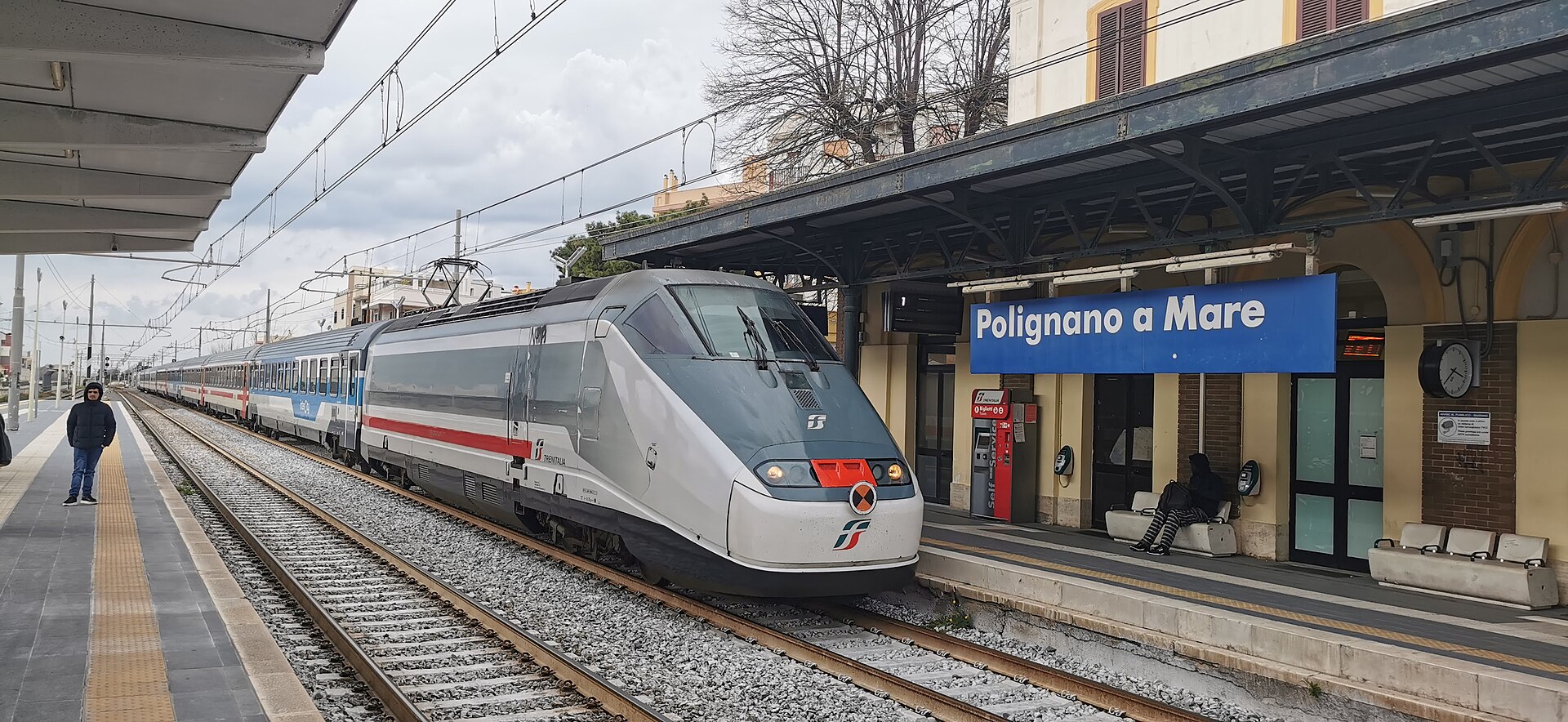
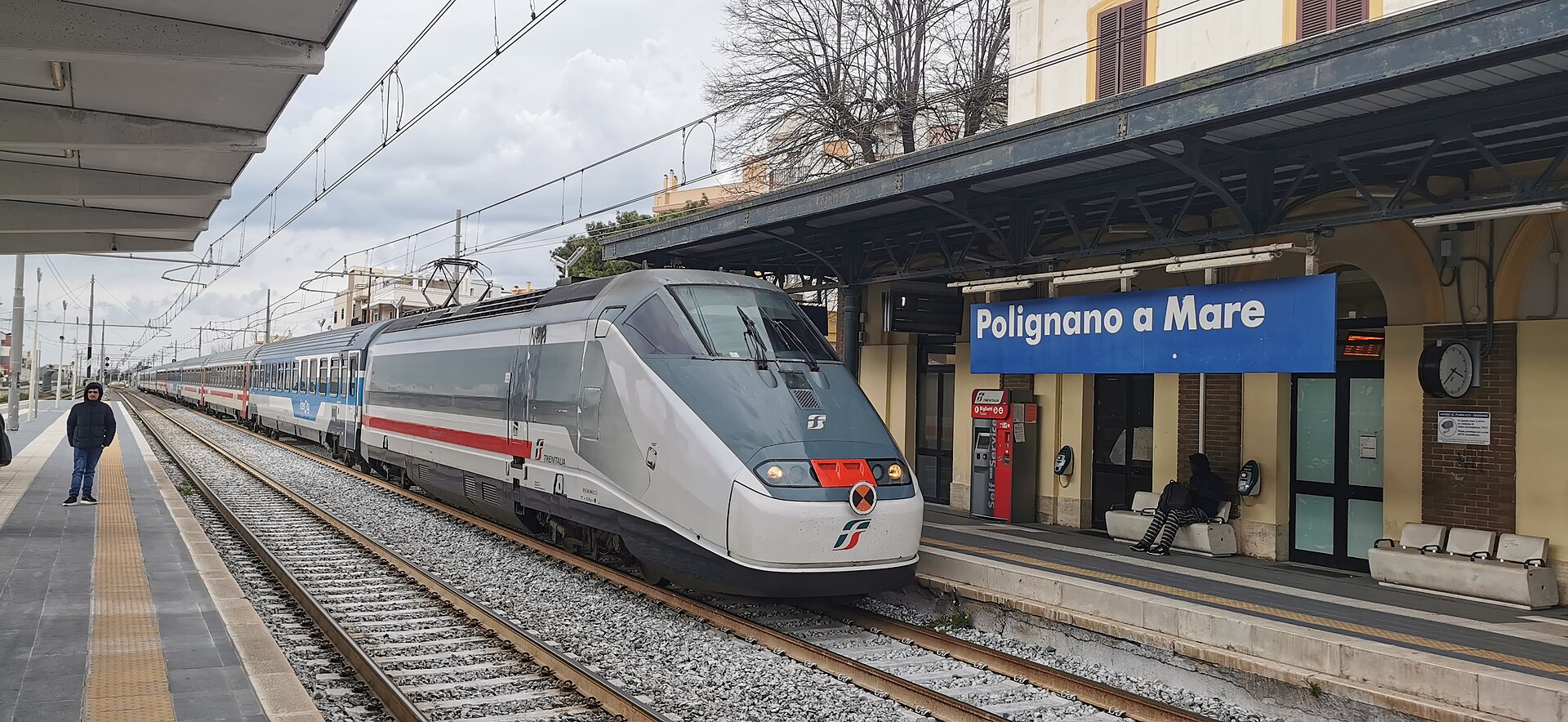
Both towns sit on the main Adriatic rail line, served by Trenitalia regional (Regionale) trains, and the stations are an easy walk from the old towns. This is the route I recommend for a day trip, because it sidesteps the parking headache entirely.
- Bari Centrale to Polignano a Mare: around 20 minutes on average, with the fastest services around 13 to 16 minutes. Trains run frequently through the day — on the order of two dozen-plus departures — so you are rarely waiting long. Fares are cheap: a regional ticket is roughly in the 3 to 5 euro range one-way as of 2026.
- Bari to Monopoli: about 25 minutes by regional train.
- Polignano to Monopoli: the short hop between the two towns is only about 5 minutes by train. This is what makes combining them so painless.
A few practical notes. Buy regional tickets at the station machines or the Trenitalia app, and validate paper tickets before boarding if your ticket type requires it. Treat all the times and fares above as “around” and as of 2026 — Trenitalia adjusts schedules seasonally, so check the official Trenitalia site or app for your travel date. The stations in both towns are in the newer parts of town; from Polignano’s station it is a short, flat walk to the old town, and from Monopoli’s it is roughly a 10-to-12-minute walk to the old town entrance.
If trains are your main way around the region, the Italy transportation guide covers how the regional network and ticketing actually work, including validation and the difference between regional and high-speed services.
By car (and the ZTL trap)
If you are already road-tripping Puglia — and many people do, because the inland trulli towns are poorly served by rail — driving here is straightforward, with one catch you must respect. Both old towns are ZTL (zona a traffico limitato), meaning the historic centres are closed to non-resident cars and monitored by cameras. Drive into one by accident and you earn a fine in the post weeks later. So do not.
Instead, park at the edge and walk in. In Polignano, the paid lots outside the old town work well — I have used the Parcheggio San Francesco e Sant’Oronzo, under a 10-minute walk to the centro storico. In Monopoli there are paid lots and street parking around the edge of the old town; in shoulder season you can usually find a spot near Piazza Vittorio Emanuele II without much drama, but in peak summer arrive early. Bari airport to Polignano is about a 40-minute drive.
My honest steer: for a day trip from Bari, take the train and skip the parking entirely. For a multi-day Puglia road trip that includes the inland towns, have the car, but park outside the centres and never trust your sat-nav to keep you out of the ZTL — it won’t. There is more on renting and driving down here in the Italy transportation guide and general road sense in the practical stuff nobody tells you about Italy.
When to go
Like most of coastal Puglia, the calendar splits cleanly. July and August are hot, expensive, and crowded — the cove and the old town alleys hit their busiest, and rooms cost the most. April to June and September to October are the shoulder seasons, and they are when I would come: warm enough to swim by late spring and into early autumn, the sea still pleasant, the crowds thinner, and the towns still fully alive. Winter is quiet to the point of sleepy — many old-town restaurants and beach clubs close, and the beach is off the table — though the new parts of Monopoli stay open year-round and a moody off-season Polignano has its own appeal if you only want the views.
One local-calendar note: Monopoli’s big festival, the Feast of the Madonna della Madia, falls on August 15 and again on December 16, with processions down at the old port. And as covered above, the Red Bull cliff-diving weekend in late September packs Polignano out. For the broader month-by-month picture across Italy, the best time to visit Italy guide breaks down the seasons, and these two towns slot naturally into the wider southern-coast circuit in the Italy itinerary library collection.
For first-time visitors building a whole-country trip, both towns fit comfortably into the southern leg laid out in the Italy travel guide.
Final thoughts
The trap with this stretch of coast is treating Polignano a Mare as a single photo to be collected and moved past. Do that and you will fight the crowd for the same railing as everyone else and leave wondering what the fuss was. Flip it instead: take Polignano in the early light, get out on the water to see the caves, and then let Monopoli give you the slow afternoon and the good dinner. Two towns, one easy train hop, and a day that feels twice as full as the one most visitors have. That is the whole trick, and it is not a hard one.
Questions travellers ask
Is Polignano a Mare worth visiting?
Yes, with one condition: go early. The cliff-top old town and the cove view live up to the photos, and the sea-cave boat tour is genuinely special. The catch is midday summer crowds in a very small centre. Arrive before late morning, pair it with calmer Monopoli, and it more than earns the trip.
How do you get from Bari to Polignano a Mare?
Take a Trenitalia regional train from Bari Centrale. It runs frequently, takes around 20 minutes (fastest services roughly 13 to 16), and costs only a few euros one-way as of 2026. The station is a short, flat walk from the old town. By car it is about 40 minutes from Bari airport, but you must park outside the ZTL.
Is Polignano or Monopoli better?
Different, not better. Polignano wins on drama — the cliffs, the cove, the photo. Monopoli wins on atmosphere, swimming, food value, and the fact that it feels lived-in rather than staged. For a quick visit, do Polignano. To stay over, base in Monopoli and day-trip to Polignano. Ideally you see both.
Can you swim at Polignano a Mare?
Yes. Lama Monachile (Cala Porto) is the pebble cove below the old town, with beautiful clear water, but it is tiny and packs out fast in summer, and it falls into shade by mid-afternoon. Go in the morning. Many people also swim off the flat rocks along the lungomare, or straight off a boat tour into the caves.
How much time do you need in Polignano a Mare and Monopoli?
You can see the core of both in a single day, since they are about 5 minutes apart by train. Give Polignano 2 to 4 hours (morning is best) and the rest of the day to Monopoli. To slow down, swim, and eat well, two nights based in Monopoli is the sweet spot.
Is the boat tour to the Polignano caves worth it?
In my view, yes — it is one of the better experiences on this coast. Tours run about 1.5 to 2 hours from Polignano or Monopoli, take you through the sea caves and arches, and include a swim stop, often with an aperitivo. Expect roughly 20 to 35 euros per person for a group trip as of 2026; book ahead in peak summer.
Should I eat at Grotta Palazzese?
Only with eyes open. The cave setting is stunning, but it is very expensive and recent reviews are mixed on whether the food and service justify the price. For most travelers I would view it from the clifftop lookout for free, photograph the cave, and spend the dinner money somewhere that delivers better value.
Do you need a car to visit Polignano a Mare and Monopoli?
No — both towns are on the Bari rail line and easy to reach by train, which is what I recommend for a day trip. A car only pays off if you are also visiting the inland trulli towns, which trains serve poorly. If you do drive, park outside the old-town ZTL zones in both towns to avoid fines.