Matera Travel Guide and How to Visit from Puglia
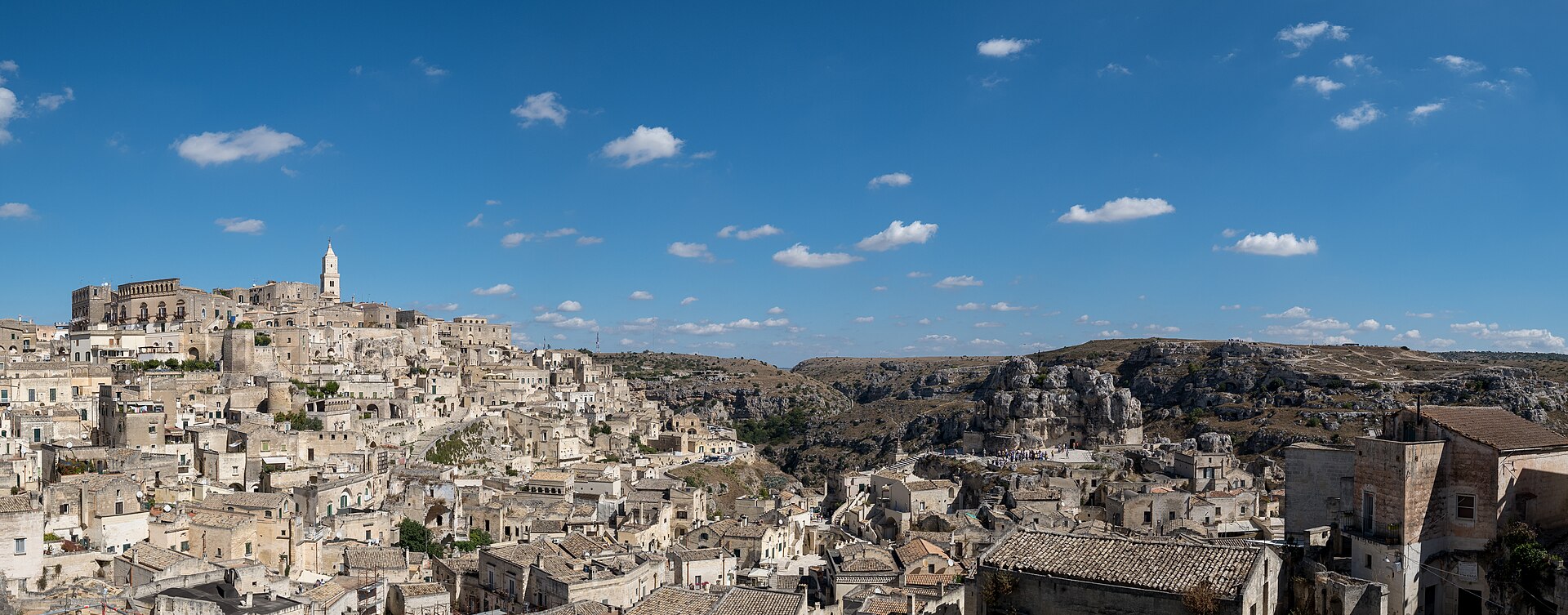
The first time I walked out onto a terrace above the Sassi, I forgot to say anything for a full minute. A whole city carved into a ravine, the color of bone and honey, stacked on itself for nine thousand years. That is the moment this Matera travel guide is built around, and the practical stuff that gets you there without wasting a day.
Short version: Matera is a cave city in Basilicata, about an hour from Bari, and it is absolutely worth the detour from Puglia. Go for the Sassi, the rupestrian cave churches, and the viewpoints. Drive if you can, take the FAL train if you can’t, and try to stay one night so you see it lit up.
This guide is for travelers already heading to Puglia who want to add Matera the smart way — and for anyone wondering if it earns a slot on a tight Italy itinerary. I have done it as a day trip and as an overnight, and I will tell you plainly which one I’d choose.
How to get from Bari to Matera: train, car, or tour
Here is the honest comparison. Matera is not in Puglia — it sits just over the regional border in Basilicata — but the gateway most people use is Bari, the Puglian capital. From Bari you have three realistic options.
| Option | Time (one way) | Rough cost | Best for |
|---|---|---|---|
| FAL train (Ferrovie Appulo Lucane) | ~1h15–1h45 | ~€5–6 each way | No car, weekday day trips, budget travelers |
| Drive / rental car | ~1h05–1h15 (~65 km) | Fuel + parking ~€10–15/day | Flexibility, Sundays, luggage, scenery |
| Organized day tour | ~Full day | ~€60–90 pp | Zero planning, a guide, no logistics |
A few things that page-one guides tend to gloss over, and that matter a lot in practice.
The FAL train is a separate railway. Ferrovie Appulo Lucane runs the narrow-gauge line from Bari to Matera, and the trains do not leave from the main Trenitalia hall. They depart from the FAL terminal on the western side of Piazza Aldo Moro, the palm-lined square right in front of Bari Centrale. Walk out of the main station, look slightly left, and you’ll find the FAL building. The ride takes roughly an hour and a quarter to an hour and three-quarters depending on the service, and it deposits you at Matera Centrale, which is a short, mostly downhill walk from the edge of the Sassi.
The Sunday problem is real. This is the single biggest “gotcha” of the Bari to Matera route, and most blogs skip it. On Sundays and public holidays the FAL rail line is typically replaced by a bus service — Ferrovie Appulo Lucane publishes a separate “holidays” timetable for exactly this. The buses run, but less often, and the journey can feel longer. If your only window for Matera is a Sunday and you don’t have a car, check the FAL holiday timetable carefully before you commit, or just take a tour that day instead.
Driving is genuinely easy. I expected the drive to be the stressful option and it was the opposite. It’s a straightforward hour or so on good roads, the Murgia landscape opens up as you approach, and — crucially — a car frees you from the train’s rigid spacing. The catch is the same as in any Italian hill town: you cannot drive into the Sassi. Leave the car in one of the monitored garages or lots on the upper, modern side of town (the area around Via Lucana and the Parcheggio Nicoletti is what I’ve used), then walk down. Many cave hotels can arrange parking or a luggage hand-off — ask when you book.
For the bigger picture on getting around the south, my Italy transportation guide covers regional trains, car rentals, and when each one makes sense.
Should you do Matera as a day trip from Puglia?
You can. Plenty of people do Matera as a day trip from Bari, and on a tight schedule it works — you’ll get the viewpoints, the main churches, a long lunch, and a real sense of the place in five or six hours. If that’s all the time you have, take it. A taste of Matera beats no Matera.
But if you can spare it, stay the night. The Sassi at dusk, when the day-trippers have left and the stone goes amber under the lamps, is the thing people actually remember. I’ll come back to the overnight case below, because it’s the heart of how I’d plan this.
Is Matera worth visiting? My honest take
Yes — with one expectation-setting caveat I wish someone had given me.
Matera is not a “do twelve different things” city. A lot of the headline sights are variations on the same wonderful theme: another belvedere, another cave, another view down into the ravine. If you treat it like a checklist you’ll burn out by lunch and start thinking it all looks the same. It does, a little, if you rush it.
The trick is to slow down. Matera rewards wandering more than ticking boxes. Pick two great viewpoints instead of all six. Go into two or three cave interiors, not every single one. Sit with a spritz on a terrace and just look. Done that way, it’s one of the most atmospheric places in Italy and an easy highlight of a southern trip. Done as a sprint, it underwhelms.
So: worth it, absolutely. Worth it the way the Amalfi Coast or the full Polignano a Mare rundown is worth it — for atmosphere and setting, not for a packed activity list.
Understanding the Sassi: Caveoso, Barisano, and the Civita
Before you walk it, a thirty-second orientation makes the whole place click.
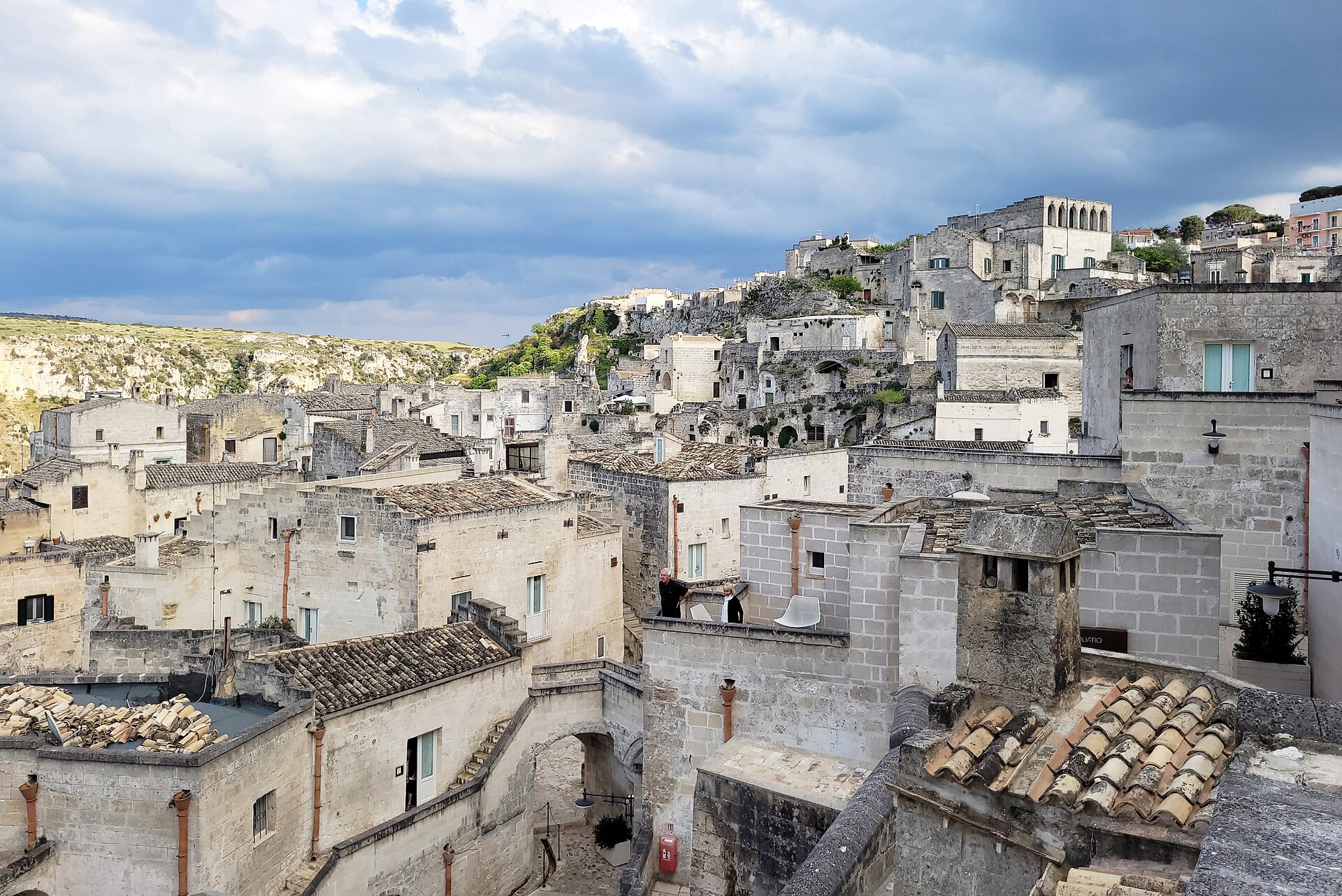
The historic core is the Sassi (literally “stones”), the two districts of cave dwellings carved into the limestone ravine. They sit below the modern town, which sits on the plateau above. The two Sassi are:
- Sasso Caveoso — the wilder, more “ancient” looking half, tumbling toward the ravine with rougher, more obviously cave-like dwellings. This is the side that looks like a nativity scene or a film set, and it’s where the most photographed churches cling to the rock.
- Sasso Barisano — the more “built up,” restored half, with carved stone facades over the caves. Quieter, with many of the cave hotels and some lovely streets.
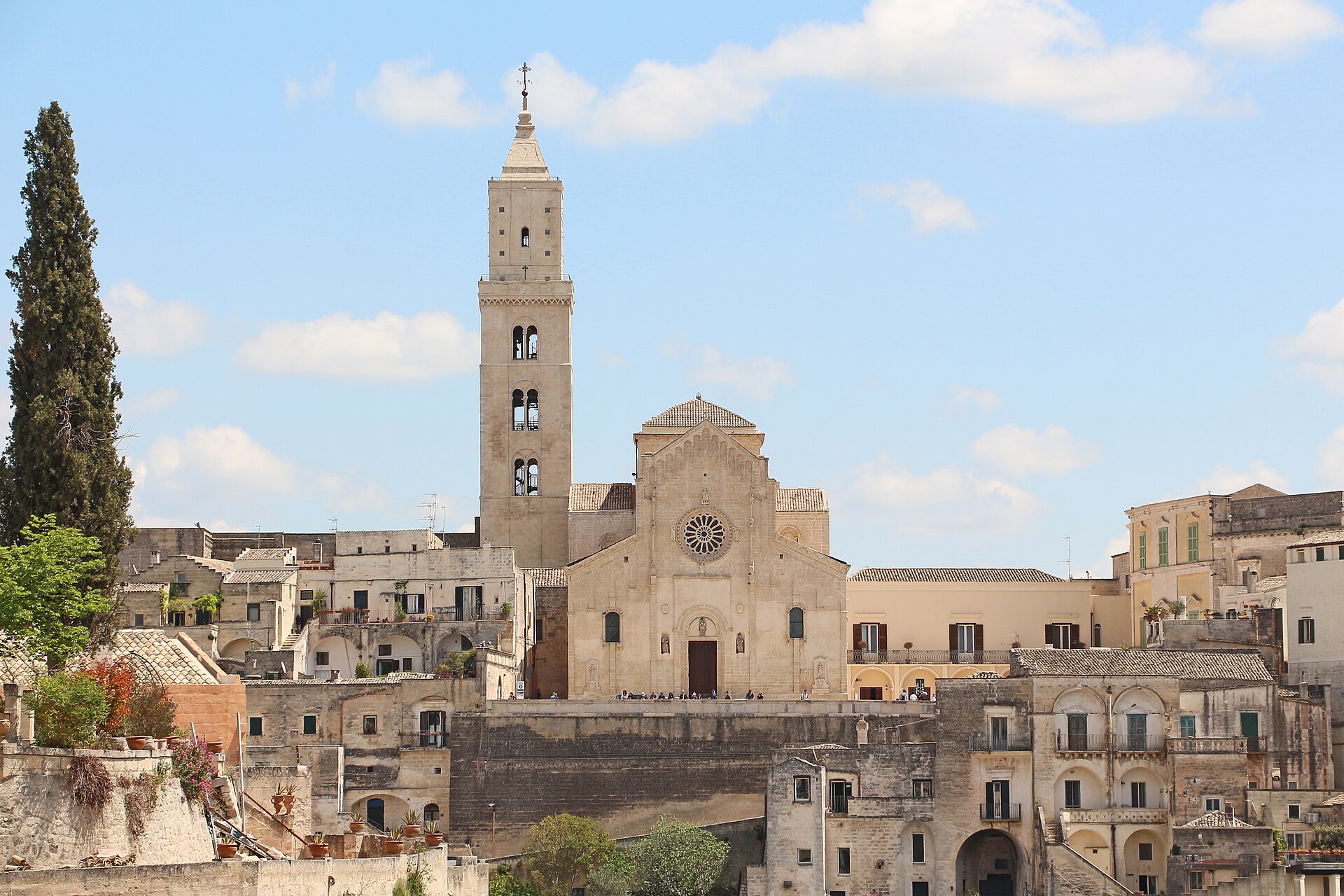
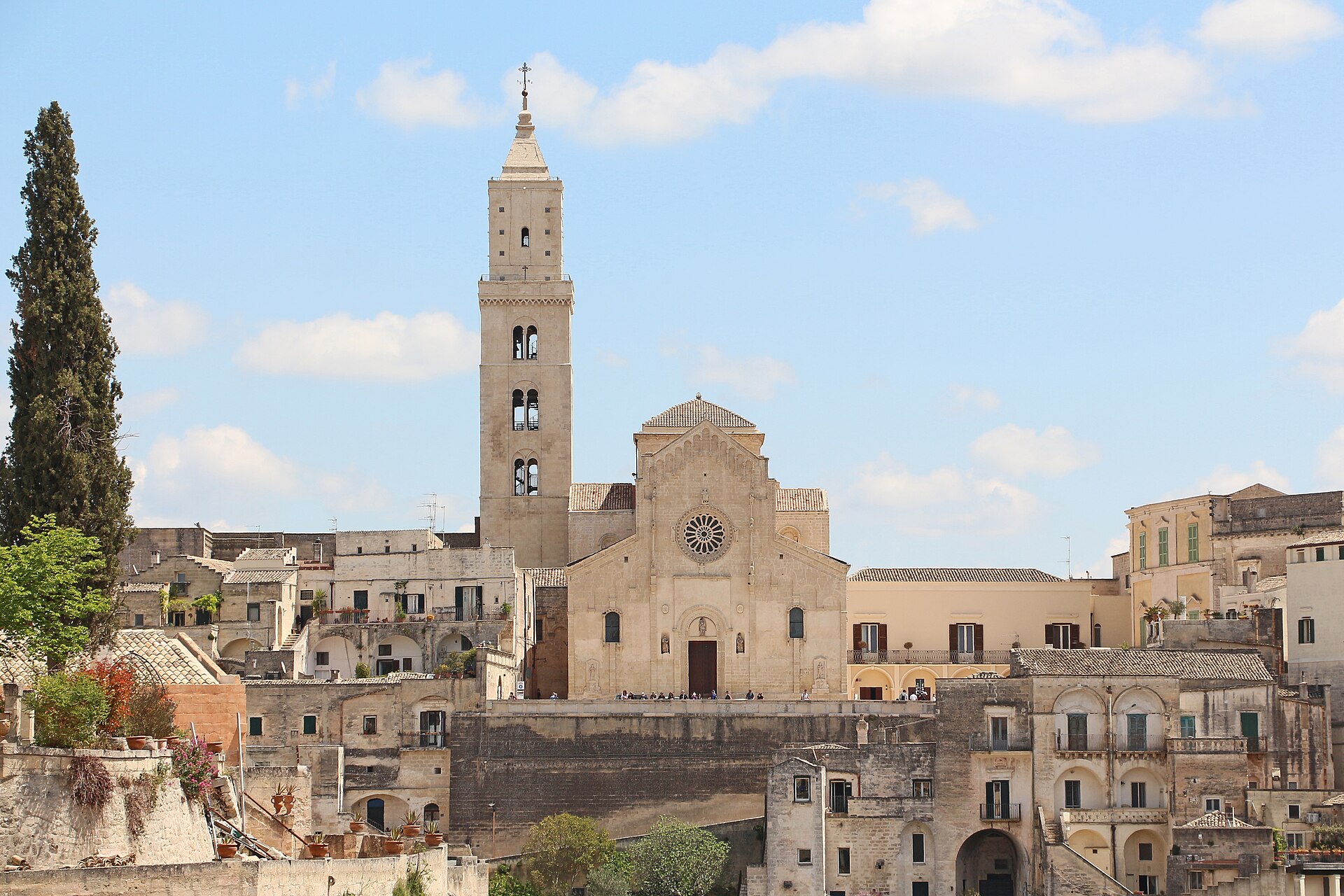
Between and above them is the Civita, the rocky spur crowned by the Cathedral (Duomo). And across the gorge, on the far side, is the Murgia plateau and its park — wild, treeless, dotted with even older caves and hermitages.
Why was a city built into a canyon at all? Because the soft tufo limestone is easy to carve and naturally insulating — cool in the brutal southern summer, warm enough in winter. People lived in these caves, with their animals, right up until the 1950s and 60s, when the Italian government declared the conditions a national disgrace and relocated everyone to new neighborhoods on the plateau. The Sassi sat largely abandoned for decades. Restoration, UNESCO World Heritage status in 1993, a turn as European Capital of Culture in 2019, and a starring role in the James Bond film No Time to Die brought it roaring back. That arc — shame to showpiece — is the story the stones are telling.
A one-day Matera itinerary: the walking route in this Matera travel guide
This is the Matera itinerary I’d hand a friend with one full day. It assumes you’re starting from the modern town up top and working down into the Sassi, which is the gentler direction on your knees.
Morning — Piazza Vittorio Veneto and the first big view. Start in the main square, Piazza Vittorio Veneto, in the modern town. Walk to the Belvedere Luigi Guerricchio, also called the “Tre Archi” (Three Arches), just off the square. It’s not the most sweeping panorama, but it’s your first proper look down into the Sassi and a great orientation point.
Descend into Sasso Barisano. Drop down from the square into Sasso Barisano. Let yourself get a little lost on the carved-facade lanes. Make your way toward the Cathedral (Duomo) on the Civita spur — the inside is far more ornate than the plain exterior suggests, and the terrace beside it gives you both Sassi at once.
Late morning — the cave churches. Cross over toward Sasso Caveoso for the rupestrian churches, which I cover in detail in the next section. This is the architectural heart of the day.
Lunch. Sit down somewhere in or near Sasso Caveoso and eat slowly — orecchiette, peperoni cruschi (those crackling-dry sweet red peppers), the local crusty pane di Matera. Long lunches are non-negotiable here.
Afternoon — a casa grotta and a wander. Visit one casa grotta (cave house) to see how families actually lived — more below. Then spend the rest of the afternoon on foot, drifting down through Caveoso toward the ravine’s edge at Piazza San Pietro Caveoso, where the church sits on a ledge above the gorge.
Golden hour — the sunset viewpoint. End at Belvedere di Piazza Giovanni Pascoli (the Pascoli viewpoint) or stay at Piazza San Pietro Caveoso as the light goes warm. If you have a car or energy for a taxi, the Belvedere Murgia Timone across the ravine gives you the whole city face-on at sunset — the postcard shot.
That’s a full, satisfying day without a single rushed moment. If you only have a half-day, cut the casa grotta or trim to one church and keep the views.
For travelers stitching Matera into a wider Puglia loop, my Puglia itinerary and the broader list of things to do in Puglia show how a day or two here slots in alongside the trulli, the baroque towns, and the coast.
The rupestrian cave churches: which tickets are worth it
The chiese rupestri — rock-hewn churches carved straight into the tufa, some with faded Byzantine frescoes — are the thing that makes Matera more than a pretty canyon. There are well over a hundred in and around the city. You do not need to see them all. Here are the ones that earn their entry fee.
Santa Maria di Idris is the iconic one, built into a huge fin of rock jutting over the ravine in Sasso Caveoso. You’ve seen it in every photo of Matera, even if you didn’t know its name. Inside it’s small but atmospheric, connected by a passage to the adjacent crypt of San Giovanni. As of 2026, entry to Idris alone runs around €5, or you can buy a combined ticket for roughly €10 that covers three churches — Idris, Santa Lucia alle Malve, and San Pietro Barisano. The churches generally open around 10am to 7pm; confirm current hours and prices locally, as they shift seasonally.
Santa Lucia alle Malve is the second on that combo ticket — less dramatic from outside, but with some genuinely interesting medieval frescoes inside, including an unusual nursing Madonna.
San Pietro Barisano, over in the quieter Sasso Barisano, is the largest rupestrian church and my dark-horse favorite. It dates back centuries and hides a frankly macabre crypt: stone niches with seats carved into the walls where dead priests were once left to decompose. It’s the most memorable interior of the three, precisely because it’s the strangest.
Beyond the ticketed three, San Pietro Caveoso (the church on the ledge above the gorge) is free to enter and worth a look since you’ll pass it constantly. And for the truly committed, the Crypt of the Original Sin — sometimes called the “Sistine Chapel of rupestrian churches” for its vivid 9th-century frescoes — sits a short drive out of town on the Appian way and requires a booked, guided visit. It’s a detour, but a stunning one if cave frescoes are your thing.
My advice: buy the €10 three-church combo, see all three, add free San Pietro Caveoso, and skip the rest unless you’re a real enthusiast. Photography is often not allowed inside, so put the phone away and just look.
Casa grotta and museums: seeing how people lived
To understand the Sassi rather than just photograph them, step into a casa grotta — a cave dwelling preserved as it was when families, livestock and all, lived inside. A single cramped room held parents, many children, the mule, and the chickens. It reframes those pretty windows in the cliff entirely.
The best-known is Casa Grotta di Vico Solitario, conveniently set near Santa Maria di Idris in Sasso Caveoso. It’s excellent but gets jammed with tour groups. On a recent visit I ducked into the quieter Casa Grotta C’era Una Volta over in Sasso Barisano and found it just as moving with half the crowd — worth knowing if you value elbow room. Either runs only a few euros and takes fifteen minutes.
If you want context with your caves, two more spots stand out. Casa Noha, run by the FAI heritage trust, uses a multimedia presentation to tell the whole arc of the Sassi — abandonment, scandal, rebirth — in about 25 moving minutes; entry is around €7. And MUSMA, the sculpture museum set inside a carved palazzo and its caves, is a genuinely cool setting even if modern art isn’t your thing. Pick one of these for depth; you don’t need both in a single day.
Where to sleep: the case for a cave hotel
This is where I’ll push you toward the overnight. Matera’s signature experience is sleeping inside the rock — dozens of the Sassi caves have been converted into cave hotels and B&Bs, and a night in one is the thing you’ll talk about afterward.
The rooms are exactly what you’d hope: vaulted stone ceilings, deep window niches, cool stone walls that hold the temperature even when the summer plateau is baking at 40°C. The best of them have terraces hanging over the ravine, perfect for a sunrise coffee or an evening drink as the Sassi light up.
A few practical notes I learned the slightly-hard way:
- Pack light. You often can’t drive or even wheel a suitcase to your door — it’s stairs, narrow lanes, and uneven stone. Many hotels offer a porter or luggage transfer; arrange it in advance.
- Location is a trade-off. A room deep in Caveoso is atmospheric but a hike up to the parking and restaurants. A room nearer the top is easier on the legs but less “in the caves.”
- Book dinner ahead. Matera’s restaurants are small and fill up, especially in shoulder season. Reserve, particularly for your one big dinner.
For how cave hotels compare to the masserie and trulli stays elsewhere in the region, see my guide to choosing a base in Puglia, and for the country-wide view, the best areas to stay across Italy.
If you’re firmly a day-tripper, that’s fine — but at least time your visit to overlap with golden hour before you catch the last train or drive back.
What to eat in Matera
Basilicata’s food is rustic, generous, and unfussy — closer to the soil than coastal Puglian cooking, though they share a love of vegetables and great bread. Look for:
- Pane di Matera — the giant, dense, golden-crusted sourdough loaf with a protected designation. Even a plain slice with local oil is a small event.
- Peperoni cruschi — sun-dried sweet red peppers flash-fried until they shatter like crisps. They turn up on pasta, with cod, or just as a snack, and they’re addictive.
- Orecchiette and cavatelli — the same ear-shaped and little-shell pastas you’ll meet across Puglia, here often with turnip tops, breadcrumbs, or those crackling peppers.
- Crapiata — a humble legume-and-grain soup, peasant food turned local pride.
It’s hearty, affordable, country cooking. For the wider regional and national context, my Italy food and wine guide goes deeper on the south’s specialties.
How many hours do you need in Matera?
Be realistic about your time and you’ll enjoy it more. Here’s how I’d budget it:
- 3–4 hours: the absolute minimum. Two viewpoints, one church, a quick walk through Caveoso, maybe a coffee. You’ll see why it’s special but feel rushed.
- 5–6 hours (a proper day trip): the sweet spot for day-trippers. Add the three-church combo, one casa grotta, and a full sit-down lunch. This is a satisfying day.
- 1 night / ~24 hours: the ideal. You add the magic hours — sunset, the lit-up Sassi after dark, a slow morning before the buses arrive. This is what I’d choose.
- 2 nights: lovely if Matera is a destination in itself, with time for the Murgia park across the ravine and a guided Crypt of the Original Sin visit. More than most itineraries need.
If you’re squeezing Matera into a packed national trip, my broader Italy travel guide and notes on the best time to visit Italy will help you decide whether to give it a night or just an afternoon.
When to go, and a budget note
Best months: April–May and late September–October. Shoulder season gives you warm-but-walkable days and softer light without the crowds. Avoid July and August if you can — the plateau bakes, the stone radiates heat, and midday in an exposed ravine is no fun. Spring and autumn are made for this kind of place.
On cost: Matera is gentle on the wallet compared to the big-name destinations. Cave-hotel nights, modest church tickets, and cheap, excellent food keep a day here very reasonable. For how it fits a wider spend, see my Italy travel budget breakdown, and skim my general hard-won Italy advice for the small stuff — cash for tiny churches, comfortable shoes, booking ahead.
How to fit Matera into a Puglia trip
Matera pairs beautifully with the Puglian heel, and it’s geographically logical: you’re already near Bari, and Matera is an hour inland. A clean way to do it is to base in or near Bari for a night, give Matera a full day (ideally with a sleep in a cave hotel), then continue south into the best Puglia beaches and the baroque streets of Lecce.
It also slots neatly between Puglia and Campania if you’re heading toward the Amalfi Coast and Naples afterward, since Matera sits roughly between the two coasts. Use the Puglia regional guide as your anchor and treat Matera as the one inland detour that’s absolutely worth the gear change.
Final thoughts
Matera is the kind of place that resets your sense of what “old” means. Sleep in a cave, watch the stone city catch fire at sunset, eat a long lunch, and don’t try to conquer it. Drive over from Puglia if you can, take the FAL train if you can’t, mind the Sunday bus swap, and give it a night. It’s an hour from Bari and it will be the part of the trip you describe first when you get home.
Questions travellers ask
Is Matera worth visiting?
Yes. Matera is one of the most atmospheric places in southern Italy — a 9,000-year-old cave city carved into a ravine. Just set expectations: it’s about wandering, viewpoints, and ambiance, not a long checklist of attractions. Give it a slow afternoon or, better, an overnight, and it becomes a clear highlight.
How do you get from Bari to Matera?
Three ways. The FAL (Ferrovie Appulo Lucane) train runs from a separate terminal beside Bari Centrale in about 1h15–1h45 for a few euros. Driving takes around an hour over roughly 65 km and gives you the most flexibility. Or join an organized day tour. Note that on Sundays and holidays the train is usually replaced by buses.
Is Matera in Puglia?
No — Matera is in Basilicata, the region next door, just over the border from Puglia. The confusion is understandable because most travelers reach it from Bari, the capital of Puglia, about an hour away. It’s a very common and easy add-on to a Puglia trip, but technically it’s a different region.
How many hours do you need in Matera?
For a day trip, 5–6 hours is the sweet spot — enough for two viewpoints, the cave churches, a casa grotta, and a long lunch. The minimum is 3–4 hours. But the ideal is one overnight, so you catch sunset and the illuminated Sassi after the day-trippers leave. That evening atmosphere is the best part.
Can you visit Matera as a day trip from Bari?
Absolutely, and many people do. The FAL train or a one-hour drive make it easy, and 5–6 hours is plenty to see the highlights. My only push-back: if you can manage one night in a cave hotel instead, do it — the Sassi at dusk and after dark are unforgettable in a way a daytime visit can’t quite match.
Do you need a car in Matera?
Not within the city — the Sassi are walkable (if steep and full of stairs), and you can’t drive into them anyway. A car helps for getting to Matera flexibly, especially on Sundays when the FAL train is bus-replaced, and for reaching the Murgia viewpoint across the ravine. In town, leave the car in an upper-town garage and walk down.
What are the cave churches and are they worth the ticket?
They’re rupestrian churches carved into the rock, some with old frescoes. The best value is the combined ticket (around €10) for three — Santa Maria di Idris, Santa Lucia alle Malve, and San Pietro Barisano — with the macabre crypt at San Pietro Barisano the standout. Free San Pietro Caveoso is also worth a peek. You don’t need to see more than these.
When is the best time to visit Matera?
April–May and late September–October. Shoulder season brings warm, walkable weather and beautiful light without summer’s crushing heat or crowds. Avoid July and August, when the exposed limestone ravine bakes. Spring and autumn evenings, with the Sassi glowing at sunset, are exactly what you came for.