Best Things to Do in Puglia
Puglia is the heel of Italy’s boot, and it is the rare Italian region where you can spend a morning inside a white stone town, an afternoon swimming under a cliff, and an evening eating burrata that was made that day a mile away. The hard part is not finding things to do. The hard part is choosing.
The best things to do in Puglia fall into a handful of buckets: the trulli and whitewashed hill towns of the Valle d’Itria, the sea caves and coves along two coastlines, the masserie where you eat and taste olive oil, baroque Lecce, and a few standalone wonders like Castel del Monte and the Grotte di Castellana. Pick two or three buckets and go deep rather than racing to tick all of them.
This guide is for the person who wants the overview first, the “what is even here and what is worth it,” before they commit to a route. If you already know you want a day-by-day plan, jump straight to the Puglia itinerary. If you want the lay of the land for the whole region, start with the Puglia travel guide. Otherwise, stay here and let me talk you through it.
Puglia attractions at a glance
Here is the region sorted the way I actually think about it: by the kind of experience, roughly where it lives, how long it eats, and who it suits. Use it to figure out which two or three threads to pull.
| Experience | Area | Time needed | Best for |
|---|---|---|---|
| Trulli & white towns (Alberobello, Ostuni, Locorotondo, Cisternino) | Valle d’Itria, central Puglia | Half to full day each cluster | First-timers, photographers, slow wanderers |
| Sea caves & coves by boat | Adriatic coast (Polignano, Castro, Gargano) | Half day | Swimmers, couples, anyone who likes water |
| Masseria food & olive-oil experience | Countryside throughout | 2-3 hours | Food lovers, rainy days, couples |
| Baroque Lecce | Salento, southern Puglia | Full day | Architecture and city people |
| Castel del Monte | Alta Murgia, near Andria | Half day incl. drive | History buffs, road-trippers |
| Grotte di Castellana (caves) | Central, near Bari | 1-2 hours plus drive | Families, hot days, geology nerds |
| Salt pans & flamingos | Margherita di Savoia, near Gargano | 2-3 hours | Birdwatchers, off-beat travelers |
| Beaches | Both coasts | As long as you like | Summer trips, families |
A note before you build your list: Puglia is bigger than people expect, and public transport is thin once you leave the main rail line. Most of this needs a car. I get into the logistics near the bottom, but file that away now because it shapes everything.
Trulli and the white towns of the Valle d’Itria
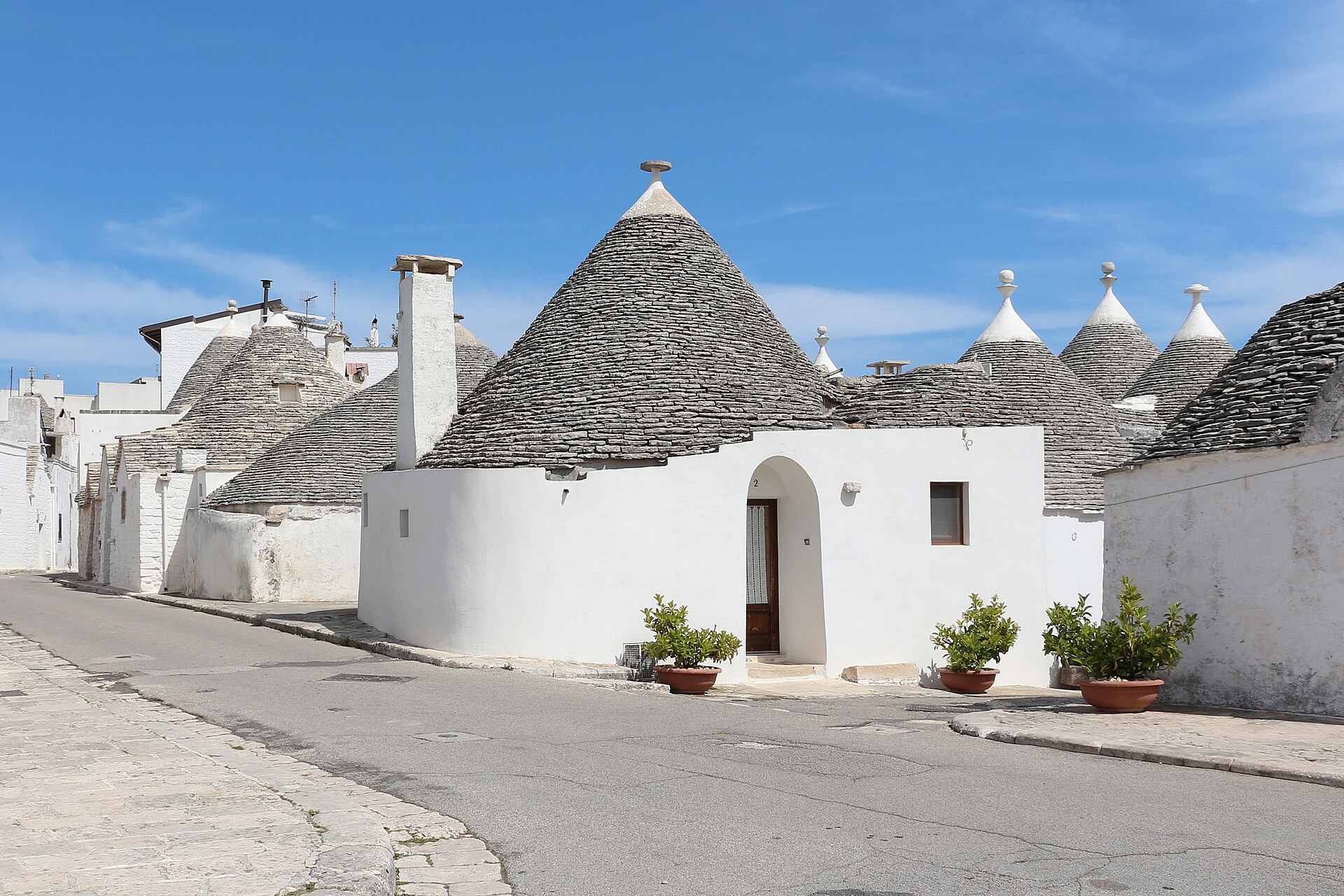
If there is one image that sells Puglia, it is the trullo: a round, dry-stone house with a grey conical roof, often capped with a little stone pinnacle and painted symbols. They cluster in the Valle d’Itria, the gentle plateau between Bari and the Salento, and this is the part of the region most people picture when they daydream about going.
Alberobello: go early, then leave
Alberobello is the postcard. Around 1,400 trulli line two whitewashed quarters, Rione Monti and the quieter Aia Piccola, and it is a UNESCO World Heritage Site for good reason: nowhere else has this density of the things. It is also, to be blunt, the most touristy single spot in Puglia. By late morning the lanes of Rione Monti are shoulder to shoulder and half the trulli are souvenir shops selling the same ceramic whistles.
My honest take: Alberobello is still worth it, but only if you respect the rhythm. Arrive by 8:30 or 9am, walk both quarters before the tour buses land, climb to the Belvedere viewpoint for the rooftop sea of cones, and be having coffee somewhere else by 11. Or flip it and stay overnight, because once the day-trippers leave it goes quiet and a little magical. An hour and a half of actual walking covers it. Do not build a whole day here.
Ostuni, the White City
Ostuni sits on a hill about 8 km from the coast, and from a distance it looks like someone spilled sugar across the ridge. The old town is a tangle of lime-washed lanes that spiral up to the cathedral, and the whole thing glows at golden hour. It earns the nickname.
It is also busy and a bit boutique-and-aperitivo these days, which some people love and some find a little polished. I’d give it an afternoon and evening: wander the white maze with no particular plan, find the loop of panoramic terraces on the town walls, and stay for dinner when the heat drops and the swallows come out.
Locorotondo, Cisternino, Martina Franca
Here is where I’ll push back on page one. The famous names get the crowds, but the towns I’d actually send you to are the quieter ones a short drive away.
- Locorotondo is built on a near-perfect circle (the name means “round place”), so its lanes curve and you keep ending up where you started, past whitewashed houses with wrought-iron balconies dripping geraniums. It has some of the best valley views in the region and a fraction of Ostuni’s foot traffic.
- Cisternino is the one I tell friends about. It is a working hill town with butcher shops where you point at the cut you want, they grill it on the spot, and you eat it at a paper-clothed table with a carafe of local wine. The grilled-meat ritual, fornello pronto, is one of the most quietly perfect meals in Puglia.
- Martina Franca swaps whitewash for baroque: elegant palazzi, curling stone balconies, and a grander, almost theatrical feel. Worth a stop for the architecture and an espresso in Piazza Plebiscito.
You can string Locorotondo, Cisternino, and Martina Franca into one unhurried day with a trulli stop, and that single loop might be the best day in the whole region. For where to base yourself for all this, see where to stay in Puglia.
Sea caves, cliffs, and coves
Puglia has two coastlines, the Adriatic on the east and the Ionian on the southwest, and somewhere around 800 km of it. The limestone means the shore is riddled with sea caves and grottoes, and the single best way to see them is from a small boat.
Polignano a Mare and the cliff coves
Polignano a Mare is the iconic one: white houses perched on the edge of a sheer cliff, with the tiny pebble beach of Lama Monachile wedged in a ravine under a Roman bridge. It is genuinely stunning and it is genuinely mobbed, especially in summer when the little beach is a carpet of towels by 10am.
My candid opinion lines up with what a lot of honest travelers say: the view is worth seeing, but the town itself can feel like a crowd-management exercise in peak season. Go for the cliff views and the caves, but consider basing yourself in calmer Monopoli a few minutes up the coast, which has the same honey-stone charm with a fraction of the selfie sticks. I cover the town properly in the Polignano a Mare guide.
The real reason to come is the water beneath the town. Boat tours leave from the little harbor and slip into a tangle of sea caves you cannot reach on foot, where light bounces off the ceiling in shifting aqua. A short cave tour runs roughly an hour. Book ahead in July and August.
Renting a boat in the Salento
Further south around Castro and Santa Cesarea Terme, the Adriatic turns a deep, clear turquoise and the coast is all cliffs and hidden inlets. You can admire it from land, but renting a small motorboat for a half-day is, for me, one of the most underrated things to do in Puglia. You drop anchor off a cove like Porto Miggiano, swim straight off the boat, and reach grottoes that have no land access at all.
You do not need a license for the smaller engines. As a rough guide, a half-day on a modest motorboat runs around 130-170 EUR and a full day around 250-300 EUR, plus fuel, depending on season and operator (prices as of 2026, confirm locally). One honest warning from people who have done it: watch the wind. When it picks up, an exposed anchorage gets uncomfortable fast, so go on a calm morning and keep an eye on the forecast.
Gargano and the Tremiti Islands
Up in the north, the Gargano peninsula, the spur of the boot, is a different Puglia: pine forest, white cliffs, and dramatic beaches around Vieste and Mattinata. Offshore lie the Tremiti Islands, a tiny archipelago of clear water and good snorkeling reachable by ferry. The Gargano is far enough from the trulli country that it really wants its own leg of a trip rather than a day trip. For the full beach rundown across the region, see the best beaches in Puglia.
Masserie, food, and olive oil
If you take one thing from this guide, take this: in Puglia, eating and the land are the same subject. The region runs on simple food made from a handful of ingredients, and the best food experiences happen on farms.
Stay in or visit a masseria
A masseria is a fortified farmhouse, historically the center of a working agricultural estate. Many have been restored into agriturismi and hotels, often with pools, olive groves, and a kitchen turning out what the estate grows. Even if you don’t stay in one, a long lunch or dinner at a masseria is a proper experience: you eat antipasti you cannot finish, vegetables you’ve never met, and cheese made on site.
Take a cooking class
The single most recommended hands-on activity in the region, and I agree with the consensus, is a pasta-making class. The classic dish is orecchiette, “little ears,” dragged into shape with a thumb across a wooden board, and the dough is often just flour, water, and a little oil. You’ll usually learn two or three shapes (orecchiette plus regional ones like minchiareddhi or sagne ‘ncannulate), then eat what you made. Classes commonly run in a masseria or a home and take two to three hours. It is the kind of thing that sounds like a cliche and turns out to be the highlight of the week.
Cheese farms: burrata at the source
Puglia is the home of burrata, the bag of mozzarella filled with cream and shreds of curd, and it does not travel. Tasting it hours after it was made, on a dairy farm with the cows in earshot, ruins the supermarket version for you forever. Several caseifici run short tours where you watch mozzarella and burrata being pulled by hand, then sit down to a tasting platter. Budget a couple of hours, and go hungry.
Olive oil and the Xylella story
Puglia produces a huge share of Italy’s olive oil, and some of these groves hold trees that are hundreds, even over a thousand, years old, gnarled into shapes like driftwood. An olive-oil tasting at a frantoio or masseria teaches you to actually taste the stuff, the grassy bitterness and the peppery catch at the back of the throat that means it is fresh, and how far that is from the bland gold in most bottles back home.
There is a sober side to this you should know about. The bacterium Xylella fastidiosa has killed millions of olive trees in Puglia, hardest in the Salento, and driving south you pass long stretches of dead and skeletal groves. It makes a tasting feel like more than a snack. You are watching farmers fight to keep a thousand-year-old tradition alive. For the broader regional food picture, see Italy food and wine travel.
Wine: Primitivo and Negroamaro
Puglia is a serious wine region, and the two reds to know are Primitivo (especially Primitivo di Manduria, big, ripe, and high in alcohol) and Negroamaro (darker, a little more savory). Order a glass of each with dinner and you’ve covered the local stars. Many masserie and wineries do tastings if you want to go deeper.
Baroque Lecce, the Florence of the South
Lecce is the cultural capital of the Salento and the one big city I’d send everyone to. It is built from a soft, honey-colored local limestone, pietra leccese, that 17th-century carvers went wild with, so the churches are encrusted with stone cherubs, fruit, beasts, and curling foliage. The Basilica di Santa Croce is the showpiece, a facade so dense with carving it looks frosted.
What I like about Lecce is the balance. It is grand without being a museum: there’s a sunken Roman amphitheater right in the main piazza, a student population that keeps the wine bars busy at night, and it never felt as overrun as Ostuni or Polignano when I’ve been. Have a pasticciotto, the warm custard-filled pastry that locals eat for breakfast, and just wander. Give it a full day, and read the Lecce travel guide before you go.
Castel del Monte: the octagon on the hill
About 20 km from Andria, alone on a low hill in the Alta Murgia, stands Castel del Monte, and it is genuinely strange in a way photos undersell. The Holy Roman Emperor Frederick II built it around 1240, and the whole thing is an obsessive geometry lesson: a perfect octagon, with eight octagonal towers at the eight corners and eight rooms on each of two floors. No moat, no real defenses, an unclear purpose. People still argue about whether it was a hunting lodge, an astronomical instrument, or a symbol of imperial power.
It is a UNESCO site and it appears on the Italian one-cent coin. Plan a half-day with the drive, because it sits out in the country with little nearby. As of 2026, entry runs a modest few euros and in high season you usually park at a lot below and take a short shuttle up rather than driving to the door; check the official site for current hours and fares, which shift by season. Pair it with a stop in Trani on the coast, where a pink-stoned Romanesque cathedral rises right at the water’s edge.
Grotte di Castellana: underground Puglia
When the surface gets blisteringly hot, go under it. The Grotte di Castellana, near Castellana Grotte about 40 km from Bari, are among the most impressive show caves in Europe: a system of caverns, tunnels, and chambers full of stalactites and stalagmites, ending in the famous Grotta Bianca, a near-white chamber of glittering alabaster-like calcite that guides save for the finale.
You visit on a guided tour, in two lengths. The complete itinerary is about 3 km and roughly 2 hours and includes the Grotta Bianca; the partial route is about 1 km and around 50 minutes and does not. Take the long one if you can. The caves are open year-round with hours that change by season, so check the official site (grottedicastellana.it) and book ahead, particularly in summer (details as of 2026). It stays cool underground, so bring a layer even in August, and wear real shoes. This is a great option with kids or on a gray day.
Salt pans, flamingos, and the off-beat north
For something almost no first-timer plans, the salt pans at Margherita di Savoia, near the Gargano, are the largest in Europe, a vast checkerboard of evaporation basins that turn pink from the brine shrimp living in them. Those same shrimp draw thousands of greater flamingos, around 6,000 in the big colonies, so this is one of the best birdwatching spots in Italy, with herons and hundreds of other species too.
You can do guided tours of the salt works and the ecosystem, walk birdwatching routes like the Airone trail, or visit the salt museum in an old warehouse. Bring binoculars and a long lens, go for sunrise or the golden hour for the color and the calm, and treat it as a half-day of slow, quiet, slightly surreal landscape. It pairs naturally with a Gargano leg of the trip.
Day trip to Matera
Just over the border in Basilicata, an easy drive from the Valle d’Itria, Matera is close enough that most people fold it into a Puglia trip. The Sassi are ancient cave dwellings carved straight into a ravine and lived in for millennia, abandoned in shame in the 20th century and now reborn as cave hotels, restaurants, and one of the most cinematic townscapes in Italy. It is a UNESCO site and has stood in for ancient Jerusalem on film more than once.
Walking the Sassi at dusk, when the stacked stone houses glow gold and lamps flicker on across the gorge, is one of the most memorable hours you can have down here. It is not technically Puglia, but it is too good and too close to skip. The Matera travel guide has the full plan if you want to give it a night rather than a day.
Bari: more than a transit stop
Most people fly into Bari and immediately leave, which is a small mistake. Bari Vecchia, the old town, is a knot of lanes where grandmothers make orecchiette by hand on tables set up in the street, drying the pasta on screens for anyone to see. There’s the Basilica di San Nicola, a major pilgrimage church holding the relics of Saint Nicholas, a long seafront promenade, and in the evening a genuinely lively bar and restaurant scene. Give it an afternoon and a dinner; it’s a fine first or last night. More in the Bari travel guide.
How long, and how to get around
Two practical truths shape any list of things to do in Puglia.
First, distances. The region stretches roughly 400 km from the Gargano to the tip of the Salento. You cannot see the trulli country, Lecce and the deep south, and the Gargano in a few days without living in the car. Pick a zone or two. The Valle d’Itria plus the Adriatic coast around Polignano and Monopoli is the easiest, highest-reward combination for a first trip.
Second, the car. A train line connects Bari, Brindisi, Lecce and some bigger towns, and there are regional buses, but the masserie, the coves, the salt pans, and most of the small white towns sit out in the countryside where transit barely reaches. Renting a car is close to essential, and the good news is that driving here is easy by Italian standards: light traffic outside cities, decent roads. The catch is parking in historic centers. Learn the line colors fast: white lines are free, blue lines are paid (buy a ticket for your full stay, the fines are real), and yellow lines are reserved. For the broader picture see Italy transportation and the Italy travel tips page.
On timing: late April to June and September into October are the sweet spots, warm enough to swim, calm enough to enjoy the towns, and cheaper than the August peak when Italians themselves descend on the coast and prices and crowds spike. For the country-wide view, see the best time to visit Italy.
If Puglia is one stop on a bigger Italy plan, the Italy travel guide and Italy itineraries will help you slot it in, and it pairs especially well with a swing through Amalfi, Naples and Campania since they share the south.
Final thoughts
The mistake people make with Puglia is treating it like a checklist and trying to drive the whole heel in a week. Do the opposite. Pick the threads that actually appeal, the white towns, the boat days, the long masseria lunches, and give them room. The region’s whole personality is unhurried, and it pays you back the most when you match its pace.
If you’re ready to turn this into a plan, the Puglia itinerary lays it out day by day, and the Puglia travel guide covers the practical groundwork. Then go eat the burrata while it’s still warm.
Questions travellers ask
What is Puglia best known for?
Puglia is best known for its trulli, the conical stone houses of Alberobello and the Valle d’Itria, plus whitewashed hill towns, a long coastline of sea caves and clear water, and a simple, brilliant food culture built on orecchiette pasta, burrata cheese, and some of Italy’s best olive oil. Baroque Lecce and Castel del Monte round it out.
How many days do you need in Puglia?
Plan five to seven days to see one or two zones well, and seven to ten if you want both the trulli country and the deep Salento or the Gargano. Anything under four feels rushed given the driving distances. A focused trip beats a frantic one here, so it’s better to skip a region than to spend the week behind the wheel.
Is Puglia worth visiting?
Yes, and it remains less overrun than Tuscany or the Amalfi Coast outside of August. You get striking towns, swimmable turquoise water, real food at honest prices, and a slower pace. The trade-off is that it rewards travelers who’ll rent a car and pick a couple of areas rather than those expecting everything to be a short hop apart.
What are the best things to do in Puglia for first-timers?
Base yourself in the Valle d’Itria, walk Alberobello early and Ostuni at golden hour, eat grilled meat in Cisternino, take a pasta-making class at a masseria, and do a boat cave tour from Polignano a Mare. Add Lecce for a day and Matera as a day trip. That covers the region’s signature experiences without overreaching.
When is the best time to visit Puglia?
Late April through June and September into October are ideal: warm, swimmable, and far calmer than the August peak, when Italian holidaymakers fill the coast and prices climb. July is hot and busy. Winter is quiet and many beach businesses close, though the towns, caves, and Lecce stay rewarding year-round.
Do you need a car in Puglia?
Effectively yes. Trains link Bari, Brindisi, and Lecce, but the masserie, sea caves, salt pans, and most small white towns are out in the countryside with little public transport. Driving is easy by Italian standards thanks to light rural traffic; the main hassle is parking in old centers, so learn the blue-line paid-parking rules to avoid fines.
Is Alberobello worth it or is it a tourist trap?
It is both. The trulli are unique and the UNESCO old town is genuinely worth seeing, but by late morning it is packed and heavily commercial. Go at opening time or stay overnight, walk the quieter Aia Piccola quarter as well as Rione Monti, then move on after an hour or two. Quieter Locorotondo and Cisternino reward more time.
What food should you eat in Puglia?
Start with orecchiette, ideally with turnip tops (cime di rapa) or a simple tomato sauce, and burrata eaten as fresh as you can find it. Add focaccia barese, grilled bombette in Cisternino, fresh Adriatic seafood in the Salento, and a pasticciotto pastry in Lecce, all washed down with a glass of Primitivo or Negroamaro.