Lecce Travel Guide
I have been to Lecce in the white heat of August and in the soft, empty light of February, and both times I left thinking the same thing: this is the most underestimated city in southern Italy. People come for the beaches of Salento and treat Lecce as a place to sleep. That is backwards.
This Lecce travel guide is about the city itself — the honey-coloured Baroque, the Roman amphitheatre sunk into the main square, the papier-mâché workshops, the pasticciotto warm from the oven — and how to use Lecce as the capital and base for the whole heel of Italy. Two days here, done right, will reset what you think a small Italian city can be.
Who it is for: travellers who like to walk a city slowly, look up at the carving, eat well for not much money, and treat a place as more than a checklist. If your trip is mostly about sand, I will point you to the best beaches in Puglia and you can skim. If you want to understand why Lecce is called the Florence of the South — and why that nickname both fits and oversells — stay with me.
Lecce at a glance: sights by type, time, and ticket
Here is the city in one table so you can plan by hours, not by guesswork. Costs are “as of 2026” and rounded — always confirm at the official ticket office, since combined-ticket prices and opening hours change.
| Sight | What it is | Time you need | Ticket (around, 2026) |
|---|---|---|---|
| Basilica di Santa Croce | The Lecce Baroque facade, the city’s symbol | 30–45 min | Included in LeccEcclesiae combined ticket |
| Piazza del Duomo + Cathedral | Italy’s grandest enclosed square; bell tower | 45–60 min | ~€11 combined / ~€21 with bell-tower climb |
| Roman amphitheatre, Piazza Sant’Oronzo | 2nd-century arena, half-excavated, in the main square | 15–20 min from above | Free to view from the square |
| Roman theatre (Teatro Romano) | Smaller, quieter Augustan-era theatre, tucked in the lanes | 20 min | Small fee / sometimes by museum |
| Museo Faggiano | Underground house turned accidental archaeology dig | 45 min | ~€5 |
| Papier-mâché (cartapesta) workshop | Hands-on craft session | ~1 hour | ~€25–40 per person |
| Passeggiata + aperitivo | The evening loop around the two piazzas | 1–2 hours | Cost of a spritz |
Everything in the historic centre is walkable in well under fifteen minutes from one end to the other. You do not need a car inside Lecce, and you actively do not want one — more on the ZTL below.
Why Lecce is called the “Florence of the South” (and where it oversells)
Let me deal with the nickname first, because it shapes expectations either way.
The phrase “Florence of the South” was, by the most-repeated account, coined by George Berkeley, an Irish bishop who travelled through Puglia in the 18th century when the Italian south was thought of as lawless and unsafe. He reached this walled city in the hinterland, found around 140 churches and a forest of carved facades, and — as the local guides like to put it — was left disconcerted. He described a place that had nothing to envy of Rome or Venice, and that resembled a small Florence. The German historian Ferdinand Gregorovius later helped the label stick.
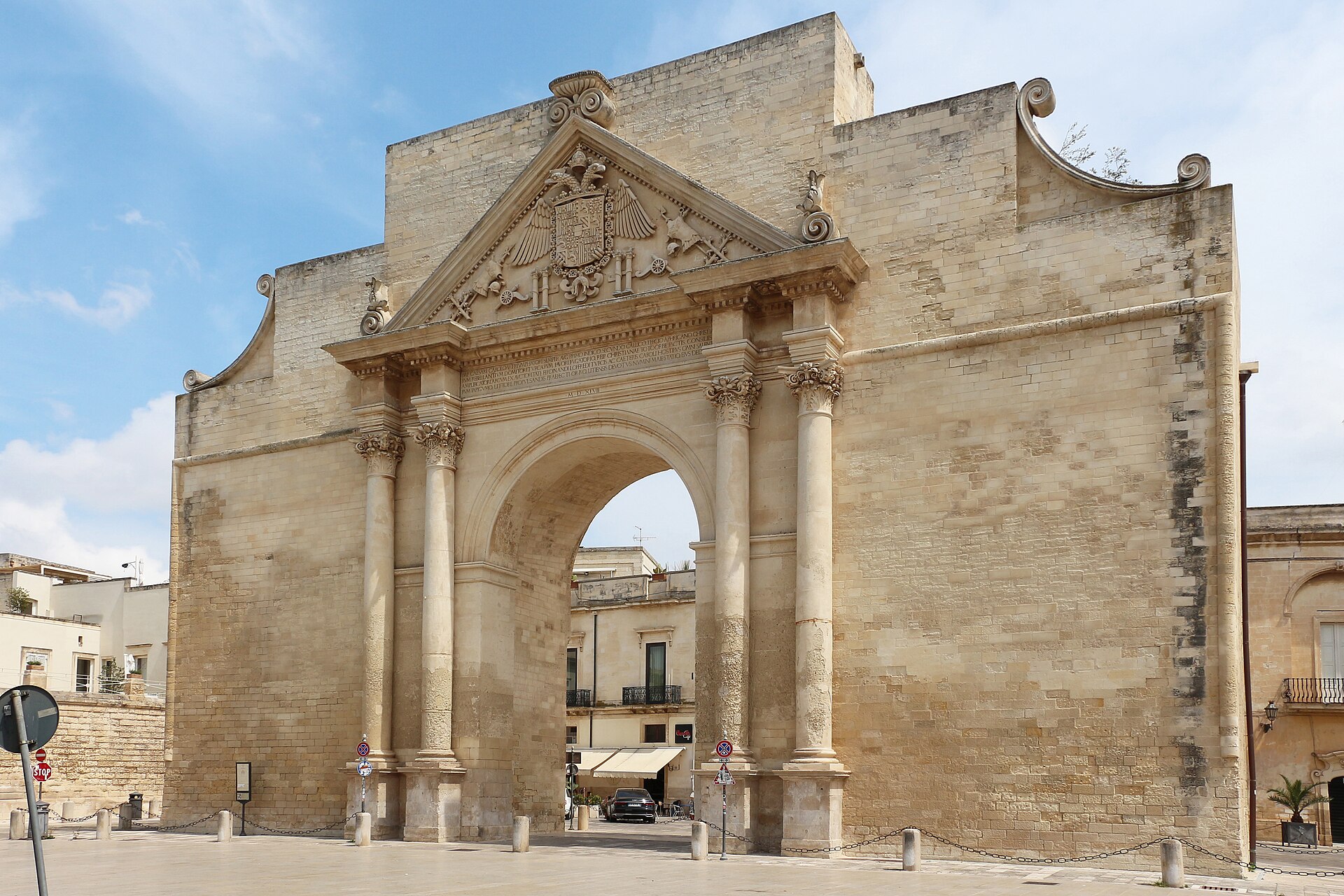
Here is where it fits. Like Florence, Lecce is a single-material city with a single golden era. Where Florence is the cradle of the Renaissance, Lecce is the high-water mark of a regional Baroque so distinct it has its own name: the Lecce Baroque, or barocco leccese. The whole centro storico is tinted the same warm, off-white-to-honey shade, and the carving is everywhere — window lintels with scallop shells, doorways flanked by Corinthian pillars, balconies on stone brackets. Walk with your eyes up and the city is an open-air museum that the locals stroll through without a second glance.
Here is where it oversells. Lecce is not Florence in scale or in the density of world-famous masterpieces. There is no Uffizi, no David, no single building that stops global traffic the way the Duomo of Florence does. What Lecce has instead is consistency and intimacy — a small city where the ordinary surfaces are extraordinary, and where you are rarely shoulder-to-shoulder with a tour group. If you arrive expecting the Tuscan capital, you will feel let down for an hour. If you arrive expecting a warm, walkable Baroque city you can have largely to yourself, you will be delighted. I am firmly in the second camp.
For the wider region this city anchors, the Puglia and southern Italy travel guide sets the frame, and the Italy travel guide puts Lecce in the context of a whole trip.
The Lecce Baroque: read the Santa Croce facade like a page
Most guides tell you Santa Croce is “ornate” and move on. That undersells the single best thing to do in Lecce, so let me slow down.
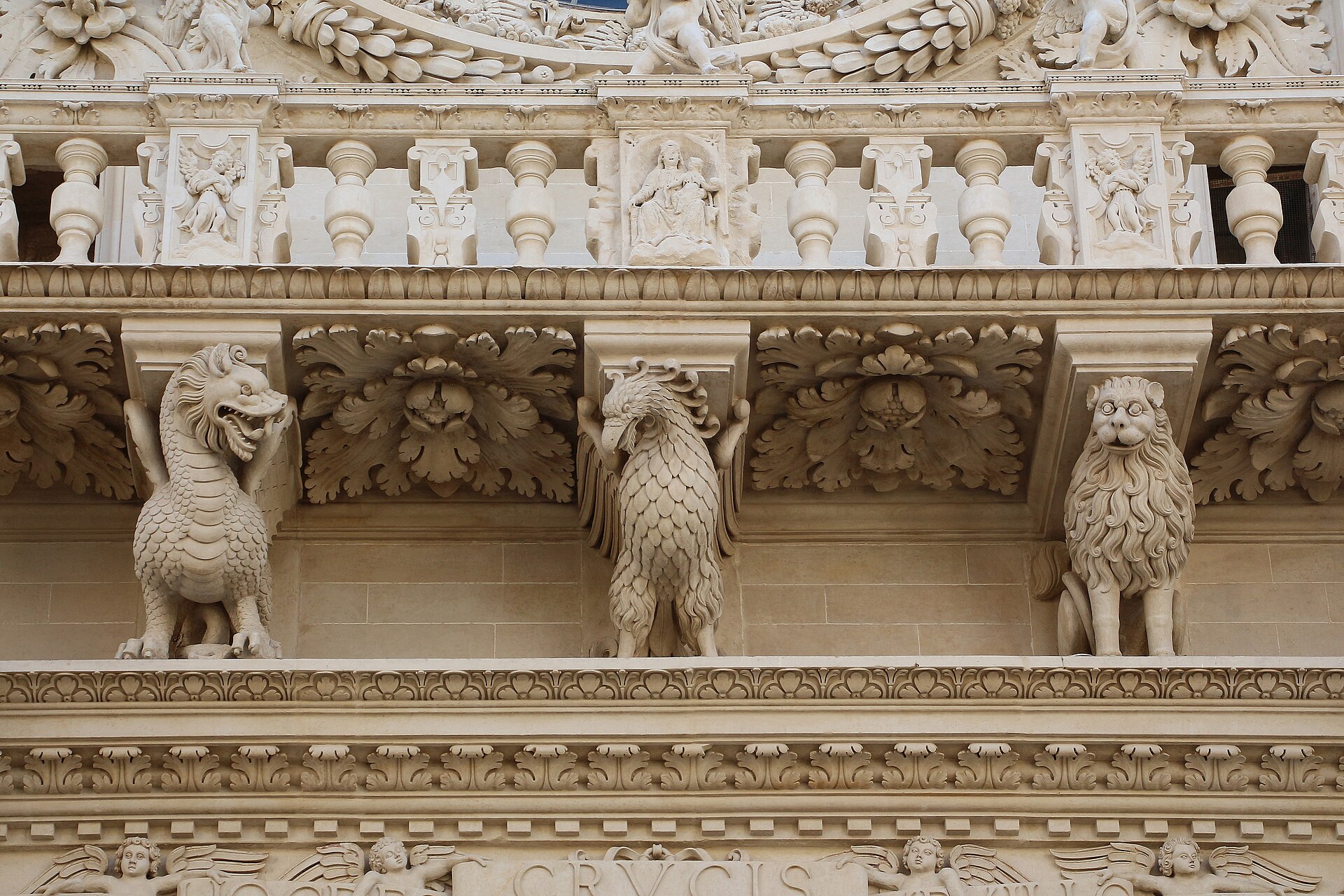
The Basilica di Santa Croce is the symbol of the city, and its facade took roughly 140 years to finish — construction began around 1549 and ran well into the 17th century, across generations of stonemasons. Stand back in the little square in front of it and read it from the bottom up, because it was designed to be read that way.
At the base, a row of figures kneels along the wall, seemingly holding the upper facade up with their bare hands — telamons straining under the weight, grotesques, animals. Above that line, the building loosens and starts to move: cherubs spiral, and garlands of pomegranate and acanthus leaves climb the surface, building toward the great central rose window where everything seems to circle at once. The lower order is relatively restrained; the upper order is the Baroque let off the leash. Spend ten minutes here actually looking, and the rest of the city’s carving suddenly makes sense.
The secret ingredient is the stone, which I will get to in its own section. For the architecture itself, the names to know are the Zimbalo family of architects, Giuseppe Zimbalo above all, whose hand shaped both Santa Croce’s upper facade and the cathedral’s soaring bell tower.
Piazza del Duomo: the room with three doors
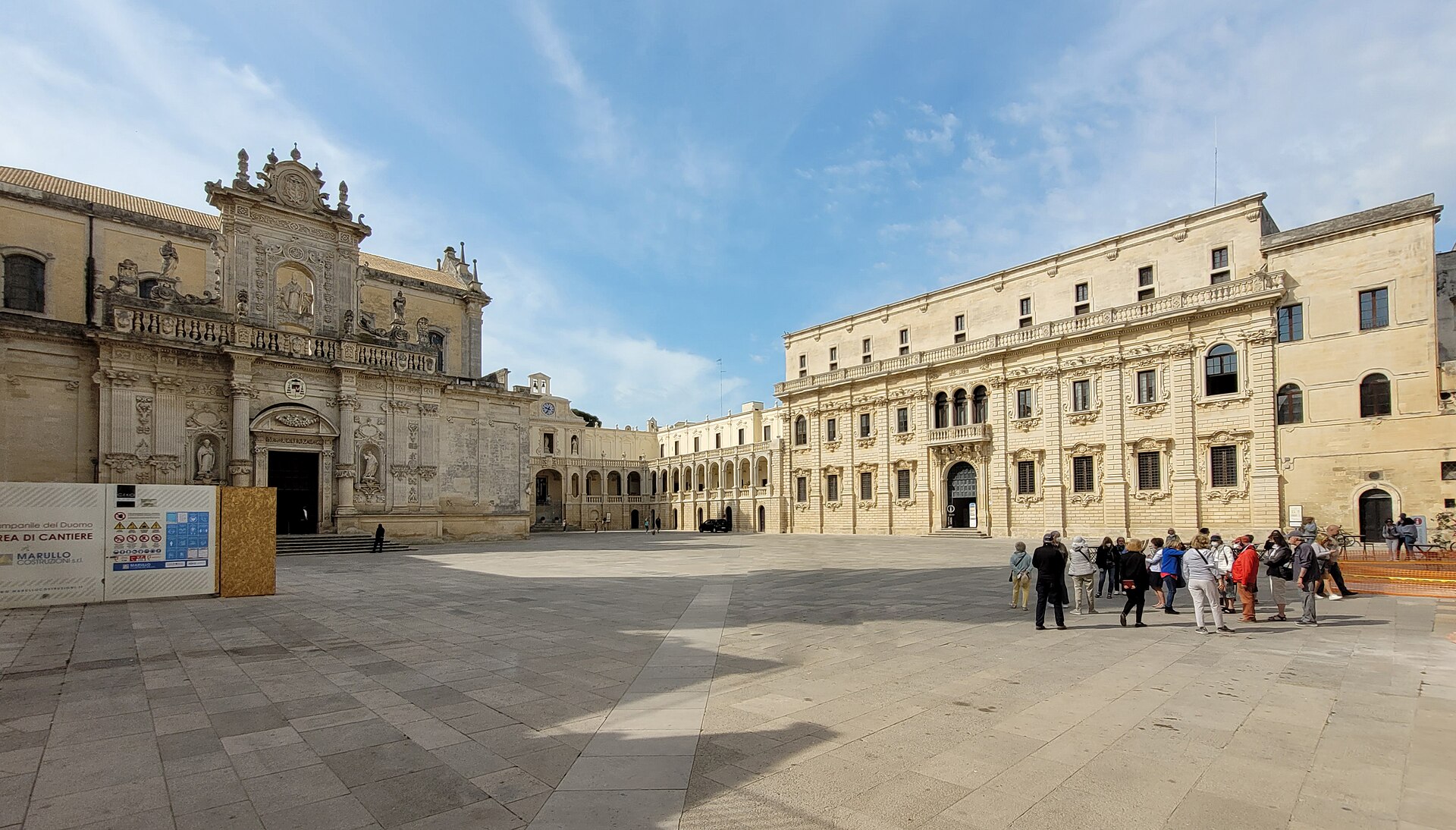
A two-minute walk away is Piazza del Duomo, and it is the piece of Lecce I would defend hardest. It is one of the only enclosed squares in Italy — a near-private outdoor room you enter through a monumental gateway, as if stepping into a courtyard rather than a public plaza. Around it stand the Cathedral, its tall campanile, the Bishop’s Palace, and the Seminary with its beautifully cloistered courtyard.
The Cathedral has two facades — a modest one and a grand ceremonial one — because Zimbalo designed the showpiece to face you as you walk in through the gate. Come back after dark. When the square empties and the stone is lit warm against a black sky, this is the most cinematic spot in the whole city, and it costs nothing to stand there.
To go inside the Cathedral, climb the bell tower, and enter the main churches, you buy the LeccEcclesiae combined ticket. As of 2026 the basic version runs around €11 per adult and covers the Cathedral and crypt, the Basilica di Santa Croce, the Church of Santa Chiara, the Church of San Matteo, and the Antico Seminario with its Museum of Sacred Art. A pricier version — around €21 — adds the climb up the bell tower for the rooftop view over the centro storico. Sites generally run roughly 9am to 9pm daily. Buy it at the official ticket office or the Infopoint inside the Antico Seminario, and treat those numbers as a guide, not a promise — confirm on the day.
Pietra leccese: the stone that made the city
You cannot understand Lecce without understanding its stone, and this is the detail page one keeps glossing.
Pietra leccese is a soft limestone quarried in the country around the city. It was once the bed of an ancient sea, and to this day you can find shells and fossils caked into its slabs. What made it the engine of the Lecce Baroque is how it behaves: it is so malleable it can be carved with a penknife. A local guide once described it to a National Geographic writer as “soft as mollica” — the soft inside of a bread roll. That softness is why the carving here gets so fevered and so fine. The Romans, the line goes, could play with sheer dimension and the Neapolitans with precious marble, but Lecce had only this “poor” material — and turned it into marvels.
There is a catch worth knowing as a traveller: fresh-cut pietra leccese is pale, almost white, and it deepens to that honey-gold over years of exposure. So the colour of the city is partly the colour of age. It also means the stone is fragile — it weathers, and you will see patient restoration going on around town.
The living end of this story is the workshops. A handful of contemporary sculptors — Renzo Buttazzo, working out of a studio near San Cesario a short drive from the centre, is the best known — have spent thirty years dragging the material out of cherubs and seraphim and into pure abstract form: clocks, lamps, sinuous faceless figures that look soft and feather-light despite being solid stone. If “another Baroque church” starts to blur after a day, an hour watching someone shape this stone with a wooden scalpel and a hammer is the antidote, and it connects directly to the Italy food and wine travel and craft side of a trip.
The Roman layer: amphitheatre and the theatre nobody tells you about
This is where I think most of page one genuinely under-delivers, so here is the part to read twice.
The amphitheatre in Piazza Sant’Oronzo
Walk into Piazza Sant’Oronzo, the working heart of the city, and the ground opens. Sunk below the modern pavement is a Roman amphitheatre, built around the 2nd century AD, when this was the Roman town of Lupiae. At full size it is thought to have held something like 25,000 spectators for gladiatorial games — a serious arena for a provincial city. Only a portion has been excavated, because medieval and modern Lecce was built directly on top of it; the rest is still down there under the surrounding buildings.
You do not buy a ticket to feel it. You stand at the railing in the square and look down at the curved tiers of seating, and then you turn around and there is a Baroque column topped by the statue of Sant’Oronzo, the city’s patron, and behind that a clean-lined 1930s building with a clock tower. Ancient, Baroque, and Fascist-era modern in a single sweep of the eye — that collision is the most Lecce photograph you will take. The arena floor itself is generally only opened up for special events, but the view from the piazza is the point, and it is free at any hour.
The Roman theatre — the one to seek out
Here is the sight almost no quick guide mentions, and the reason this guide earns its keep: Lecce has a second Roman monument, a separate Roman theatre (Teatro Romano), and it is tucked into the lanes a few minutes south of the amphitheatre, half-hidden between later buildings. It is smaller — figures of roughly 5,000 to 6,000 spectators get quoted — and likely dates to the Augustan age. Where the amphitheatre staged blood sports, the theatre staged comedies and tragedies.
Crucially, the two are not the same place, and people constantly conflate them. The amphitheatre is the big oval in the open square; the theatre is the intimate semicircle you have to go looking for. Because hardly anyone bothers, you can often have the theatre nearly to yourself — which, in a city as photogenic as this, is a small gift. Hours and access can be seasonal and are sometimes tied to the regional museums, so check locally before you make a special trip.
Museo Faggiano: the city under the city
For the layers made personal, the Museo Faggiano on Via Ascanio Grandi is a brilliant hour. A family bought an ordinary house, started fixing a plumbing problem around the turn of the millennium, and instead fell through roughly 2,500 years of history — a Messapian-era tomb, medieval cisterns, even etchings linked to the Knights Templar — all stacked beneath one home. It is entirely family-run, you climb down through it on ladders and narrow stairs, and entry is around €5. It is the clearest illustration in town of how Lecce sits on top of every age that came before it.
A two-day Lecce itinerary on foot
You can see the headline sights of Lecce in a single day. Give it two and the city stops being a checklist and starts being a place you live in for a moment. Here is the Lecce itinerary I would actually walk, designed so you are never doubling back far.
Day 1 — the Baroque core. Start early at the Basilica di Santa Croce while the light is low and the facade is at its best, and give it real time. Buy the LeccEcclesiae combined ticket here or at the Seminary. Walk down to Piazza del Duomo, go inside the Cathedral, and climb the bell tower if you bought the upgrade. Coffee and your first pasticciotto on the way. After lunch, wander out to the city gates — Porta Napoli and the older Porta Rudiae are the handsome pair, Porta San Biagio the quiet one — and loop back through the Villa Comunale gardens. As the afternoon cools, join the passeggiata around Piazza Sant’Oronzo, looking down into the amphitheatre, then settle in for an aperitivo as the stone turns gold.
Day 2 — the layers and the craft. Go looking for the Roman theatre while the lanes are quiet, then drop underground at the Museo Faggiano. Spend mid-morning on a papier-mâché or pietra leccese workshop — book ahead. Use the afternoon for the thing page one forgets to schedule: nothing. Sit in a sunny square, eat a rustico, drink a caffè leccese (iced espresso cut with almond milk — a Salento thing), and let the city be a city. If you would rather move, this is the day to launch a Salento day trip, which I will lay out below.
If you only have one day, do Day 1 and steal the Roman theatre and a single coffee-stop from Day 2. For how Lecce slots into a longer regional route, see the day-by-day Puglia plan, and for the broader country, the sample itineraries for Italy.
What to eat in Lecce: pasticciotto, rustico, and the rhythm of the day
Lecce eats by the clock, and once you learn the rhythm you eat much better. This is the single most useful food note I can give you, and most guides skip it.
Pasticciotto is the morning. It is a small, oval shortcrust pie with a warm custard — a vanilla cream core in the Lecce version — and you eat it fresh from the oven for breakfast, ideally standing at the counter. Cold, a day later, it is fine; warm, that morning, it is a different food entirely. The classic addresses are Pasticceria Natale on Via Trinchese and Caffè Alvino right on Piazza Sant’Oronzo, both serving them for generations. Ask for it caldo (warm) if there is a fresh tray.
Rustico leccese is the afternoon. It is a round of flaky puff pastry filled with mozzarella, béchamel, a little tomato and a hit of black pepper, baked golden — the proper merenda, the afternoon snack. Martinucci is a Salento name many locals treat as the benchmark for it. Order a pasticciotto at 8am and a rustico at 5pm and you will be eating exactly as the city does.
Beyond the pastries: this is Salento, so expect orecchiette and other handmade pasta, pucce and friselle, peppery Pugliese olive oil you will want to take home, burrata, and a glass of Primitivo or Negroamaro red, or a Salento rosé that this corner of Italy does as well as anywhere. A pasta-making or olive-oil tasting is one of the better-value things to do in Lecce. For the wider regional table, the things to do in Puglia guide and the national Italy food and wine travel page go deeper.
Cartapesta: Lecce’s papier-mâché tradition
One of the genuine surprises of Lecce is that it is a papier-mâché town. Cartapesta — figures built up from paper, flour-and-water glue, and straw, then painted — has been a Lecce craft since the 17th century, born partly because the city could not always afford marble or bronze for its churches and saints. Look up inside the Church of Santa Chiara and the ceiling is cartapesta made to imitate carved and gilded wood.
You will see the souvenirs everywhere, but the better experience is a short workshop with one of the surviving cartapestai, where you build a small piece yourself in about an hour using paper and flour-glue. It is cheap, it is hands-on, it is suitable for kids, and it tends to run in the early evening as the passeggiata winds down — a good way to fill the gap before dinner.
Getting there: trains from Bari and Brindisi
Lecce sits at the far southeastern end of the Italian rail network, and getting here is easier than its remoteness suggests.
By air, the closest airport is Brindisi–Salento (BDS), about 30 minutes up the coast. From Brindisi itself, a Trenitalia regional train reaches Lecce in around 24 minutes, which is the cleanest connection of all. Brindisi has limited flights, though, so many travellers — myself included — fly into the larger Bari (BRI) instead.
By train from Bari Centrale, reckon on roughly 1 hour 45 minutes, often with a change at Brindisi; check current times and fares on Trenitalia, as they vary by service. High-speed Frecciarossa trains run all the way down from the north — Rome to Lecce is in the region of 5.5 hours, and there are direct services from much further afield. These are comfortable but get pricier the later you book, so reserve ahead.
A word on driving: like most Italian historic centres, Lecce has a ZTL (zona a traffico limitato) where only residents may drive and park, enforced by cameras. If you arrive by car to use Lecce as a base, do not drive into the centre — park outside the ZTL and ask your accommodation exactly where. Inside the city you will not want the car anyway. For the mechanics of moving around the country, see Italy transportation, and for shaping the budget, what an Italy trip actually costs.
This Lecce travel guide in one idea: use Lecce as your Salento base
This is the argument at the centre of this Lecce travel guide: do not day-trip Lecce — sleep in it, and let it be your base for the heel.
Lecce is the unofficial capital of Salento, and almost everything in the southern tip is within an easy drive or a regional train. The honest catch is that Salento’s best beaches and small towns are far easier with a car; public transport exists but eats your day. Stay two or three nights in the centre, and you can fan out to a different corner each day and come home to good dinners and that nightly passeggiata.
The classics within reach: Otranto, the easternmost town in Italy, with a cathedral floor covered in an extraordinary 12th-century mosaic and an Aragonese castle. Gallipoli, whose old town floats on a fortified limestone island off the Ionian coast. Galatina, for the frescoes of Santa Caterina. And the famous Salento beaches — Porto Cesareo, Torre Lapillo, Punta Prosciutto on the Ionian side; the Adriatic coves running south toward Santa Maria di Leuca at the very tip. I am deliberately not turning this into a beach catalogue; for that, go to the best Puglia beaches.
If you are pairing Lecce with the more famous northern half of the region, the cinematic cave city of Matera is roughly two hours away (technically over the border in Basilicata), while the cliff-top town of Polignano a Mare and the port city of Bari sit further up toward the heel’s top. For deciding where to base yourself across the whole region, the best places to stay in Puglia is the companion piece, and picking the right base in Italy zooms out further. For sequencing it all, see the suggested route through Puglia.
When to go, and a few honest tips
The short version on timing: avoid peak July and August if you can, both for heat and for crowds on the coast. May, early June, September and October are the sweet spots — warm, swimmable, and far calmer. Puglia’s season is long, so you can sometimes swim from late May into mid-October. Winter is quiet and many beach lidos shut, but the city itself is lovely and cheap, and Lecce’s stone in low winter sun is a thing to see. For the wider calendar, the best time to visit Italy page lays out the trade-offs season by season.
A handful of things I wish I had known:
- Lecce is genuinely affordable by Italian standards — meaningfully cheaper than Rome, Florence or the Amalfi Coast — so a small splurge on a Baroque-mansion hotel goes a long way.
- The combined church ticket is worth it even if you are not a “church person,” purely for the Seminary courtyard and the bell-tower view.
- Carry small cash for the cartapesta stalls, the Faggiano, and the espresso counters.
- Look up. The whole city is carved above eye level, and the people who live here have stopped noticing — you should not.
For the country-wide version of this kind of practical advice, the Italy travel tips page is the broader reference, and if your route reaches the other end of the south, the Amalfi Coast, Naples and Campania guide picks up from there.
Final thoughts
Lecce rewards the traveller who slows down. The Baroque is not a single monument to tick but a whole city carved above your head; the Roman past is literally underfoot; the food has a daily rhythm you can learn in an afternoon. Treat it as the capital of Salento, sleep here, look up, and give it two unhurried days. That is the version of this Lecce travel guide I would hand to a friend — and the version of the city I keep going back to.
Questions travellers ask
Is Lecce worth visiting?
Yes — and it is the part of southern Italy I most often see undersold. Lecce gives you a complete Baroque city, a Roman amphitheatre in the main square, real food culture and craft, and prices well below the famous hotspots, usually without the crowds. If you like walking a beautiful city slowly, it is absolutely worth two nights.
How many days do you need in Lecce?
One full day covers the headline sights — Santa Croce, the Duomo square, the amphitheatre and a wander through the gates. Give it two days and you can add the Roman theatre, the Museo Faggiano, a craft workshop and the food rhythm without rushing. If you are using Lecce as your Salento base, plan three or four nights and day-trip out.
Why is Lecce called the Florence of the South?
The nickname is usually traced to George Berkeley, an 18th-century Irish bishop who travelled through Puglia and found a walled city with around 140 churches and astonishing carved facades, and said it rivalled Rome or Venice. Like Florence, Lecce is a single-material, single-golden-era city — here the material is honey-coloured pietra leccese and the era is the Baroque.
What is Lecce famous for?
Lecce is famous for the Lecce Baroque — exuberant 17th-century architecture carved from soft local limestone, with the Basilica di Santa Croce as its symbol. It is also known for its sunken Roman amphitheatre in Piazza Sant’Oronzo, its papier-mâché (cartapesta) craft, and its food: pasticciotto pastries and rustico leccese.
What is the difference between the Roman amphitheatre and the Roman theatre in Lecce?
They are two separate monuments people often confuse. The amphitheatre is the large 2nd-century oval arena half-excavated in Piazza Sant’Oronzo, built for gladiatorial games and once holding around 25,000. The Roman theatre is smaller, older, hidden in the lanes nearby, seated a few thousand, and hosted plays rather than blood sports.
How do you get to Lecce?
The nearest airport is Brindisi (about 30 minutes away; trains from Brindisi reach Lecce in roughly 24 minutes). Many fly into larger Bari instead, around 1 hour 45 minutes by train with a change. High-speed Frecciarossa trains connect Lecce to Rome in about 5.5 hours. Confirm current times and fares on Trenitalia.
What should I eat in Lecce?
Eat by the clock: a warm pasticciotto with custard for breakfast, and a flaky rustico filled with mozzarella, béchamel and tomato in the late afternoon. Add orecchiette pasta, peppery Salento olive oil, burrata, and a glass of Primitivo, Negroamaro or local rosé. Try a caffè leccese, iced espresso with almond milk.
Do you need a car in Lecce?
Not inside the city — the historic centre is small, walkable and has a ZTL where only residents may drive. You do want a car to explore Salento’s beaches and smaller towns, which are slow to reach by bus. Park outside the ZTL and ask your accommodation where; check the Italy transportation guide for the details.