Where to Stay in the Dolomites
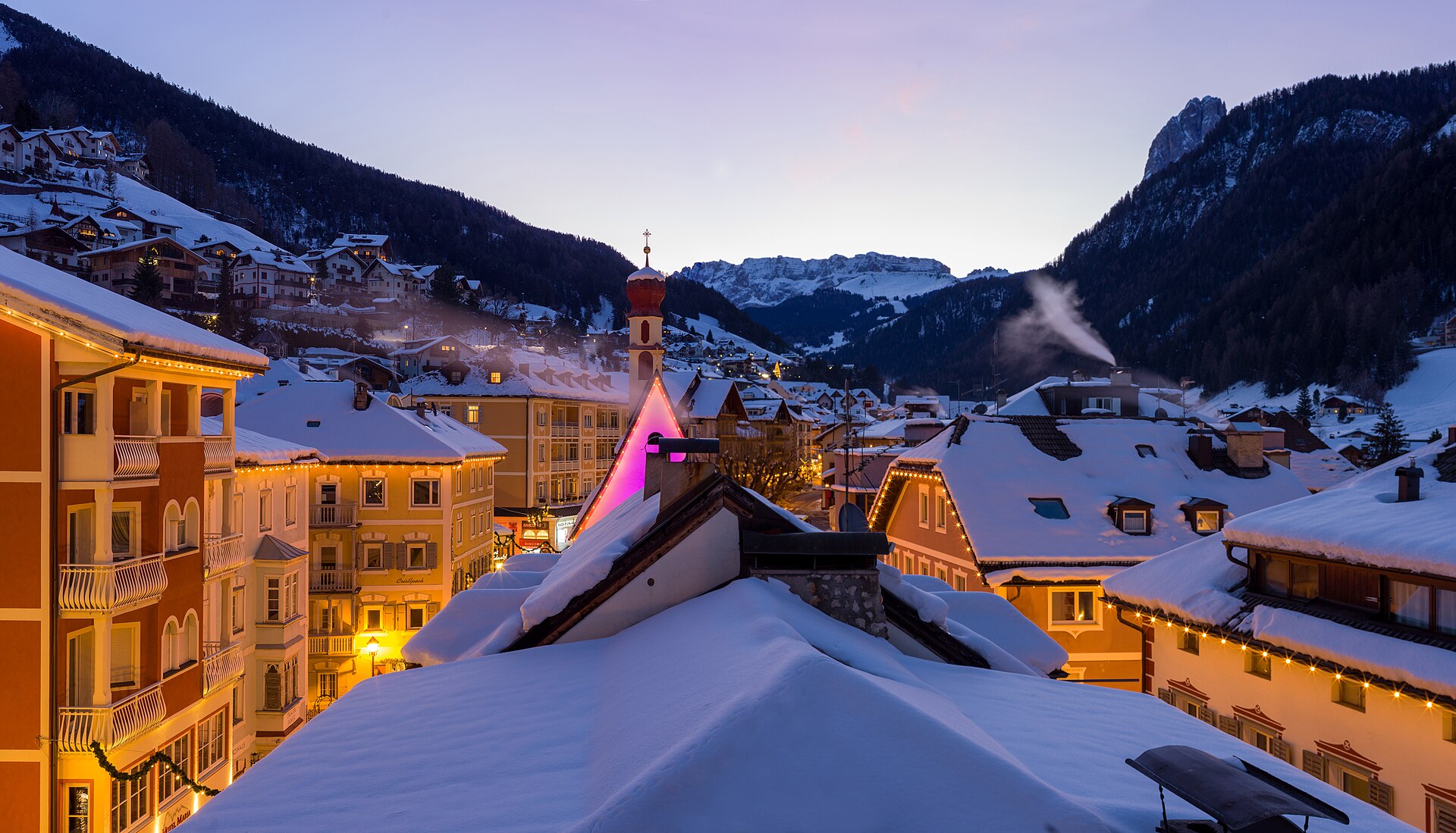
The hardest part of a Dolomites trip is not the hiking. It is figuring out which valley to sleep in, because the range is enormous and the roads are slow.
Short answer on where to stay in Dolomites: pick one or two valleys and stay put. Val Gardena (Ortisei or Selva) is the easiest all-round first base, and Cortina d’Ampezzo is the best base for the eastern icons. With three-plus nights, do one of each and split the range west and east.
This guide is for people choosing a base, not a hike. If you want trails or a route, the siblings below cover those.
Feel free to use my photos, but ple / CC BY-SA 3.0 via Wikimedia Commons
The fast version: a base-by-base table
I will explain all of this below, but if you only read one thing, read this. The “nights” column assumes you are using that town as a hub, not just sleeping there.
| Base (valley) | Best for | Car needed? | Vibe | Nights here |
|---|---|---|---|---|
| Ortisei / Selva (Val Gardena) | First-timers, hikers, car-free | No (great buses + lifts) | Alpine-pretty, lively, walkable | 3-4 |
| Corvara / La Villa (Alta Badia) | Foodies, families, ski-in/ski-out | Helpful, not required | Polished, relaxed, gourmet | 2-4 |
| Cortina d’Ampezzo | Eastern icons, scenery, see-and-be-seen | Yes (or Venice bus + tours) | Chic, resort-town, pricey | 2-3 |
| Santa Maddalena (Val di Funes) | Photographers, slow days, non-skiers | Yes | Quiet, postcard, farm-quiet | 1-2 |
| Castelrotto / Alpe di Siusi | Meadow walks, families, wellness | No (cable car + buses) | Gentle, sunny, tidy | 2-3 |
| Canazei (Val di Fassa) | Sella passes, budget, dramatic peaks | Helpful | Busy, sporty, central | 2-3 |
| Dobbiaco / San Candido (Val Pusteria) | Tre Cime, Braies, train access | No (on the rail line) | Low-key, practical, family | 2-3 |
| Bolzano | Arrival/exit night, no-car gateway | No | City, warm, wine-and-museums | 1 |
A note before you book: most mountain hotels run a minimum stay, often two to seven nights in high season, and many bundle a guest/mobility card plus half board into the rate. Both of those change the math, so I will come back to them.
How to actually choose: base by trip type
Forget “best town.” There is no single best town in the Dolomites. There is a best base for the trip you are taking. Here is the logic I use.
Base here if it is your first time
Stay in Val Gardena, in Ortisei or Selva. It is the most forgiving choice: three cable cars out of the valley, a flat-ish valley road, a direct bus from Bolzano, and trailheads you can reach without a heart-stopping pass drive. You get Seceda, Alpe di Siusi, and the Puez-Odle peaks on your doorstep, plus enough restaurants and shops that a rained-out afternoon is not a disaster.
If your trip is built around the famous eastern lakes and towers, swap or add Cortina d’Ampezzo. More on the classic Ortisei vs Cortina decision below, because it is the question most first-timers actually have.
Base here if you are a serious hiker
Two bases, split east and west, is the move. Val Gardena or Alpe di Siusi for the western Odle/Sella trails; Cortina or Val Pusteria (Dobbiaco/San Candido) for the eastern Tre Cime, Cadini, and Sorapis country. If you only get one, I lean Cortina for raw trail density, but I lean Val Gardena for the gentler learning curve. For the actual routes, see the best hikes in the Dolomites and the Tre Cime di Lavaredo guide.
Base here if you have kids
Alta Badia (Corvara) or Castelrotto / Alpe di Siusi. Both give you gentle meadow walks, lifts kids can ride, playgrounds, and hotels that are set up for families with pools and early dinners. The Alpe di Siusi plateau in particular is stroller-and-small-legs friendly in a way the steep eastern valleys are not. For broader planning, the Italy family vacation guide helps.
Base here if you are not renting a car
Val Gardena first, then Val Pusteria (it is on the train line). Both let you reach most of the headline sights by lift and bus, and the regional guest card usually makes that free. I wrote a whole sibling on this because it changes which valleys make sense: the Dolomites without a car. Skip Val di Funes and the high passes if you are car-free; they punish you.
Base here if you want luxury or wellness
Alta Badia and Cortina have the deepest benches of spa hotels and gourmet half-board kitchens; Alpe di Siusi has a cluster of design-led wellness hotels up on the plateau. This is South Tyrol’s quiet superpower: even mid-range mountain hotels often have a sauna, a pool, and a dinner that would embarrass a city restaurant. If you are planning a romantic trip, the Italy for couples guide pairs well with these.
Base here if you are on a budget
Sleep one valley out from the headline town. Canazei (Val di Fassa) and the smaller Val Pusteria villages run cheaper than Cortina or central Val Gardena, and a guesthouse or apartment a few kilometres outside any resort core drops the price without really costing you time, since you will be driving or busing around anyway. Build the rest of the math with the Italy cost breakdown and how much a trip to Italy costs guides.
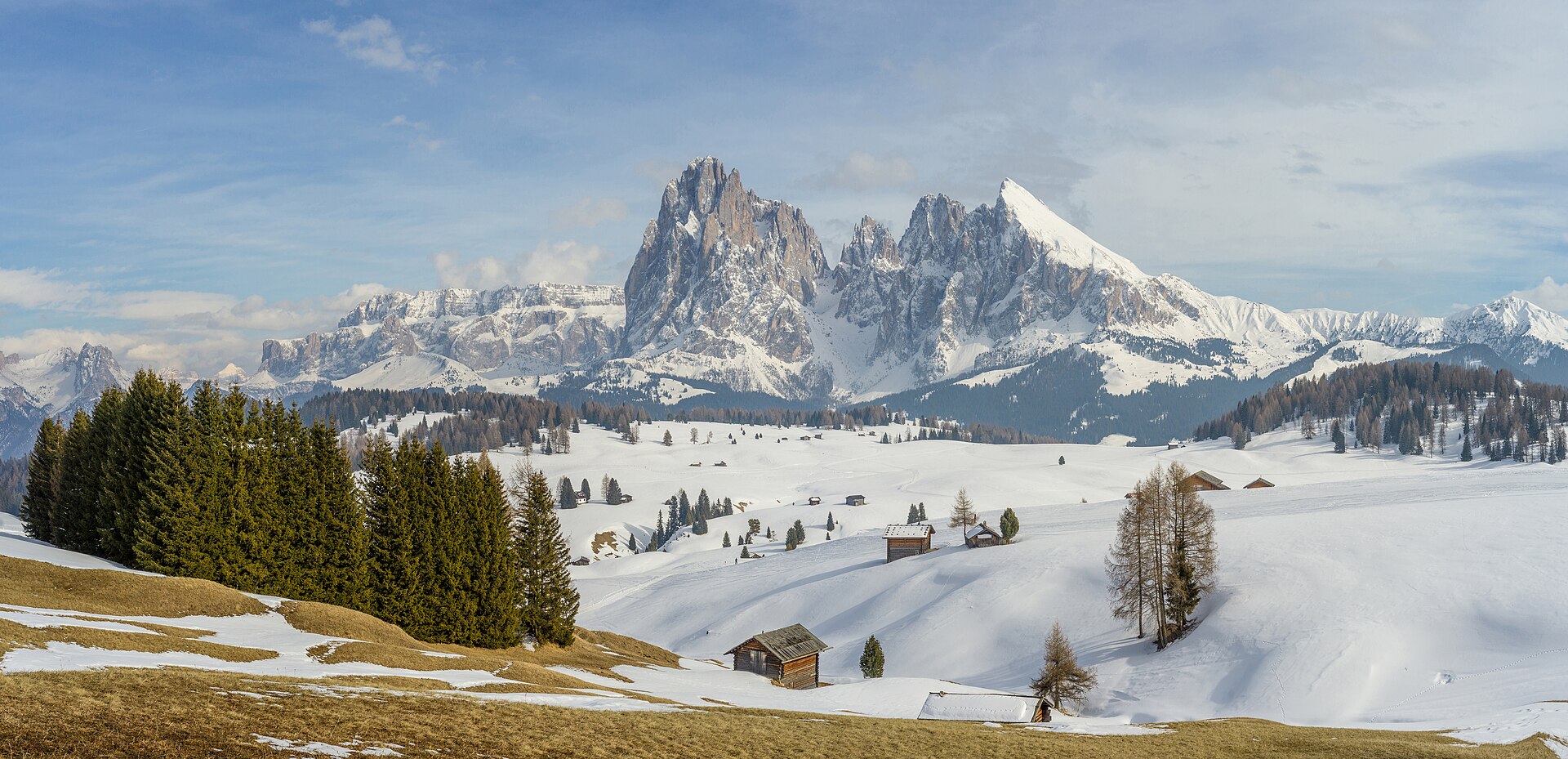
Feel free to use my photos, but ple / CC BY-SA 3.0 via Wikimedia Commons
The valleys, one by one
Here is the honest character of each base, in my order of usefulness for a first trip.
Val Gardena: Ortisei and Selva
This is the default answer to where to stay in Dolomites for a reason. Three towns share the valley: Ortisei (prettiest old centre, art-carving heritage, cable cars to Seceda, Resciesa, and Alpe di Siusi), Santa Cristina (quieter, central), and Selva (flattest, most walkable, best placed for the Sella passes and Puez-Odle). I usually point first-timers to Ortisei for atmosphere and Selva for convenience. You can hike straight from the valley, and the buses are genuinely good. The full breakdown lives in the Val Gardena travel guide. Plan 3-4 nights.
Alta Badia: Corvara, La Villa, San Cassiano
If Val Gardena is the all-rounder, Alta Badia is the comfortable one. Corvara sits at the centre of the lift network, so it is excellent for ski-in/ski-out in winter and lift-assisted hiking in summer. The food here is a notch above almost everywhere else in the range. It is a touch less “postcard village” than Funes and a touch more “resort,” but families and anyone who books half board seriously will be happy. Plan 2-4 nights.
Val di Funes: Santa Maddalena
The most photographed view in the Dolomites is the little church of Santa Maddalena with the Odle/Geisler peaks behind it. Staying here is slow, quiet, and farm-pretty, with the Adolf Munkel Trail on your doorstep. The catch: it is a dead-end valley with thin bus service, so it really wants a car, and it has fewer restaurants. I treat it as a 1-2 night add-on, not a main hub, unless you crave stillness.
Alpe di Siusi: Castelrotto and Seis
Europe’s largest high-alpine meadow, and one of the gentlest places in the range to walk. Base in Castelrotto (Kastelruth) or Seis (Seis am Schlern) below the plateau, ride the cable car up, and note that car access onto the meadow itself is restricted during the day, which is actually a feature. Sunny, tidy, family-friendly, strong wellness hotels. Plan 2-3 nights.
Cortina d’Ampezzo
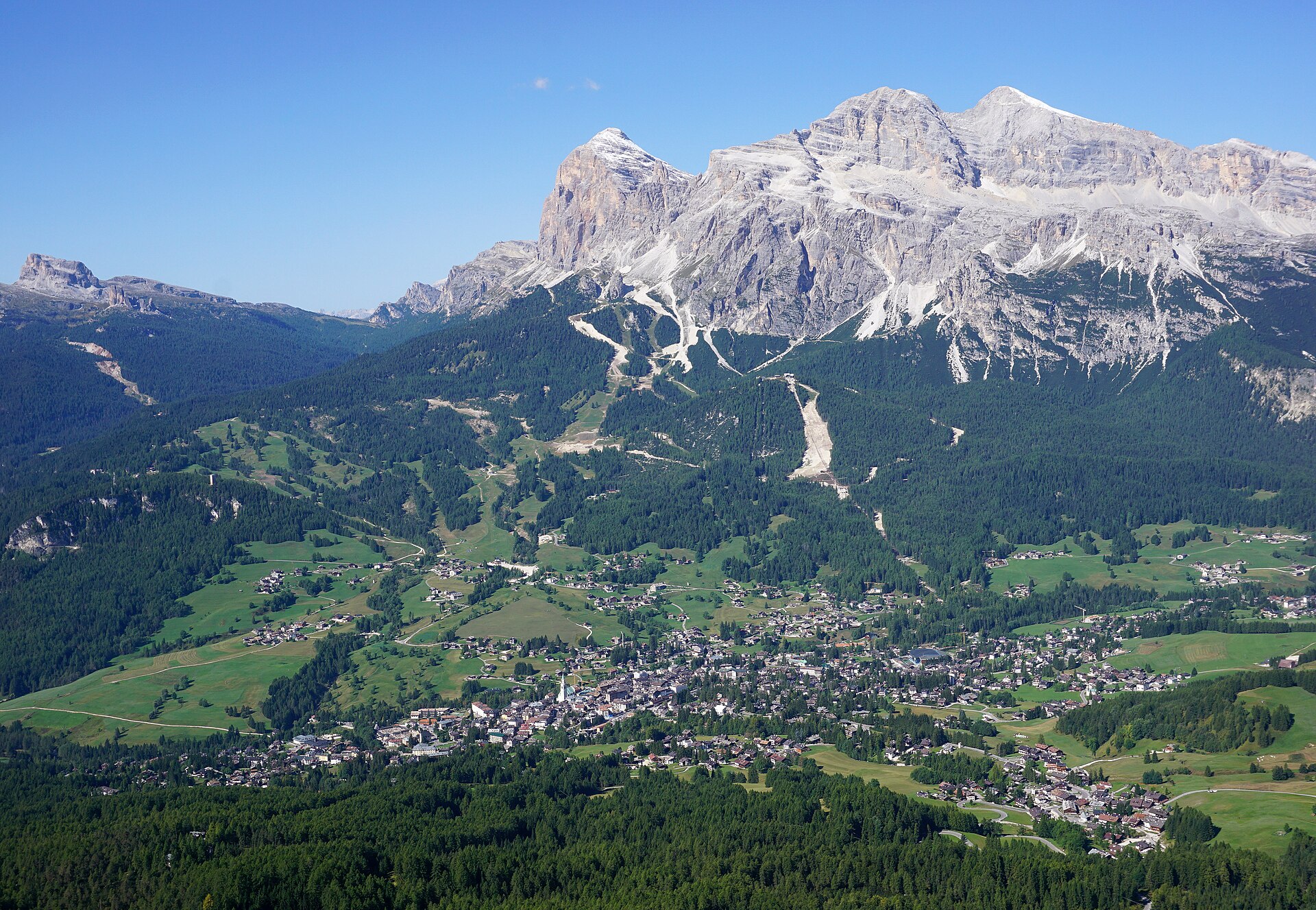
The famous one, and the only base in this guide that is fully on the Veneto side rather than South Tyrol. Cortina is chic, expensive, and unbeatably placed for the eastern A-list: Tre Cime, Cadini di Misurina, Lago di Sorapis, Cinque Torri, Croda da Lago. It is the easiest base to reach from Venice (direct buses run, roughly a two-hour transfer as of 2026). It is not the best value, and the lifts are spread out, so a car or hotel shuttle helps. The deep dive is the Cortina d’Ampezzo travel guide. Plan 2-3 nights.
Val di Fassa: Canazei
The Trentino side, and the best-value way to be central. Canazei sits right under the Sella massif at the foot of the Pordoi, Sella, and Fedaia passes, so the high-mountain drama is immediate. It is busier and sportier than pretty Funes, and it leans younger. Good buses in season. Plan 2-3 nights if you want passes and Marmolada without Cortina prices.
Val Pusteria: Dobbiaco and San Candido
The quiet, practical northeast. Dobbiaco (Toblach) and San Candido (Innichen) sit on the train line, which makes this the other strong car-free base, and they are well placed for Tre Cime, Lago di Braies, and the Sexten Dolomites. Lower-key and more residential than the resort valleys, often better value, and very family-comfortable. Plan 2-3 nights.
Bolzano: the gateway, not really a base
I would not “stay in the Dolomites” in Bolzano. It is a warm, walkable South Tyrolean city in the valley, not in the mountains. But it is the rail and bus hub, it has the Otzi museum and great wine, and it is a smart 1-night arrival or exit stop, especially if you are flying via a distant airport or going car-free into Val Gardena. For city logic across the country, see which Italian cities to base yourself in.
Ortisei vs Cortina: where to stay in Dolomites if you only pick one
Most first-timers are really deciding between these two. Here is the candid version.
Pick Ortisei (Val Gardena) if you are coming from the west (Bolzano, Innsbruck, or continuing to the lakes), you want a walkable village with lifts you can use without a car, you like green meadows and the Odle/Sella scenery, and you want a wider spread of budgets. It is the better base in the engineering sense: easier to reach, easier to get around, easier on the wallet.
Pick Cortina if you are coming from Venice, you are chasing the cinematic eastern lakes and towers, and you do not mind paying for a glossier town. It is the better launchpad for the eastern icons, full stop.
If you have three or more days, the honest answer is do both: Ortisei for the western half, Cortina for the eastern half. That single split solves most Dolomites trips. The Dolomites itinerary shows how to string the days together; this guide just gets your head on the right pillow.
Hotel vs rifugio vs apartment vs agriturismo
Where you stay is also a what. The four options behave very differently here.
Hotels are the backbone, and South Tyrol’s are unusually good: pools, saunas, and half-board dinners are common even mid-range. This is the safe, comfortable default and what I book most of the time.
Mountain rifugi (huts) are the magic trick most visitors skip. Sleeping in a hut high on the mountain, after the day-trippers leave, with alpenglow on the peaks and a plate of canederli in front of you, is a genuinely different experience from a valley hotel. Book the popular ones months ahead, expect simple shared or small rooms, and treat it as one or two special nights inside a hotel-based trip, not your whole stay.
Apartments and self-catering make sense for families and longer stays, especially if half board feels like too much restaurant food. Watch for longer minimum stays and tighter availability than hotels.
Agriturismo and the South Tyrolean “maso” (farm stays, often via the Roter Hahn / Gallo Rosso network) are the quiet sleeper pick of the region: a working alpine farm, a few rooms, your own eggs and speck at breakfast. They are usually a car-based, slow-travel choice rather than a hiking hub. If that appeals, read the cross-country agriturismo in Italy guide.
Half board, guest cards, and the stuff that changes the price
Three local quirks decide your real cost and convenience. Understand them before you book.
Half board (mezza pensione) means breakfast and a multi-course dinner are built into the room rate. In the Dolomites this is not the sad buffet you might fear; the dinners are often excellent and a big reason people rate these hotels so highly. My advice: take it. After a long day on the mountain you will not want to drive out for food, and the value is usually strong. Only skip it if you are in a town with lots of restaurants (Ortisei, Selva, Cortina) and like to wander for dinner.
Guest and mobility cards are huge for car-free travel. Many South Tyrol hotels include a card (Sudtirol Guest Pass / regional Mobilcard-style schemes) that gives free or near-free regional buses and trains. In Val Gardena and Val Pusteria this can make a car genuinely optional. Confirm what your hotel includes, because it changes your whole transport plan.
Minimum stays are real and they shape the itinerary. Two to seven nights is common in peak season, and Saturday-to-Saturday weeks appear in ski season. This is the single biggest argument for fewer, longer bases: you often cannot do one-night hops even if you want to. As of 2026, treat the regional tourism boards (suedtirol.info, valgardena.it, cortina.dolomiti.org) and the hotel itself as the source of truth on cards, passes, and stay rules.
How many nights, and how many bases
A simple framework:
- 2-3 nights total: one base only. Val Gardena if you want the all-rounder, Cortina if you are flying via Venice and want the eastern icons.
- 4-6 nights: two bases, split west and east (classic: Val Gardena + Cortina, or Val Gardena + Val Pusteria).
- 7+ nights: two or three bases, and now you can add a slow valley like Funes or a hut night without rushing.
Do not try to “stay in the middle” to see everything from one spot. The passes are slow and winding, and you will spend the trip nauseous in a car instead of on the mountain. Fewer bases, longer stays, less driving. For the bigger picture of fitting the Dolomites into a route, see the northern Italy itinerary and the broader Italy itineraries hub. And for the full regional context around these valleys, start at the Dolomites and Alps travel guide.
Summer base vs winter base: they are not the same
The right base shifts with the season, and most guides only talk summer.
Summer (roughly June to September) is about hiking and sightseeing, and the central, lift-rich valleys win: Val Gardena, Alta Badia, Cortina. Buses run frequently, the high passes are open, and the meadows are at their best. September and October are my favourite windows for fewer crowds and crisp light, covered in Italy in September and Italy in October.
Winter (roughly December to March) is about skiing, and ski-in/ski-out access becomes the priority. Val Gardena and Alta Badia, both on the vast Dolomiti Superski network, are the strongest ski bases; Cortina works but its lifts are more spread out. If snow is your reason to come, the Italian Alps in winter guide gets into the season properly. Season dates and lift-pass details shift year to year, so check dolomitisuperski.com around the time you book.
Getting there, parking, and the bus reality
A few logistics that affect where you sleep.
Airports: Venice is closest to Cortina (about two hours). Innsbruck and Bolzano are closest to Val Gardena and the South Tyrol valleys. Verona, Milan, Bergamo, and Munich are all 3-4+ hours out. Compare options in the Italy airports guide.
By train, then bus: the railway reaches Bolzano (for the western valleys via bus) and runs through Val Pusteria to Dobbiaco and San Candido. That is the spine of a car-free trip; see trains in Italy and the general Italy transportation overview.
Driving and parking: a car gives you freedom and early starts, but mountain parking is limited and the passes are slow, so book hotels with parking and start headline hikes early. The driving in Italy guide covers the rules and the realities.
Final thoughts
Where to stay in the Dolomites comes down to two honest questions: which half of the range do you care about, and are you driving? Answer those and the base picks itself. For most first trips, that means Val Gardena for the west and, if you have the nights, Cortina for the east, booked for several nights each with half board, and not a frantic one-night hop in sight. Get the base right and the mountains do the rest.
Questions travellers ask
What is the best place to stay in the Dolomites?
For a first trip, Val Gardena (Ortisei or Selva) is the best all-round base: easy to reach, walkable, well served by lifts and buses, and central to the western highlights. If you are flying via Venice and want the eastern icons, Cortina d’Ampezzo is the better single base. With more time, stay in both.
Is it better to stay in Cortina or Val Gardena?
Both are excellent; they just point different directions. Cortina is better placed for the eastern lakes and towers (Tre Cime, Sorapis) and easiest from Venice, but pricier. Val Gardena is easier to reach from the west, more walkable, better for car-free travel, and kinder on the budget. With three-plus days, do one of each.
How many days do you need in the Dolomites?
Plan at least 3-4 nights for a first visit, and 6-10 if you want to hike and see the headline sights without rushing. Because many hotels require a minimum stay of several nights, longer stays in fewer bases are usually easier to book and far less tiring than nightly hops.
Do you need a car in the Dolomites?
No, but it helps. Val Gardena and Val Pusteria are very doable car-free thanks to lifts, buses, trains, and included guest cards. A car gives you freedom, early starts, and access to dead-end valleys like Funes. If you would rather not drive, base in Val Gardena or on the Pusteria train line.
Where should I stay in the Dolomites without a car?
Base in Val Gardena (direct bus from Bolzano, three cable cars, strong local buses) or in Val Pusteria at Dobbiaco or San Candido, which sit on the train line. Many South Tyrol hotels include a regional transport card, so confirm that when you book and you can skip the rental entirely.
What is the best base in the Dolomites for hiking?
Split the range: Val Gardena or Alpe di Siusi for the western Odle and Sella trails, Cortina or Val Pusteria for the eastern Tre Cime, Cadini, and Sorapis. If you must pick one, Cortina has the densest cluster of famous eastern hikes, while Val Gardena offers the gentlest mix for a first-timer.
Is half board worth it in the Dolomites?
Usually yes. Half board (breakfast plus a multi-course dinner) is a local strength, the dinners are often genuinely good, and after a day on the mountain you rarely want to drive out for food. Skip it only if you are in a restaurant-rich town like Ortisei, Selva, or Cortina and prefer to wander for dinner.
When is the best time to visit the Dolomites?
Summer (June to September) for hiking, with September and early October offering crisp light and thinner crowds; winter (December to March) for skiing. Shoulder weeks can be quiet but some lifts and trails close, so check what is actually open before booking. See the best time to visit Italy for the wider picture.